
Introduction: The City as Target, the City as Witness
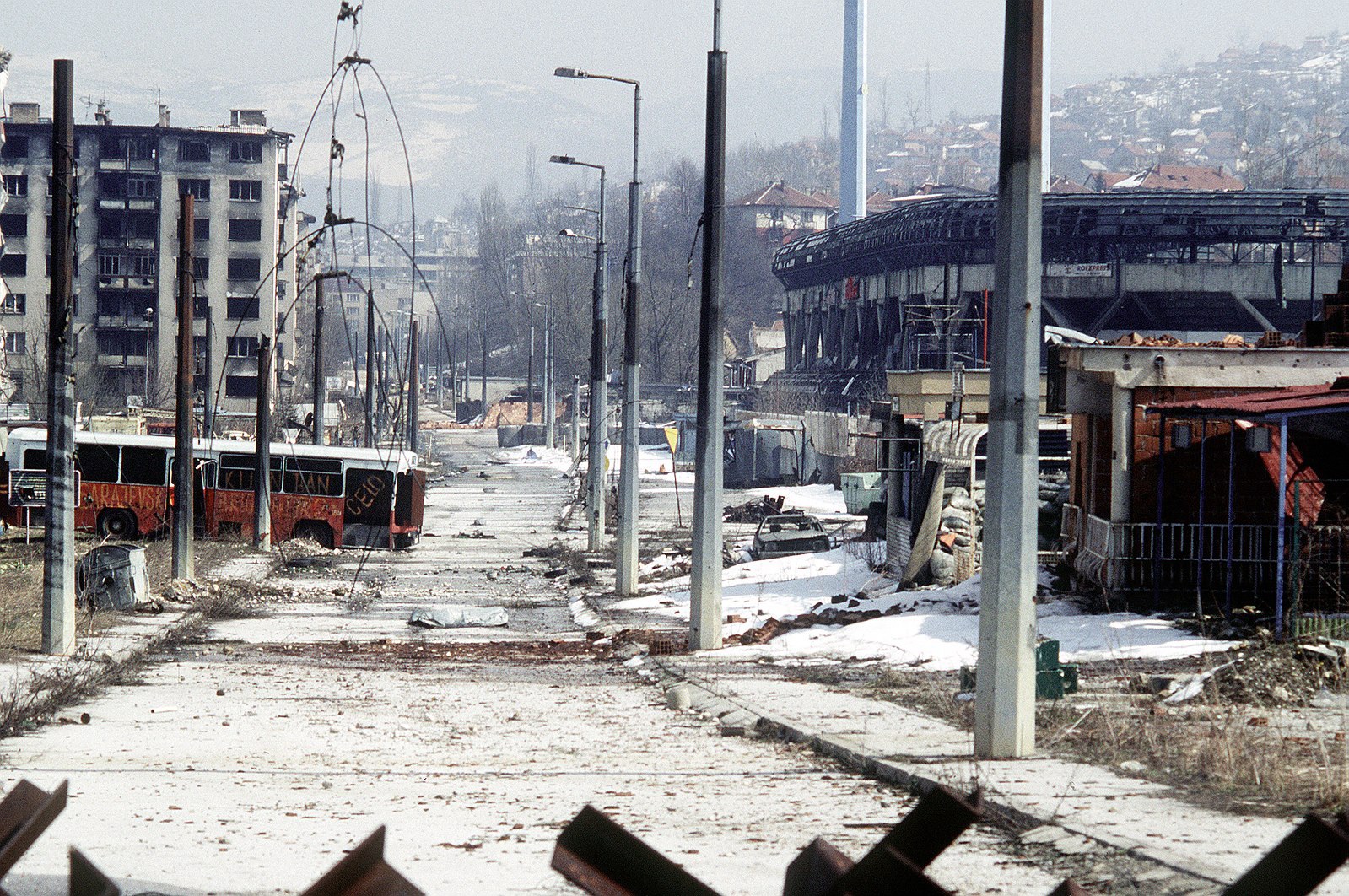
From 5 April 1992 to 29 February 1996—1,425 days—the city of Sarajevo endured the longest siege of a capital city in the modern history of warfare. It was a siege conducted not with the medieval aim of starving a fortress into submission, but with the late-twentieth century tools of televised terror: the systematic bombardment of homes, hospitals, markets, and libraries from the surrounding hills; the constant, indiscriminate crack of sniper fire targeting children, water collectors, and the elderly; the calculated destruction of everything that constituted civic life. The siege transformed Sarajevo from a vibrant, multi-ethnic metropolis—the symbolic heart of Yugoslav “Brotherhood and Unity”—into a necropolis of rubble, hunger, and defiance.
To view the siege of Sarajevo merely as a military event, a tragic subplot of the Bosnian War, is to miss its profound historical significance. Rather, the city functioned as the essential microcosm of the entire Yugoslav conflict. Within its besieged valley, every driving force of the wars was condensed, amplified, and laid bare: the nationalist project of partitioning territory through ethnic terror; the desperate resilience of a civic, pluralist ideal; the catastrophic failure of international protection; and the grotesque transformation of everyday life under the gun-sight. This essay argues that the siege was a deliberate and symbolic campaign of urbicide—the murder of the city—aimed at destroying the very possibility of a multi-ethnic Bosnia. Yet, simultaneously, Sarajevo became a theatre of astonishing cultural and social resistance, where the maintenance of ordinary life became an extraordinary political act. Through an examination of the siege’s mechanisms, its human landscape, and its cultural front, we can move beyond strategic maps to understand the war as it was lived: as a total assault on the urban fabric of coexistence.
The Stage: “The Jerusalem of Europe” and its Strategic Trap
To comprehend the siege’s symbolism, one must first understand pre-war Sarajevo. As the capital of Bosnia-Herzegovina, it was the most potent embodiment of the Yugoslav ideal. Here, Ottoman-era mosques, Orthodox and Catholic churches, and Ashkenazi synagogues stood within blocks of each other. Here, intermarriage rates exceeded 30%, and census categories often felt less important than one’s identity as a Sarajlija—a citizen of Sarajevo. The city was a living refutation of the nationalist myth that Serbs, Croats, and Bosniaks were inherently antagonistic tribes. This made it the primary ideological target for the Bosnian Serb political and military leadership, whose goal, as articulated by Radovan Karadžić, was the creation of an ethnically pure Serb state, Republika Srpska.
The Military Geography of Entrapment:
Sarajevo’s topography sealed its fate. Nestled in a narrow valley along the Miljacka River and surrounded by steep, forested hills, the city was a textbook case of vulnerability to high-ground domination. In the spring of 1992, as Bosnia declared independence, these hills were swiftly occupied by the Yugoslav People’s Army (JNA) and its Bosnian Serb successor, the Army of Republika Srpska (VRS), under the command of General Ratko Mladić. By May, the ring was closed. The siege forces, comprising approximately 18,000 troops with artillery, mortars, tanks, and an estimated 300 snipers, commanded a terrifying panorama of the city’s entirety. The Bosnian government defenders, the Army of the Republic of Bosnia and Herzegovina (ARBiH), were initially a ragged mix of police and volunteers, desperately outgunned and confined to the urban centre. The strategic objective was not to capture the city through infantry assault—which would have been costly—but to strangle, terrorize, and fragment it into surrender or partition.
The Mechanisms of Urbicide: The Logic of Total Assault
The VRS campaign followed a chillingly coherent logic that transcended military necessity, aiming to dismantle the city’s physical and social infrastructure.
- Indiscriminate Shelling and Sniper Terror:
The hallmark of the siege was randomness. The “Sarajevo Rose”—the concrete scars left by mortar impacts, later filled with red resin—became the city’s morbid pavement art. Shells fell on bread queues, funerals, trams, and playgrounds. The July 1994 attack on a water queue in the Dobrinja neighbourhood killed 8. The August 1995 market massacre in Markale, which killed 43, became an iconic moment of international shock. Snipers, positioned in high-rises like the “Holiday Inn” or hillside apartments, turned streets into “sniper alleys,” targeting pedestrians with cruel selectivity. This was not collateral damage; it was psycho-social engineering, designed to instill paralyzing fear, sever social bonds, and demonstrate that no place, no moment, was safe. The goal was to break the will to resist by making urban life untenable. - The Destruction of Cultural Memory (Memoricide):
The assault targeted the very symbols of Sarajevo’s pluralist identity. On the night of 25 August 1992, VRS artillery systematically shelled the National and University Library of Bosnia and Herzegovina (Vijecnica). Over a million volumes, including irreplaceable Ottoman and Habsburg manuscripts, were consumed by flames. The fire, visible across the city, was an attack on the collective memory of a civilization. Similarly, the Oriental Institute, the National Museum, and the Gazi Husrev-bey Library were targeted. As scholar András Riedlmayer documented, this was a deliberate campaign of “memoricide”—erasing the physical proof of centuries of shared history to justify the nationalist narrative of ancient, irreconcilable difference. - The Siege Within: The Struggle for Survival
The physical encirclement created a dystopian internal economy. Utilities were destroyed; water was collected from leaky mains or polluted wells under sniper fire; electricity was sporadic; food and fuel were smuggled through the perilous, UN-controlled airport tunnel or by daring drivers on “Snipers’ Alley.” A black market flourished, creating grotesque inequalities. The average citizen survived on humanitarian aid—often inadequate and manipulated for political control—while a siege profiteer class emerged. Malnutrition became rampant, with the average resident losing 20-30% of their body weight. The city’s social fabric was strained by this brutal calculus of survival, yet it did not fully rupture.
Resistance: The Moral Architecture of Everyday Life
Paradoxically, the campaign of terror galvanized a form of resistance rooted not in military counter-offensives, but in the stubborn preservation of civic normalcy. This was the Sarajevo paradox: the more the city was targeted for annihilation, the more its symbolic value as a bastion of pluralism grew.
- Cultural Resistance as Defiance:
In the midst of the bombardment, Sarajevans staged a potent, symbolic defence of their identity.
· Theatre and Music: The Sarajevo National Theatre and the youth theatre, SARTR, performed in basements and bunkers. The Sarajevo String Quartet, led by cellist Vedran Smailović—who famously played Albinoni’s Adagio in the rubble of the National Library—became a global icon of defiance.
· Film and Media: The Sarajevo Film Festival was founded in 1995, screening films in a bombed-out cultural centre. Newspapers like Oslobođenje (“Liberation”) continued to publish daily, its staff working in a shell-pocked building, declaring it was “published daily, despite everything.”
· The “Miss Sarajevo” Pageant: In 1993, a beauty pageant was held in a basement, a defiant assertion of life, beauty, and normalcy in the face of death. The event asked the world, “Don’t let them kill us.”
- The Social Fabric: Networks of Solidarity and the “Dustbin Community”
Formal institutions were supplemented by grassroots, improvised networks. Neighbours shared resources, risked their lives to fetch water for the elderly, and created communal kitchens. The mixed neighbourhoods of Koševo and Centar became strongholds of a persistent, multi-ethnic civic spirit. Journalist Tom Gjelten, in his book Sarajevo Daily, chronicled how the staff of Oslobođenje—Serbs, Croats, and Bosniaks—continued to work together, a living rebuke to the ethno-nationalist project. This organic solidarity gave rise to the concept of the “Dustbin Community”—a society stripped to its essentials, where pre-war social hierarchies dissolved, and shared suffering forged new bonds. - The International Gaze and the “Sarajevo Olympics”:
Sarajevo’s resistance was performed for a global audience. The city, which had hosted the 1984 Winter Olympics, now became the stage for a macabre inversion: journalists and aid workers became key actors, and events were timed for the evening news. This created a complex, sometimes problematic, dynamic. While it generated crucial global awareness and pressure, it also risked reducing Sarajevo’s suffering to a media spectacle and fostered a dependency on external saviours.
The Historiographical Front: Debating Sarajevo’s “True” Nature
The siege has spawned a rich and contentious historiography centred on a central question: Was Sarajevo a genuine bastion of Yugoslav civic identity, or was its multi-ethnic character always a superficial veneer over latent tensions?
The “Last Stand of Civic Yugoslavia” Thesis:
Proponents, often drawing on survivor testimonies and the work of journalists like David Rieff (Slaughterhouse) and Barbara Demick (Logavina Street), portray Sarajevo as the heroic, if tragic, defender of a secular, pluralist ideal. They point to the high rates of intermarriage, the sustained multi-ethnic cooperation during the siege, and the conscious cultural resistance as evidence of a deep-seated civic identity that withstood extreme pressure. In this view, the city’s destruction was necessary for the ethno-nationalist project to succeed because its very existence disproved the myth of inevitable ethnic conflict.
The “Fragile Illusion” or “Wartime Construct” Thesis:
Sceptical scholars, including some influenced by post-conflict analyses of nationalist politics, offer a more nuanced, sometimes darker, reading. They argue that while a civic ideal existed, it was concentrated among the urban, intellectual, and mixed-family elite. They note that by the war’s end, Sarajevo’s demographic had radically shifted, with most Serbs having fled or been expelled from government-held areas, becoming a overwhelmingly Bosniak city. Scholars like Xavier Bougarel and Gearóid Ó Tuathail suggest that the siege, while attacking the old Sarajevo, also contributed to the “national homogenization” of its population and the consolidation of a Bosniak-led state power. The “Sarajevo spirit,” in this interpretation, was both a genuine resistance and a narrative strategically embraced by the Bosnian government to secure international sympathy as a victimized, pluralist state.
A synthetic view acknowledges that both truths coexisted. The siege was an external, genocidal assault on the city’s pluralist essence. Yet, the trauma of the siege also inevitably altered the city’s social composition and political character. The pre-war Sarajevo could not survive untouched; the miracle is that its spirit survived at all.
The International Community: Complicit Bystanders
The role of the United Nations Protection Force (UNPROFOR) in Sarajevo remains a subject of profound controversy. Tasked with delivering humanitarian aid and protecting civilians, UN soldiers were often powerless spectators to the slaughter. The Sarajevo airport, under UN control, became a lifeline for aid and a stage for farce, as flights were routinely blocked by political wrangling. The UN’s neutrality, in practice, often benefited the besiegers, as its rules of engagement prevented meaningful retaliation against artillery positions. The “pinprick” NATO airstrikes in 1994 and 1995, such as the limited response to the first Markale massacre, were too little, too late, demonstrating a paralysis of will. It was only after the second Markale massacre in August 1995, which provoked sustained NATO bombing (Operation Deliberate Force), that the siege’s military equation changed. The international community, by failing to lift the siege for over three years, became an unwitting accomplice to the terror, its humanitarian convoys merely managing the starvation it was unwilling to stop by force.
Conclusion: The Siege’s Unending Legacy
The siege of Sarajevo ended with the Dayton Peace Agreement in 1995, but its legacy is etched into the city’s stones and psyche. Physically, Sarajevo remains a divided city, its eastern suburbs formally part of the Serb-majority Republika Srpska entity. Socially, while it has regained its vibrant, cosmopolitan air, the wounds of loss and the altered demographics are indelible.
As a microcosm, the siege teaches us that modern warfare is not merely a contest for territory, but a battle over meaning, memory, and identity. The VRS’s urbicide was an attempt to kill a idea—the idea that diverse peoples could share a common city and a common future. Sarajevo’s resistance proved that idea was harder to kill than its bricks and mortar. The city’s enduring symbol is not just the Sarajevo Rose or the ruined Vijecnica, but the tunnel that allowed it to breathe, the newspaper published despite everything, and the music played in the rubble. It stands as the ultimate rebuttal to the myth of ancient hatreds, a testament to the fact that coexistence was not a fantasy, but a lived reality—one that had to be systematically and brutally destroyed by an artillery barrage that lasted 1,425 days. In understanding the siege, we move beyond statistics of shellings and casualties to grasp the true cost of the Yugoslav wars: the violent unmaking of a world, and the fragile, tenacious courage of those who refused to let it be unmade.

Leave a Reply