
Introduction: The 67 Words That Redrew the Map
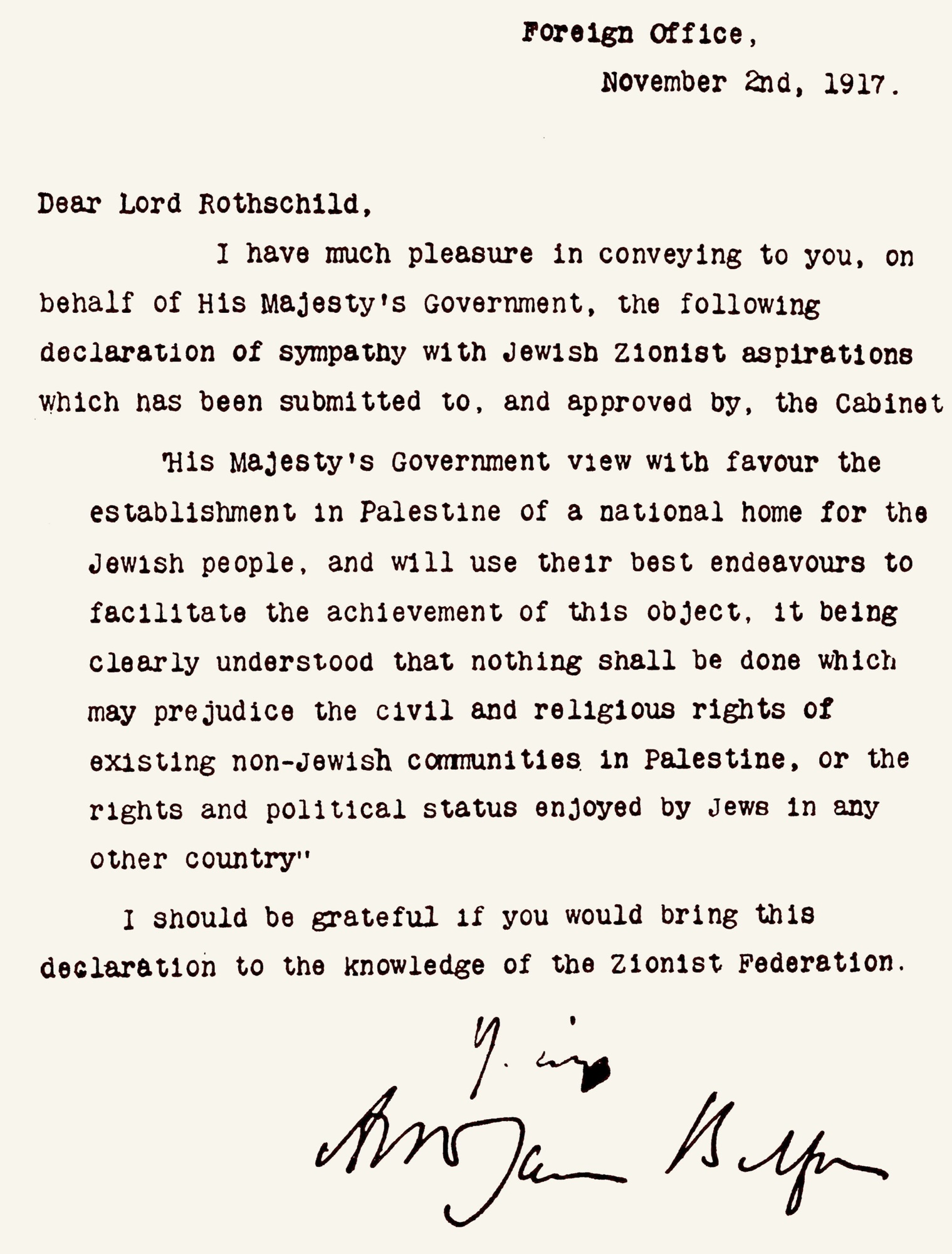
On November 2, 1917, the British Foreign Secretary, Arthur Balfour, dispatched a private letter to Lord Rothschild, a figurehead of the British Jewish community, for transmission to the Zionist Federation. The text contained within the letter was brief—comprising a mere 67 words of operative policy—but its implications were instrumental in dismantling the geopolitical framework established by the Sykes-Picot Agreement just a year and a half prior.
The declaration stated that the British government viewed with favor “the establishment in Palestine of a national home for the Jewish people.” In popular historiography, this document is often analyzed through the lens of religious sentiment, humanitarianism, or the efficacy of Zionist lobbying. However, within the context of World War I statecraft, the Balfour Declaration was primarily a strategic instrument of the British Empire.
By late 1917, the British War Cabinet, led by Prime Minister David Lloyd George, had concluded that the Sykes-Picot arrangement regarding Palestine—which designated the territory as an international zone (the “Brown Area”)—was no longer compatible with British imperial interests. Britain required a pretext to claim sole trusteeship over Palestine to secure the eastern flank of the Suez Canal against future threats. The Zionist project provided the necessary political cover to exclude France from the Holy Land.
This article examines the Balfour Declaration not as an isolated act of benevolence, but as the “Third Promise” in Britain’s contradictory wartime diplomacy. It analyzes the specific diplomatic maneuvering of Chaim Weizmann, the propaganda calculations regarding Russia and the United States, and the immediate friction the declaration caused with the military administration in Jerusalem. It argues that the declaration was the lever used by Britain to revise the 1916 partition of the Ottoman Empire, effectively trading an international administration for a British imperial outpost.
The Geopolitical Pivot of 1917
To understand the issuance of the Declaration, one must situate it within the crisis of 1917. The war had reached a grinding stalemate. On the Eastern Front, the Russian Empire was collapsing; the February Revolution had toppled the Tsar, and the provisional government was teetering under the strain of the Bolshevik agitation. On the Western Front, the French army had suffered mutinies following the disastrous Nivelle Offensive. While the United States had entered the war in April, its military power had not yet materialized in Europe.
In the Middle East, however, the situation was fluid. General Edmund Allenby had taken command of the Egyptian Expeditionary Force (EEF) and was preparing to break the Ottoman lines at Gaza and advance into Palestine.
For the British War Cabinet, military victory in Palestine presented a diplomatic problem. Under the terms of the 1916 Sykes-Picot Agreement, Britain was not entitled to annex Palestine. The agreement stipulated that the territory roughly corresponding to modern-day Israel and the West Bank (excluding the Negev) was to be placed under “an international administration.” This compromise had been necessary to satisfy Russia’s religious interests (as protector of the Orthodox Christians) and France’s colonial ambition (as protector of the Catholics).
By 1917, Lloyd George viewed this “Brown Area” as a strategic liability. The Prime Minister, who had not been involved in the original Sykes-Picot negotiations, argued that allowing an international—and likely French-dominated—administration next to the Suez Canal was unacceptable. The security of the British Empire relied on the Suez-India route. Therefore, Britain needed a mechanism to annul the internationalization clause of Sykes-Picot and substitute it with a British protectorate.
The Manchester Connection: Weizmann’s Diplomacy
The shift in British policy was not spontaneous; it was cultivated by the intense diplomatic efforts of Dr. Chaim Weizmann. A Russian-born chemist and the de facto leader of the Zionist movement in Britain, Weizmann possessed a unique combination of scientific utility and political acumen.
Weizmann’s initial access to the British establishment came through his scientific work at the University of Manchester, where he developed a fermentation process to mass-produce acetone, a key solvent used in the manufacture of cordite (smokeless gunpowder). This contribution brought him into contact with Lloyd George (then Minister of Munitions) and Winston Churchill (First Lord of the Admiralty).
However, Weizmann’s true diplomatic breakthrough was not chemical but political. He cultivated a close relationship with C.P. Scott, the influential editor of the Manchester Guardian. Scott acted as a conduit, introducing Weizmann to the Liberal elite. Through these channels, Weizmann began to reframe Zionism not merely as a romantic nationalist aspiration, but as a British strategic asset.
Weizmann argued that a Jewish Palestine would owe its existence solely to Great Britain. Unlike the Arabs, who had a vast demographic spread and potentially conflicting loyalties, the Zionists would be a concentrated, modern enclave dependent on British protection. Weizmann successfully sold the idea that a Zionist entity would function as a “Little Ulster” in the Middle East—a loyal, pro-British buffer state guarding the northern approaches to the Suez Canal. This argument resonated deeply with politicians like Arthur Balfour and Mark Sykes, who were looking for a way to secure Palestine without appearing to annex it outright.
Zionism as an Imperial Asset
For the British Foreign Office, backing Zionism solved the “French problem.” If Britain entered Jerusalem as the liberator and the trustee for the Jewish people, it could argue at the peace conference that it had a moral obligation to remain in Palestine to oversee the establishment of the National Home. This would provide the legal and moral justification to sideline the French and scrap the international administration proposed in 1916.
This strategic realignment was formalized in the secret discussions of the War Cabinet. The minutes reflect a growing consensus that the Sykes-Picot “internationalization” was obsolete. As Lord Curzon noted, the British were effectively using Zionism as a shield against French ambition. The logic was clear: the French could not object to a British mandate if it was framed as a humanitarian mission to restore an ancient people to their land, supported by the United States.
The Propaganda Calculation: Russia and the American Link
Beyond the territorial maneuvering in the Levant, the War Cabinet was driven by a belief in the political power of “World Jewry.” This view, rooted in exaggerated and often antisemitic tropes regarding Jewish influence over global finance and politics, permeated the British establishment.
In 1917, the immediate concern was Russia. The British feared that Russia would sign a separate peace with Germany, releasing dozens of German divisions to the Western Front. The Foreign Office believed that the Russian revolutionary movement was heavily influenced by Jews (conflating Jewish identity with Bolshevism). The logic followed that a British declaration in favor of Zionism would rally Russian Jews to the Allied cause, and they, in turn, would pressure the provisional government to keep Russia in the war.
Simultaneously, Britain sought to solidify support in the United States. While Woodrow Wilson had declared war, American mobilization was slow. British policymakers believed that American Jews exercised significant influence over the White House and public opinion.
This transatlantic diplomacy involved complex back-channeling. The draft of the declaration was actually sent to the United States for review before its issuance. Louis Brandeis, a Supreme Court Justice and a leader of the American Zionist movement, played a crucial role in editing the text and securing President Wilson’s private approval. Wilson’s quiet endorsement was the green light London needed. It assured the British Cabinet that if they claimed Palestine as a mandate for Zionism, the Americans would not oppose it at the peace table. Thus, the declaration was drafted partly as a piece of wartime propaganda, designed to mobilize a specific transnational demographic in service of the Entente’s survival.
Internal Dissent: The Montagu Memorandum
The consensus within the Cabinet was not absolute. The most vociferous opponent of the Declaration was, ironically, the only Jewish member of the government: Edwin Montagu, the Secretary of State for India.
In August 1917, Montagu submitted a secret memorandum titled “The Anti-Semitism of the Present Government.” He argued that Zionism was a “mischievous political creed” that endangered the status of Jews in Western nations. Montagu’s concern was that by defining Jews as a separate “nation” with a home in Palestine, the British government was implicitly suggesting that Jews were not fully British, potentially providing a justification for their disenfranchisement or expulsion in the future.
Furthermore, Montagu viewed the policy through the lens of Indian security. As the minister responsible for the British Raj, he warned that promising Palestine to the Jews would inflame Muslim opinion across India. He argued that Britain had already made commitments to the Arabs (via the McMahon-Hussein Correspondence) and that prioritizing a Jewish minority over the Muslim and Christian Arab majority in Palestine would be viewed as a betrayal of Islam.
Montagu’s dissent forced the Cabinet to dilute the language of the declaration. The initial drafts had used the phrase “Palestine as the national home,” implying the entire country would become a Jewish state. The final version changed this to “a national home in Palestine,” and added a safeguard clause regarding the rights of non-Jewish communities.
The Textual Ambiguity
The final text of the Balfour Declaration was a masterpiece of diplomatic ambiguity, meticulously crafted to allow for multiple interpretations.
“His Majesty’s Government view with favour the establishment in Palestine of a national home for the Jewish people, and will use their best endeavours to facilitate the achievement of this object, it being clearly understood that nothing shall be done which may prejudice the civil and religious rights of existing non-Jewish communities in Palestine, or the rights and political status enjoyed by Jews in any other country.”
Three key aspects of the text reveal the Cabinet’s intent and constraints:
- “National Home” vs. “State”: The term “National Home” (Heimstätte) had no precedent in international law. It was chosen specifically to avoid the word “State.” This allowed Britain to support Zionist immigration and settlement without immediately committing to Jewish sovereignty, which would have triggered immediate conflict with the Arab population and the French.
- “In Palestine”: By rejecting the phrase “Palestine as the national home,” the British left the geographical extent of the home undefined. This ambiguity would later allow Britain to partition the Mandate, separating Transjordan from the area west of the River Jordan.
- The Rights of “Non-Jewish Communities”: The declaration defined the Arab population (which constituted roughly 90% of the demographic at the time) merely as “non-Jewish communities.” Crucially, the text promised to protect their “civil and religious rights” but omitted any mention of “political rights” or “national status.” This linguistic exclusion effectively disenfranchised the Arab majority in the eyes of British policy, framing them as a religious minority in a land destined for another people.
The Silence in Jerusalem: Allenby and the OETA
While the Declaration was celebrated in London and among Zionist communities worldwide, its reception in the theater of war was markedly different. General Edmund Allenby, whose forces entered Jerusalem in December 1917, viewed the political commitment as a tactical nightmare.
Allenby established the “Occupied Enemy Territory Administration” (OETA) to govern the conquered lands. The military governors on the ground, such as Ronald Storrs in Jerusalem, were acutely aware of the local demographics. They understood that the Arab population viewed the Ottomans as occupiers, but they viewed the prospect of Zionist dominance with even greater alarm.
Allenby took the extraordinary step of suppressing the publication of the Balfour Declaration in Palestine. For nearly two years after its issuance, the declaration was not officially read out or posted in the territory it concerned. The military administration feared that publicizing the text would trigger an immediate uprising among the Arab population and mass desertions among the Muslim troops serving in the British Imperial forces (particularly the Indian Army).
This created a schism between the Foreign Office in London, which was committed to Zionism, and the military administration in Palestine, which tried to maintain the status quo. The OETA officers frequently complained that London was unaware of the “facts on the ground,” warning that imposing a National Home against the will of the majority would require a permanent garrison of British troops—a prophecy that proved accurate.
The American Audit: The King-Crane Commission
The contradiction between Britain’s promises was eventually exposed by an external audit: the American King-Crane Commission of 1919.
When the peace conference convened in Paris, President Woodrow Wilson proposed a commission of inquiry to ascertain the true desires of the local populations in the former Ottoman Empire, in line with his principle of “self-determination.” The British and French refused to participate, knowing the results would be unfavorable to their imperial designs. Consequently, the commission proceeded as a solely American enterprise, led by Henry King and Charles Crane.
After traveling extensively through Palestine and Syria and interviewing hundreds of delegations, the King-Crane report delivered a scathing indictment of the Balfour policy. The commissioners reported that the Zionist program was vehemently opposed by the vast majority of the population. They concluded that the “National Home” could not be established without the grave violation of the rights of the existing inhabitants and that it could only be enforced through the “force of arms.”
The report recommended that the Zionist project be significantly curtailed and that a single mandate for a united Syria (including Palestine) be established, preferably under American supervision. However, the report was ignored by the European powers and suppressed by the US State Department until 1922. By then, the partition was a fait accompli.
The Convergence of the Three Promises
The issuance of the Balfour Declaration created a “trilemma” in British wartime diplomacy. By November 1917, Britain had issued three distinct and contradictory visions for the post-war Middle East:
- McMahon-Hussein (1915): Implied Arab independence in the Levant (with ambiguous exclusions) to secure the Arab Revolt.
- Sykes-Picot (1916): Partitioned the Levant between Britain and France, with Palestine as an international zone.
- Balfour (1917): Promised a Jewish National Home in Palestine under British protection.
Technically, these promises were mutually exclusive. An international Palestine (Sykes-Picot) could not be a British-protected Jewish home (Balfour). An Arab independent state (McMahon) could not include a Zionist Palestine.
However, for Lloyd George, the Balfour Declaration was the trump card. When the war ended and the peace conference convened at Versailles, Britain used the Declaration to dismantle the Sykes-Picot arrangement. At the San Remo Conference in 1920, Britain argued that the pledge to the Zionists required a specific British administration to implement it.
The French, exhausted by the war and focused on the Rhine frontier, conceded. The “Brown Area” was abolished. Palestine became a British Mandate, incorporating the commitment to the Balfour Declaration into its legal charter.
Conclusion: The Legacy of Instrumentalization
The Balfour Declaration succeeded in its immediate strategic objective: it provided the political leverage for Britain to acquire Palestine as a buffer state, excluding the French and securing the Suez Canal. However, the long-term cost of this diplomatic maneuver was incalculable.
By utilizing a national movement (Zionism) as an instrument of imperial policy, Britain inextricably linked its rule in Palestine to the escalating conflict between two distinct nationalisms. The Declaration transformed the status of Palestine from a piece of Ottoman territory into a contested homeland, setting the stage for the communal violence of the Mandate era and the 1948 war.
Ultimately, the Balfour Declaration exemplifies the cold logic of the “Great Game.” It was not a product of sentimentality, but a mechanism of revision. It was the tool by which the British Empire erased the international lines it had drawn in 1916, replacing shared control with sole hegemony, and in the process, planting the seeds of a century of conflict.

Leave a Reply