
Introduction: The Velocity of Liberation
On December 3, 1971, the Pakistani Air Force launched Operation Chengiz Khan, a series of preemptive airstrikes against Indian airbases in the western sector. This act formally initiated the third war between India and Pakistan. Thirteen days later, on December 16, Lieutenant General A.A.K. Niazi, the commander of the Pakistani Eastern Command, signed an unconditional instrument of surrender in Dhaka.
In the historiography of post-World War II conflicts, the liberation of East Pakistan is frequently cited as a textbook example of a “Lightning Campaign.” Retrospective analyses often utilize the term Blitzkrieg to describe the Indian offensive. However, this terminology requires nuance. Unlike the German doctrine of 1939, which relied on mechanized armor on open plains, the Indian campaign of 1971 was conducted in a riverine delta—terrain historically considered hostile to rapid maneuver. Furthermore, while the formal state-on-state war lasted only two weeks, the conflict was the culmination of nine months of guerrilla warfare, diplomatic isolation, and logistical preparation.
The swift collapse of the Pakistani military in the East was not inevitable. It was the result of a specific operational convergence: a Pakistani defensive strategy that misread the political context, the Indian Army’s adoption of a maneuver-centric “bypass” doctrine (a significant departure from its traditional methodical approach), and the decisive role of the Mukti Bahini, which blinded the Pakistani command and destroyed their mobility. This article analyzes the strategic geography, the operational evolution of the Indian plan, and the logistical improvisations that allowed Indian forces to race to Dhaka before international pressure could force a ceasefire.
The Geographical Paradox: A Defender’s Citadel
To appreciate the operational complexity of the 1971 campaign, one must first analyze the theater of operations. East Pakistan (now Bangladesh) is defined by its hydrography. It is the delta of three of the world’s most formidable river systems: the Padma (Ganges), the Jamuna (Brahmaputra), and the Meghna. These rivers, kilometers wide and unbridgeable in 1971 without heavy engineering support, dissect the land into four distinct geographical sectors.
Beyond the major arteries, the terrain is a lattice of tributaries, marshes, and soft soil. For a mechanized army, this is nightmare terrain. Tanks bog down in paddy fields; supply trucks are confined to narrow embankments that are easily interdicted. In military terms, this geography favors the defense. A competent defending force, utilizing the rivers as natural moats, should theoretically be able to hold off a superior attacker for months, trading space for time until the monsoon rains render offensive operations impossible.
The challenge for the Indian Army Headquarters was not merely defeating the Pakistani Army in combat, but doing so against the clock. The geopolitical reality—specifically the threat of intervention by the United States or China through the United Nations—dictated that the campaign had to be conclusive within weeks. A prolonged war of attrition, which the terrain favored, would have resulted in a ceasefire and a stalemate, leaving the political objective of a liberated Bangladesh unfulfilled.
The Strategic Disconnect: Fortress Defense vs. The Center of Gravity
The outcome of the war was determined largely by the divergent strategic concepts adopted by the opposing commands.
The Pakistani Concept: The Fortress Strategy
Lieutenant General A.A.K. Niazi, commanding the Pakistani forces in the East, faced a dilemma. He had to defend a border that was over 4,000 kilometers long, surrounded on three sides by India and on the fourth by the sea, which was blockaded by the Indian Navy.
Niazi adopted a forward defense posture. He deployed his divisions along the periphery of the province to seal the borders. His operational concept relied on turning key border towns—Jessore, Jhenaidah, Sylhet, Comilla, Rangpur—into “fortresses” or strongpoints. The logic was that the Indian Army, adhering to British-era conventions of linear warfare, would be forced to besiege and capture these towns to clear their lines of communication.
Niazi calculated that he could hold the Indians at the border for at least three weeks. His strategic objective was not to defeat India in the East—which Islamabad recognized was militarily impossible given the isolation—but to hold out long enough for a decisive victory in the West or for international intervention to impose a status quo ceasefire. Crucially, this strategy left the capital, Dhaka—the geopolitical center of gravity—lightly defended. Niazi assumed the war would be fought on the periphery, not in the interior.
The Indian Concept: The Evolution of the Bypass Doctrine
The Indian plan was not static; it evolved significantly through the autumn of 1971. Early drafts by the Indian Army Headquarters envisioned capturing the ports of Chittagong and Khulna to cut off Pakistani logistics, with Dhaka considered a secondary, perhaps unattainable, objective given the river obstacles.
However, the final operational plan, shaped by the Eastern Command under Lieutenant General Jagjit Singh Aurora and his Chief of Staff, Major General J.F.R. Jacob, shifted the focus. The objective became the psychological and political collapse of the Pakistani command.
The strategy relied on three pillars:
- Multi-Pronged Offensive: India would attack from the west, northwest, north, and east simultaneously. This would stretch the Pakistani forces, preventing them from shifting reserves from one sector to another.
- The Bypass Doctrine: This was the critical innovation. Indian divisional commanders were instructed to avoid direct assaults on the fortified towns. Instead, they were to fix the enemy in their fortresses with smaller holding forces, while the main armored and mechanized columns bypassed the towns using secondary tracks, cutting off the Pakistani supply lines from the rear.
- The Race to Dhaka: All axes of advance were to converge on Dhaka. The goal was to reach the capital before the Pakistani troops on the border could retreat to defend it, creating a “collapse from within.”
The Air War: Achieving Asymmetric Supremacy
Modern maneuver warfare is predicated on air dominance. In 1971, the air war in the East was short, sharp, and decisive.
Pakistan deployed No. 14 Squadron, equipped with F-86 Sabre jets, based at Tejgaon airfield in Dhaka. While the Sabre was a capable dogfighter, the Pakistan Air Force (PAF) in the East was numerically overwhelmed. The Indian Air Force (IAF) deployed ten squadrons in the theater, flying Hawker Hunters, Gnats, MiG-21s, and Su-7s.
The IAF’s primary objective in the first 48 hours was the suppression of enemy air defenses (SEAD). On December 4 and 5, waves of Indian aircraft struck Tejgaon and Kurmitola airbases. Using anti-runway bombs, they cratered the tarmac, rendering it unusable for jet operations. By December 6, the PAF in the East was effectively grounded.
The implications of total air supremacy were profound for the ground campaign.
- Close Air Support: Indian ground troops could operate with impunity. When columns encountered resistance, forward air controllers could call in immediate strikes to clear obstacles.
- Interdiction: The IAF relentlessly targeted Pakistani convoys and river transport, paralyzing Niazi’s ability to redeploy troops.
- The Psychological Dimension: For the Pakistani infantryman in a trench, the constant roar of Indian jets overhead, combined with the total absence of their own air force, created a sense of abandonment that accelerated the collapse of morale.
The Ground Offensive: Learning the Lesson of Hilli
The execution of the “bypass” strategy was not uniform; it required learning from early mistakes. The campaign unfolded across four sectors, each presenting unique challenges.
The Battle of Hilli (North-Western Sector)
In the sector commanded by XXXIII Corps, the Indian Army initially deviated from the bypass doctrine. The plan required capturing the railway hub of Hilli to secure the line of advance. The attack was a frontal assault on a well-prepared Pakistani position. The Battle of Hilli (roughly November 23 to December 11, bridging the pre-war and war periods) was brutal and attritional. The Indian 20 Mountain Division suffered heavy casualties against the entrenched Pakistani 4 Frontier Force.
Hilli served as a grim lesson. It demonstrated that Niazi’s fortress strategy could work if the Indians engaged in head-on collisions. Recognizing this, the Indian command quickly adjusted. Subsequent operations in the sector bypassed Hilli, cutting the railway lines to the north and south. This isolated the Pakistani defenders, rendering their fierce resistance strategically irrelevant.
The Western Sector (II Corps)
In the west, facing the fortress of Jessore, Major General Dalbir Singh’s 9 Infantry Division applied the lesson. Rather than launching a direct assault on the heavily fortified cantonment, the Indian division executed a hooking maneuver to the north. Realizing they were being encircled and their retreat to the Ganges cut off, the Pakistani 9th Division abandoned Jessore on December 7. The fortress fell without a siege, validating the bypass strategy.
The Decisive Front: IV Corps and the Meghna Crossing
The war was ultimately decided in the Eastern Sector, commanded by the aggressive Lieutenant General Sagat Singh of IV Corps. His objective was to clear the region east of the Meghna River.
By December 9, IV Corps had made rapid progress, capturing key towns and reaching the banks of the Meghna at Ashuganj. They were less than 70 kilometers from Dhaka, but they faced a catastrophic obstacle: the retreating Pakistani 14th Division had destroyed the King George VI Bridge, the only railway bridge across the river. The Meghna at this point is nearly four kilometers wide—a formidable barrier.
In a traditional military campaign, this would have been the culmination point. Bridging such a span requires heavy engineering pontoon equipment, which was miles behind in the traffic jams of the advance. Waiting for it would have taken days, allowing the Pakistani forces to regroup for the defense of Dhaka.
General Sagat Singh made the decisive call of the war: he refused to wait. He ordered a crossing using “available means.” This led to the “Meghna Heli-lift,” an operation that has entered military folklore, though often with some exaggeration regarding its scale.
The IAF utilized its Mi-4 helicopter fleet. These were aging, piston-engined transport helicopters, not modern assault craft. They were vulnerable to ground fire and had limited lift capacity. Throughout the night of December 9 and into the following days, the helicopters ferried troops of the 311 Brigade across the river to Narsingdi.
However, helicopters alone could not move an entire corps. The bulk of the force, along with light vehicles and supplies, was transported by a “riverine mosquito fleet”—hundreds of local country boats commandeered and operated by Bengali locals and Mukti Bahini guides.
By December 11, Indian troops were established on the western bank of the Meghna. The “river line” defense—the primary geographical shield of Dhaka—had been breached. The road to the capital was open, and there were no significant Pakistani reserves left between Sagat Singh’s forces and the city.
The Role of the Mukti Bahini: The Force Multiplier
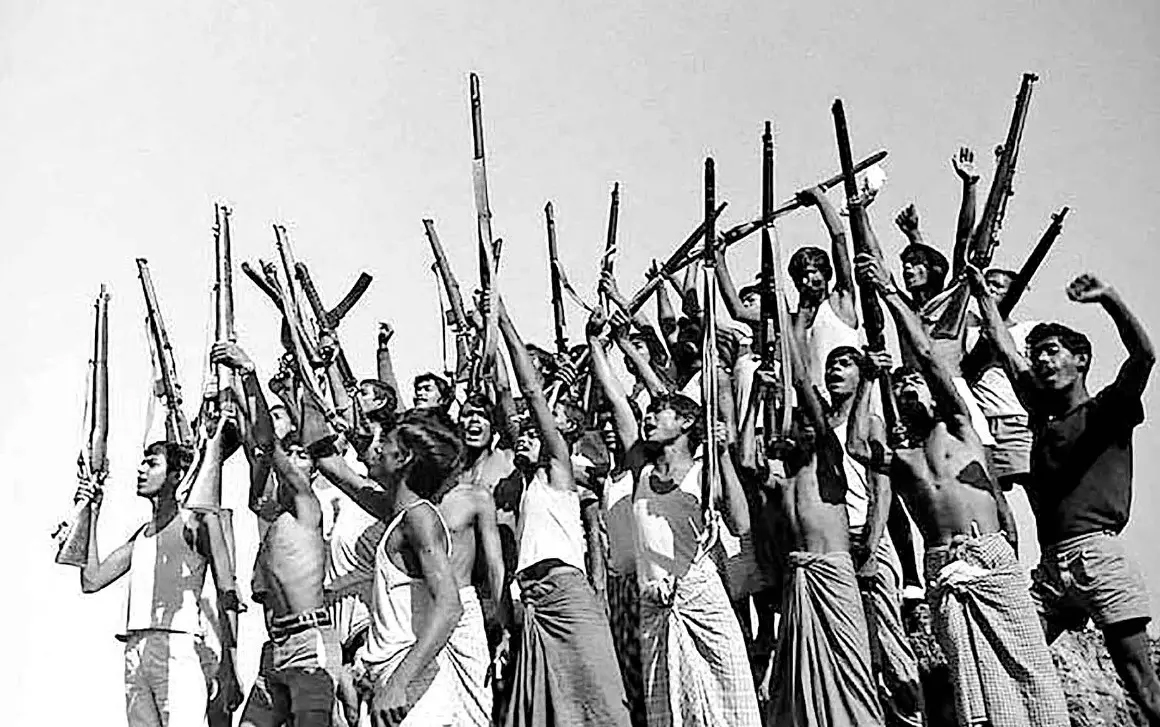
To characterize the 1971 victory solely as an Indian triumph is to ignore the operational reality. The speed of the Indian advance was made possible by the Mukti Bahini (the Bengali resistance forces). By December, the Mukti Bahini had evolved from a disorganized insurgency into a potent paramilitary force, trained and equipped by India.
Their contribution to the “Lightning Campaign” was structural:
- Intelligence: The Indian Army was advancing into terrain it did not know intimately. The Mukti Bahini provided real-time human intelligence on minefields, bunkers, and troop strengths.
- Logistics and Mobility: As seen at the Meghna crossing, the Mukti Bahini mobilized the local population to provide transport. Furthermore, they guided Indian columns through secondary tracks and marshes, allowing the heavy armor to bypass the mined main roads.
- Isolation: Behind Pakistani lines, Mukti Bahini saboteurs destroyed culverts, cut telephone wires, and ambushed supply convoys. This severed the nervous system of the Pakistani command. General Niazi in Dhaka frequently lost contact with his field divisions because the guerrillas had destroyed the communication infrastructure. The Pakistani Army was fighting blind.
The Psychological Collapse and the Tangail Drop
By December 11, the physical encirclement of Dhaka was underway, but the city was still garrisoned. To accelerate the surrender, Indian strategy shifted to psychological warfare.
On December 11, the Indian Army executed a battalion-sized airborne operation. The 2nd Battalion of the Parachute Regiment (2 Para) was dropped at Tangail, north of Dhaka. Their tactical mission was to capture the Poongli Bridge and cut off the retreat of Pakistani forces withdrawing from Mymensingh.
The strategic impact of the Tangail drop was far greater than the tactical achievement. Indian information operations deliberately exaggerated the size of the force. General Niazi was led to believe that an entire paratroop brigade had landed. This deception was inadvertently aided by foreign media reports which, operating on limited information, overstated the Indian presence.
This created a sense of panic in the Eastern Command headquarters. Niazi believed he was being swarmed from all sides. On December 14, the IAF conducted a precision strike on the Governor’s House in Dhaka, disrupting a high-level meeting of the East Pakistan civilian administration. The psychological dislocation was complete. The Pakistani command felt isolated, surrounded, and defenseless against air attack.
The Surrender: A Statistical Clarification
By December 15, Indian forces were at the gates of Dhaka. General Niazi commanded a significant number of troops within the Dhaka bowl—estimates vary, but he had roughly 26,000 soldiers available for the city’s defense. A “Stalingrad-style” urban defense was theoretically possible, which would have inflicted heavy casualties and delayed the end of the war.
However, the will to fight had evaporated. The “fortress strategy” had resulted in the bulk of the Pakistani combat power being stranded on the borders, irrelevant to the defense of the capital.
On December 16, Major General Jacob flew to Dhaka to negotiate the capitulation. He presented a draft Instrument of Surrender that demanded an unconditional lay-down of arms. Niazi accepted.
That afternoon, the formal surrender took place at the Ramna Race Course. The figure often cited is that 93,000 Pakistani personnel surrendered. It is important to clarify this statistic. This number includes not only the regular soldiers of the Pakistan Army but also paramilitary units (Rangers, irregulars), police forces, and civilian administrators and their families. While the combat strength was lower, the capture of 93,000 prisoners represented the total collapse of the Pakistani state apparatus in the East.
Conclusion: Maneuver and Context
The 1971 campaign remains a study in the effective application of military force within a constrained political timeframe. The success of the “13-day war” was not due to a single “Blitzkrieg” doctrine, but rather a combination of flexibility and context.
The Indian Army succeeded because it adapted. It abandoned the rigid methodical advance for a fluid campaign of bypass and encirclement. It leveraged the unique asset of the Mukti Bahini to turn the hostile terrain into a permissive environment. Most importantly, it identified the correct center of gravity: not the territory of East Pakistan, but the mind of the opposing commander.
For Pakistan, the defeat was a failure of strategic alignment. The military strategy (forward defense) was disconnected from the political reality (lack of popular support and isolation). By trying to defend every inch of the border, they ultimately defended nothing.
The liberation of Dhaka proved that in the specific context of 1971, speed was the ultimate weapon. By outpacing the diplomatic machinery of the Cold War, the Indian Army and the Mukti Bahini created a fait accompli on the ground, redrawing the map of South Asia before the superpowers could intervene.

Leave a Reply