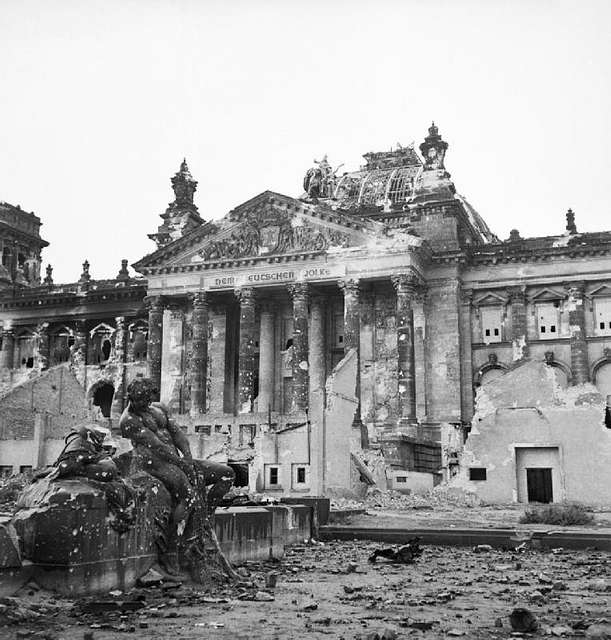

Introduction: After the Fall
In early May 1945 Berlin ceased to be the capital of a genocidal empire and became a city of ruins under Soviet control. Before British, American, or French officials arrived, Berliners encountered a new power that was at once liberator, conqueror, and architect of a different totalitarian future. What follows draws on Sinclair McKay’s Berlin, Richard J. Evans’s analysis of popular knowledge under Nazism, and wider scholarship to reconstruct those first weeks: hunger and sexual violence; the quick, almost defiant return of urban life; the politics of “antifascist democracy” under Walter Ulbricht; and the unresolved moral language of guilt and responsibility that would shadow German society for decades.
“Knowing” and “Not Knowing”: The Open Secret
By 1943–44, the mass murder of Europe’s Jews had become—borrowing Evans’s phrase—an “open secret.” You did not need to have seen a gas chamber to understand that deportation meant disappearance. Railway staff processed special trains; officials reallocated Jewish apartments and possessions; neighbors watched families vanish; rumors circulated from front-line soldiers and armaments workers. The state tried to keep details compartmentalized, but as Himmler himself implied to SS leaders, this was a deed to be endured and not spoken of publicly. Evans’s point is not that every German knew every detail, but that it was possible to know—and many chose not to look.
This framing matters for 1945 because it shaped how Berliners anticipated the world’s judgment after capitulation. It also sets the stage for later historiographical debates: Daniel Jonah Goldhagen’s thesis of a broadly “eliminationist” culture (now debunked by most historians on the subject) contrasted with Christopher Browning’s emphasis on situation, conformity, and bureaucratic routinization; Mary Fulbrook and Robert Gellately, among others, mapped the gradients between coercion, consent, opportunism, and fear. In the streets of Berlin that summer, those abstract debates did not yet exist—but the weight of complicity, silence, and rumor certainly did.
Guilt, Responsibility, and the Language of Judgment
Thomas Mann’s wartime broadcasts suggested that the roots of German evil ran deep; Bertolt Brecht recoiled at the idea of a people condemned for crimes committed by tyrants. Hannah Arendt would later offer a vocabulary Berliners lacked in 1945: the difference between collective guilt (which no one can truly bear) and collective responsibility (which societies cannot evade). In practice, hungry, violated, and displaced civilians experienced such distinctions as luxuries. Still, Arendt’s categories became central to postwar political culture—especially in the West German Vergangenheitsbewältigung (coming to terms with the past) that unfolded unevenly from the 1950s through the 1980s.
Conquest, Vengeance, and the New Order
The Red Army’s victory brought vengeance. Sexual violence was widespread; property was seized; industrial know-how at AEG, OSRAM, Siemens and the Kaiser-Wilhelm Institutes was stripped or “recruited” for Soviet purposes, including atomic research. Norman Naimark’s work documents the dual nature of Soviet rule: ruthless extraction and retribution, but also the rapid creation of administrative structures meant to normalize life and, crucially, to root Communist power.
In June 1945, the Soviet-appointed Bürgermeister, Arthur Werner—an engineer with local credibility—broadcast warnings echoing the coercive cadences of the regime just fallen: attacks on Soviet personnel would be met with collective reprisals. Simultaneously, Walter Ulbricht and the returning German Communists assembled an “antifascist-democratic” façade—coalition in appearance, Communist dominance in fact. This is the prehistory of the Socialist Unity Party (SED) state: a careful choreography to make revolution look like reconstruction.
Hunger Politics: Calories, Queues, and Black Markets
Rationing stratified the city. Targets hovered around ~1,100 calories per day in the worst weeks—bread and potatoes were relatively steady; meat was rare; coffee existed mostly as rumor. Priority categories (builders, transport workers, even actors in some districts) sometimes received slightly more, a practice with both practical and political logic: calories built houses and loyalties. The black market—the Schwarzmarkt—emerged immediately, part survival strategy, part moral gray zone. Tony Judt’s Postwar situates Berlin’s hunger within a continental story: millions on the move, shattered harvests, and cities improvising life with generators, water standpipes, and barter.
The City That Refused to Die: Trains, Trams, and Light
One of Berlin’s most striking features in summer 1945 was the speed of its partial reanimation. Within weeks, the U-Bahn and S-Bahn rumbled again on cleared sections; trams were re-threaded; buses ran on wood gas; water returned to districts like Moabit after months at standpipes. Urban repair became a civic ritual: every functioning light, every rattling carriage announced that the city, though conquered, would not submit to stillness. Comparative cases—in bombed Naples or postwar Warsaw—show similar civic “switching on,” but Berlin’s scale and immediacy made it emblematic.
Trümmerfrauen: Myth, Memory, and the Work of Clearing
Images of the Trümmerfrauen—women passing bricks in long human chains—became global symbols. Harald Jähner’s Aftermath complicates the picture: much rubble work was organized, paid (meagerly), and sometimes closer to harsh civic labor than to pure coerced punishment, though refusals could mean ration cuts and the line between necessity and compulsion blurred. The icon endures because it compresses so much: women’s centrality to survival; the humiliation of public toil in one’s best dress because work clothes had burned; the state’s hunger to see and photograph redemption. Memory politics later elevated these images into proof of moral renewal; historians caution that symbolism should not eclipse the messy, often coerced reality.
Deportations East: The Vanishing of the Defeated
Beyond prisoners of war, thousands of German civilians—especially men deemed useful—were swept east for labor in mines and reconstruction. Some never returned. This story sits uncomfortably in postwar narratives because it coexists with German culpability for far greater crimes. Naimark and others insist we hold both facts at once: Soviet forced labor and retributive violence were real; they do not relativize the Holocaust or German occupation atrocities. They are part of a full accounting of how empires end and new security orders are built on the suffering of the defeated.
“Antifascist Democracy”: Ulbricht’s Tightrope
Ulbricht’s maxim—“It must look democratic, but we must have everything in our hands”—captures the June–July 1945 project. The Soviets and German Communists staffed municipal offices with a careful mix of Communists and “non-party” figures to imply pluralism while building the skeleton of a one-party state. When the Western Allies entered Berlin later in the summer, they confronted a fait accompli in the Soviet sector. The rhetoric of antifascism did double work: it justified purges and re-education, and it provided moral cover for a new authoritarianism designed to prevent the “return” of Nazism by pre-empting political competition.
Moral Landscapes: Living With the Past in the Present
What did ordinary Berliners think and feel? Diaries and postwar testimonies are laced with contradiction: shame and self-pity; relief at survival and fury at Soviet abuses; flashes of empathy for Jewish neighbors belatedly acknowledged; insistence that “we knew nothing,” alongside matter-of-fact recollections of deportations and confiscations. Miriam Gebhardt’s work on sexual violence reminds us that women bore a disproportionate share of the city’s immediate trauma; Mary Fulbrook’s writings press us to map the gray zones of complicity in everyday life. The philosopher Karl Jaspers, lecturing in Heidelberg later in 1945, proposed four kinds of guilt—criminal, political, moral, and metaphysical—an attempt to give people categories to think with. In Berlin that summer, categories lagged behind experience.
Conclusion: Beginning Again Among the Ruins
The first weeks of Soviet-occupied Berlin were a crucible in which three stories entangled:
A moral reckoning that remained largely inarticulate on the streets but would define German politics and memory thereafter. A social miracle of restoration, powered by hunger, improvisation, women’s labor, and the stubborn rhythms of urban life. A political sleight of hand, where the language of antifascist democracy midwifed an authoritarian state in the eastern half of the city.
To understand 1945 Berlin is to resist the ease of singular narratives. The city was both victim and perpetrator, both resilient and broken, both newly free of Nazism and already being organized for the SED state to come. Out of that paradox came the divided Berlin that would stand for the next 45 years as the stage on which Europe’s 20th century played out its final act.
Suggested Reading & Scholarship
Sinclair McKay, Berlin: Life and Death in the City at the Center of the World (esp. ch. 16, “Complicity”). Richard J. Evans, The Third Reich at War (ch. “German Moralities”). Harald Jähner, Aftermath: Life in the Fallout of the Third Reich, 1945–1955. Norman M. Naimark, The Russians in Germany: A History of the Soviet Zone of Occupation, 1945–1949; Fires of Hatred. Antony Beevor, Berlin: The Downfall 1945. Tony Judt, Postwar: A History of Europe Since 1945. Hannah Arendt, “Organized Guilt and Universal Responsibility” (1945); Eichmann in Jerusalem. Christopher R. Browning, Ordinary Men; Mary Fulbrook, Reckonings: Legacies of Nazi Persecution and the Quest for Justice. Miriam Gebhardt, When the Soldiers Came: The Rape of German Women at the End of World War II.
Listen & Learn: Related Podcast Collections
Explore these curated episode collections to go deeper on the history behind this article:

Leave a Reply