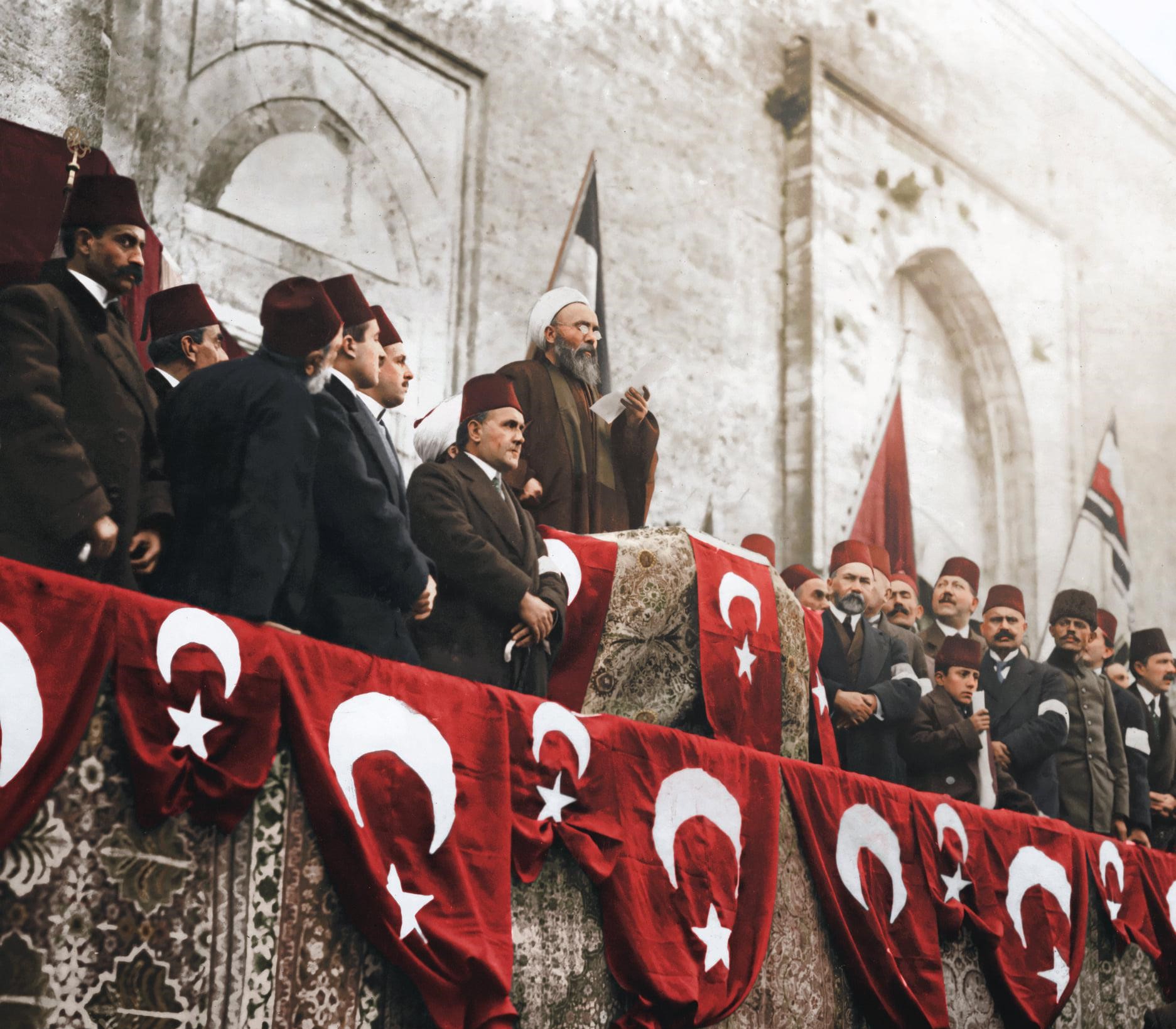


The Ottoman Empire and Germany – 1914 – Explaining History
The Ottoman Empire, the so-called “Sick Man of Europe,” entered the cataclysm of the First World War on the side of Germany after signing a secret treaty on August 2nd 1914. This was not the simple act of a German puppet, but a desperate, calculated gamble by a proud empire caught in the crosshairs of European rivalries.
For decades, the great powers had circled the dwindling Ottoman Empire, pondering the “Eastern Question”—what to do with its territories once it inevitably collapsed. The Empire had been dealt a series of staggering blows: humiliating defeats in the Balkan Wars of 1912-13 stripped it of its last European holdings, while Italy had seized Libya just a year prior. Internally, the government was in the hands of the Committee of Union and Progress (CUP), the “Young Turks,” led by a powerful triumvirate: Enver Pasha, Talat Pasha, and Djemal Pasha. They were nationalists, modernizers, and acutely aware that without a powerful European ally, the Empire would be carved up by its predators, chief among them Russia, which had long coveted Istanbul and the Straits.
Germany’s Eastern Promise
Into this volatile situation stepped Kaiser Wilhelm II’s Germany. A latecomer to the imperial game, Germany saw in the Ottoman Empire a golden opportunity to project its power—its Weltpolitik. As we discussed in the podcast, the Kaiser’s 1898 visit to the Ottoman lands was a masterstroke of political theatre. He declared himself the friend of the world’s 300 million Muslims, a clear strategic move designed to unsettle Britain, which ruled over 100 million Muslims in India. Germany offered the Ottomans what they craved: respect, investment, and military expertise.
The most ambitious symbol of this partnership was the Berlin-to-Baghdad Railway. More than just an infrastructure project, it was a geopolitical weapon. This “steel spine” was designed to transport German troops and influence directly to the Persian Gulf, threatening Britain’s control over the Suez Canal and its “jealously guarded lake” of the Indian Ocean.
This growing bond was solidified by a German military mission, led by General Otto Liman von Sanders, tasked with reorganizing the battered Ottoman army. For Russia, the idea of a German general commanding the troops that controlled the Dardanelles and Bosphorus—its only warm-water access to the world’s oceans—was an existential threat. Yet, as the podcast transcript highlights, the irony was that Britain had its own mission, with Admiral Arthur Limpus effectively commanding the Ottoman Navy. The Empire was not yet in Germany’s pocket; rather, it was the subject of an intense tug-of-war between the European blocs.
A Desperate Search for a Friend
When Archduke Franz Ferdinand was assassinated in Sarajevo in June 1914, the Ottoman leadership knew they had to choose a side. Neutrality was not an option; a victorious Russia would undoubtedly seize its long-sought prize of Istanbul. As historian Mustafa Aksakal argues in The Ottoman Road to War in 1914, the Young Turks saw the looming war not just as a threat, but as an opportunity to secure the Empire’s independence from all European encroachment.
Their first choice was not Germany. Djemal Pasha, a noted Francophile, was dispatched to Paris. His plea, as recounted in the podcast, was blunt and desperate: “You must take us into your entente, and at the same time protect us against the terrible perils threatening us from Russia.” But France, bound by its alliance with Russia, could not alienate its primary partner for the sake of the Ottomans. London offered similar ambivalence. For the Entente powers, keeping Russia committed to the fight against Germany was far more important than saving the Turkish Empire. The door to an alliance with Britain and France was politely but firmly shut.
The Final Betrayal: Churchill’s Dreadnoughts
This rejection left the Ottomans isolated and vulnerable. The final, decisive push towards Germany came not from Berlin, but from London, in an act of staggering political miscalculation.
For years, the Ottoman government had been raising funds to build a modern navy capable of challenging its regional rival, Greece. Two state-of-the-art dreadnoughts, the Sultan Osman I and the Reşadiye, were under construction in British shipyards. These warships were more than military hardware; they were symbols of national resurgence. Their cost was paid for not just by the treasury, but by a massive public subscription campaign. Schoolchildren donated their pocket money, and women sold their hair. The ships represented the hopes of a nation.
On August 1, 1914, just three days before Britain declared war on Germany, the First Lord of the Admiralty, Winston Churchill, made a fateful decision. He ordered the two dreadnoughts to be requisitioned and absorbed into the Royal Navy. From a British military perspective, it was a pragmatic move to prevent the powerful ships from falling into enemy hands.
But in Istanbul, the news was received as an act of brazen theft and a profound national humiliation. It was the ultimate betrayal. The one power the Ottomans might still have sided with had just seized their most prized national assets without compensation. As historian Christopher Clark notes in The Sleepwalkers, Churchill’s decision “did more than any other to push the Ottoman leaders towards Germany.” It confirmed their worst fears: the British could not be trusted, and the Entente saw them as disposable.
The very next day, on August 2, 1914, Enver Pasha concluded a secret treaty of alliance with Germany. The path to war was now set. The Ottoman Empire’s entry into the First World War was not a foregone conclusion. It was a gamble made out of desperation, a choice made only after every other door had been slammed in their face. It was a decision sealed not by German persuasion alone, but by a British act of appropriation that turned a potential ally into a bitter enemy, forever changing the map of the Middle East.
Listen & Learn: Related Podcast Collections
Explore these curated episode collections to go deeper on the history behind this article:

Leave a Reply