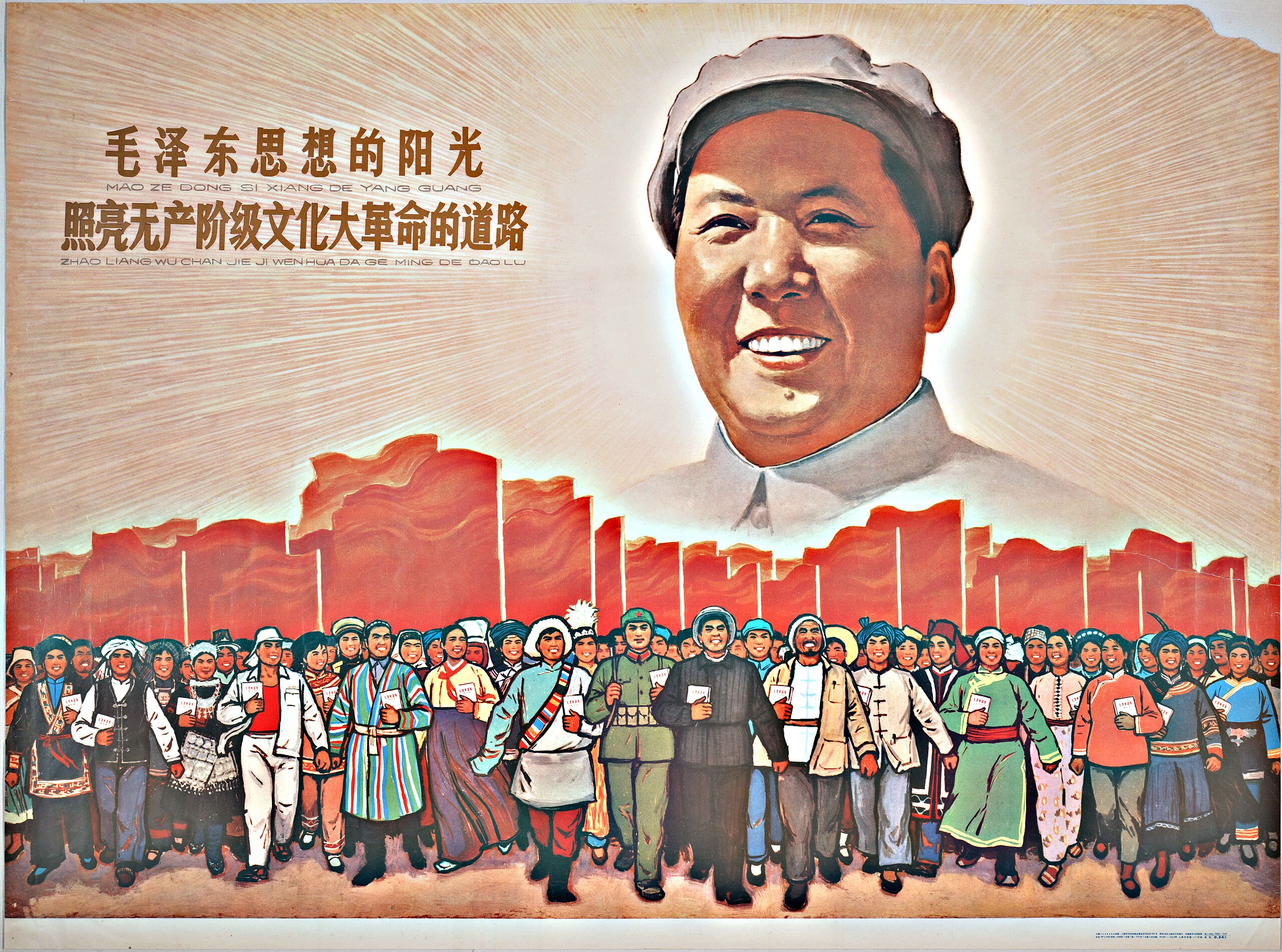
The Chinese Cultural Revolution (officially the Great Proletarian Cultural Revolution) was a decade-long political and social upheaval launched by Mao Zedong in May 1966 to “renew the spirit of the Chinese Revolution” .
Far from benign, the campaign brought widespread violence and chaos: as many as 1.5–2 million people died and tens of millions were persecuted in mass campaigns . Triggered by Mao’s fear of Soviet-style “revisionismRevisionism Full Description:Revisionism was framed as the greatest threat to the revolution—the idea that the Communist Party could rot from within and restore capitalism, similar to what the Chinese leadership believed had happened in the Soviet Union. Accusations of revisionism were often vague and applied to any policy that prioritized economic stability, material incentives, or expertise over ideological fervor. Critical Perspective:The concept served as a convenient tool for political purging. It allowed the leadership to frame a factional power struggle as an existential battle for the soul of socialism. By labeling pragmatic leaders as “capitalist roaders,” the state could legitimize the dismantling of the government apparatus and the persecution of veteran revolutionaries. ” and perceived enemies in his own party, the Cultural Revolution saw China’s youth mobilized as Red Guards to wage class struggle. In Mao’s words, it was a fight to “crush… those persons in authority who are taking the capitalist road” .
The movement, which Mao and his allies initially touted as injecting new life into socialism , instead crippled the economy, tore apart families, and halted education across China . Key figures included Mao himself, his wife Jiang Qing and the Gang of FourGang of Four
Short Description (Excerpt):A political faction composed of four influential Chinese Communist Party officials, including Mao’s wife, Jiang Qing. They were the primary architects of the Cultural Revolution’s harshest policies, controlling the propaganda apparatus and orchestrating the persecution of intellectuals and rivals.
Full Description:The Gang of Four dominated the latter stages of the Cultural Revolution. They advocated for “continuous revolution” and strictly policed cultural expression, banning traditional opera, literature, and art in favor of revolutionary propaganda. Following Mao’s death, they were arrested in a coup and put on trial.
Critical Perspective:The trial of the Gang of Four served a specific political function: scapegoating. By blaming the “Gang” for the chaos and violence of the decade, the Communist Party was able to preserve the legacy of Mao Zedong while rejecting his policies. It allowed the party to maintain its legitimacy and monopoly on power while pivoting toward market reforms.
Read more, military leader Lin Biao, and targets such as President Liu Shaoqi and Deng Xiaoping. After Mao’s death in 1976, the new leadership officially deemed the Cultural Revolution a “grave error” and reversed many policies.
The Cultural Revolution’s causes and course remain intensely debated. Historians face challenges from scarce archival access and conflicting narratives: official Chinese sources call it a “ten years of turmoil” blamed on Mao’s mistakes, whereas some Western scholars emphasize factional power struggles and ideological fanaticism . In this overview, we examine the origins, chronology, and major actors of the Cultural Revolution, survey the historiographical debates surrounding it, and assess its long-term impacts on Chinese society, culture, and international relations. Our goal is to provide a comprehensive foundation — or “pillar” — for understanding the Cultural Revolution, onto which more detailed studies (of the Red GuardsRed Guards Full Description:The Red Guards were the instrument through which the leadership bypassed the established bureaucracy to unleash chaos on society. Encouraged to “rebel is justified,” these groups engaged in humiliated public “struggle sessions,” violent raids on homes, and the physical abuse of teachers, intellectuals, and local officials. Critical Perspective:The mobilization of the Red Guards represented the weaponization of the youth against the older generation. It exploited the idealism and energy of students, channeling it into mob violence and destruction. This resulted in a “lost generation” who were denied formal education and sent to the countryside, their futures sacrificed for a political power struggle. , Gang of Four, art and culture, etc.) can attach.
Background and Causes
By the early 1960s, China’s leaders were already at odds over the country’s direction. The catastrophic Great Leap Forward (1958–1961) had caused a massive famine, leading Mao to withdraw from day-to-day governance while pragmatists like President Liu Shaoqi and Premier Zhou Enlai quietly implemented market-oriented reforms. These moderate policies — reintroducing incentives for peasants, tolerating wage differentials, etc. — revived the economy but frustrated Mao, who feared they betrayed socialist principles . At the same time, the Sino-Soviet split loomed large. Mao was deeply alarmed by Nikita Khrushchev’s denunciation of StalinStalin Joseph Vissarionovich Stalin (18 December 1878 – 5 March 1953) was a Soviet politician, dictator and revolutionary who led the Soviet Union from 1924 until his death in 1953. Read More and reforms in the USSR, seeing them as “revisionism” that China must avoid . He feared China might itself drift toward bureaucratic elitism (as in the Soviet model) rather than proletarian revolution.
In this tense context Mao grew convinced that class struggle had to continue even within the Communist Party. He blamed recent setbacks on a betrayal of revolutionary zeal, writing that party cadres had become “bureaucratic” and “abandoning… values of communism”. By late 1965 he began plotting a new campaign to reassert ideological purity. His stated goals included replacing inconvenient party leaders, reinforcing mass revolutionary fervor, and rooting out capitalist-roaders from culture, education and government . He also recruited a close circle for this: his wife Jiang Qing and radical intellectuals would oversee culture, and military chief Lin Biao promoted Mao’s image (e.g. the cult of the Little Red BookLittle Red Book
Short Description (Excerpt):Officially titled Quotations from Chairman Mao Zedong, this pocket-sized book became the ultimate symbol of the era. It was required reading for all citizens, serving as a talisman of loyalty and a weapon against perceived class enemies.
Full Description:The Little Red Book was more than a collection of political aphorisms; it was a social license. Red Guards waved it during rallies and used its passages to settle arguments, justify violence, or attack authority figures. Not carrying it, or failing to recite specific passages on command, could lead to accusations of counter-revolutionary thought.
Critical Perspective:The ubiquity of the book represents the replacement of critical thinking with religious-like dogma. It reduced complex political and social problems to catchy slogans. Its function was to enforce ideological conformity, ensuring that the only “truth” available to the population was the word of the leader.
Read more) . In Mao’s own words, the aim was to “struggle against… those in authority who are taking the capitalist road… to consolidate the socialist system” .
By spring 1966, Mao was poised to act. During a May 1 rally Lin Biao gave a speech urging schoolchildren to criticize officials influenced by Soviet ideas, and on 16 May 1966 the Politburo issued a secret “May 16 Notice” warning of a bourgeois plot within the CCP . This marked the launch of the Cultural Revolution. As British journalist Tom Phillips explains, Mao turned China’s cities into “turmoil… in a monumental effort to reverse [social stratification]” . Shortly after, Mao and Jiang Qing began purging soft-line cultural figures, setting the stage for mass mobilization against perceived class enemies . In sum, the Cultural Revolution began as Mao’s bid to reassert his control by unleashing ideological revolt – a decision that “historians struggle to make sense of” even today .
Early Mobilization and the Red Guards
In mid-1966 the movement quickly swept through China’s schools and universities. In Beijing, a university philosophy student posted a dazibao (big character poster) attacking her administration; students and radicals at other schools followed suit . Mao and his allies encouraged this unrest. On 18 August 1966, for example, Jiang Qing declared squads of revolutionary students the “Red Guards – the front line of the new revolutionary upheaval” . Mao personally endorsed the Red Guards’ activities, famously greeting gigantic student parades holding up copies of his Little Red Book . Lin Biao’s cult of Mao further fueled the craze: his propaganda required every soldier (and soon every citizen) to study Mao’s quotations, elevating the Chairman to a near-prophetic stature . Within weeks, Red Guards across China were mobilized to “expose” and criticize party cadres labeled as “revisionists” or class enemies .
Mao and the party leadership explicitly withheld protection from these mass actions. A central Communist Party document (the “Sixteen Points”) issued in August 1966 effectively declared the Cultural Revolution’s aims and forbade suppression of the movement . By this point Mao had largely sidelined experienced administrators like Liu Shaoqi (accused of taking the capitalist road) and Deng Xiaoping (labeled a traitor), replacing them with loyalists . In practice, school children and youth armies terrorized perceived enemies: teachers, intellectuals, and officials were publicly humiliated and beaten if deemed insufficiently revolutionary. “If good people beat bad people, it serves them right,” Jiang Qing told a Red Guard rally – a comment revealing the regime’s indifference to brutality . With Mao’s blessing, students roamed campuses and streets in red armbands, fighting factional battles and destroying symbols of the “Four Olds” (old ideas, customs, culture and habits) . By late 1966 the initial phase of the Cultural Revolution was in full swing, marked by mass rallies, sectarian struggle sessionsStruggle Sessions
Short Description (Excerpt):A form of public humiliation and torture used by the Red Guards against “class enemies.” Victims were forced to admit to various crimes before a crowd of people who would verbally and physically abuse them.
Full Description:Struggle Sessions (or thamzing) were a primary weapon of terror. Intellectuals, landlords, and party officials were dragged onto stages, forced to wear dunce caps or heavy placards detailing their “crimes,” and beaten by their former students, colleagues, or neighbors until they confessed to counter-revolutionary thoughts.
Critical Perspective:This practice weaponized the community against the individual. It was designed to break the psychological will of the victim and to implicate the crowd in the violence. By forcing colleagues and neighbors to participate in the abuse to prove their own revolutionary fervor, the state successfully destroyed social trust and interpersonal bonds.
Read more, and an atmosphere of revolutionary zeal run amok.
Chaos and Collapse (1967–1968)
The party’s gamble was that grassroots fervor would ignite a new socialist fervor – but instead order broke down nationwide. By late 1966 and into 1967, factional violence became common. Schools and factories closed to allow mass “struggle,” and Red Guards and allied worker-peasant groups vied for control of localities . Temples, libraries, and art works were vandalized as part of the assault on tradition . Party authorities were caught in the crossfire: at times Red Guards even attacked militant peers or loyal party members for not being sufficiently radical . As Phillips notes, Red Guard mobs “attacked people wearing ‘bourgeois’ clothes” on the streets and dragged intellectuals through humiliating struggle sessions . In Beijing alone nearly 1,800 people were killed or wounded in August–September 1966 as student militias ran riot .
The violence only escalated in 1967. Newspapers urged armed coalitions of workers, peasants, and students to seize local power . Rival Red factions often turned on one another, leading to bloody street battles. The Communist Party found itself embroiled: according to Stanford historian Stefanie Lamb, the result was a “bewildering series of attacks and counterattacks, factional fighting, and unpredictable violence” . Particularly intense fighting occurred in late 1967: military units clashed with rebel groups (notably in Wuhan, where over a thousand protestors died) . In some cities radicals even seized control of government ministries and embassies, installing their own “revolutionary cadres” . In effect, China spiraled into what many historians call a form of civil war . Millions of ordinary people suffered—beaten in street struggles, driven to suicide, or arbitrarily imprisoned. Thousands of “counter-revolutionaries” were executed or tortured in mass campaigns, while millions of youths were sent to the countryside on Mao’s orders, ostensibly to be re-educated by peasants .
Military Intervention and Gradual Stabilization (1968–1969)
By 1968 Mao and other senior leaders saw that the anarchy was endangering China. Mao realized the “revolution” had spiraled out of control . Late in 1968 he quietly acted to curb excesses: in December he ordered the massive “Down to the Countryside Movement,” sending millions of urban youth to rural areas for labor and ideological re-education . Simultaneously, the People’s Liberation Army (PLA) was instructed to restore order. The PLA crushed the most unruly Red Guard factions (e.g. at Beijing’s Tsinghua University), suffering dozens of casualties in the process . In effect, the CR shifted from popular militias to military control: China became a quasi-military dictatorship until about 1971 .
By mid-1968 “Revolutionary Committees” co-chaired by the army, selected workers and loyal Party cadres were installed at factories, schools and local governments to replace seized authorities . At the same time, Mao and his allies began targeting overly ultra-left elements. From 1967–69 a “Campaign to Purify Class Ranks” recursively purged even militant Red Guards, accusing them of poor class background or hidden revisionism . This campaign tortured and banished many former Red Guard fervents as “rebel addicts” . Educational institutions also saw uneasy transition: by 1968–69 some schools reopened, but chaos lingered. Not until 1973 were exams (the gaokao) reinstated nationwide, replacing revolutionary slogans as college admission criteria . In sum, the late-1960s phase ended the worst street violence but continued the Cultural Revolution’s unpredictability under military supervision.
Lin Biao and Factional Power Struggles (1969–1971)
In 1969 the party formally named Defense Minister Lin Biao as Mao’s successor . Lin, a former general who had championed Mao’s cult, now held enormous prestige. That year also saw a flare-up with the Soviet Union: Soviet and Chinese troops exchanged fire on the border, which in China led to even greater reverence for the PLA (still under Lin’s leadership) . However, Lin’s position soon became precarious. In 1970 Mao privately turned against Lin, reshuffling the constitution to block Lin’s rise . On 13 September 1971 Lin Biao died in a mysterious plane crash over Mongolia. The CCP declared that Lin had plotted to assassinate Mao and flee . Whether true or not (many scholars doubt Mao ordered it, but Lin’s fall was used for effect), Lin was posthumously denounced as a “renegade and traitor” . His abrupt downfall shocked China — as one historian noted, Chinese citizens who once revered Lin now doubted the Party’s truthfulness . This episode consolidated Mao’s remaining control: the Party could claim Lin’s death as evidence that even top military leaders must bow to Mao’s will.
After 1971, with Lin gone and the PLA firmly in command, a relative calm (albeit under dictatorship) settled. By 1972 Mao’s regime even began outreach abroad: during this period the Sino-Soviet split propelled China to seek new alliances. Nixon’s landmark visit in February 1972 re-established Sino-American ties , and China signed trade deals with Western countries to counterbalance Soviet hostility . Yet Mao reacted to opening with suspicion: at the same time he launched an “Anti-Lin Biao, Anti-Confucius” campaign to root out traditional values and anti-revolutionary ideas, warning that Western cultural influence should not dilute socialist ideals . In China’s politics, the final half-decade of the Cultural Revolution (1972–1976) became characterized by factional jockeying: moderates like Premier Zhou Enlai began cautiously restoring some order, while radical Maoists (the Gang of Four) pushed for continued revolution.
The Final Phase and End of the Revolution (1973–1976)
By the mid-1970s Mao was aging and ill, and China’s leadership was split. Zhou Enlai, as Premier, managed day-to-day government and opened diplomacy (including normalizing relations with the West). Conservatives around Mao’s wife Jiang Qing (one of the “Gang of Four”) continued to purge perceived enemies and keep revolutionary fervor alive. In January 1976 Zhou Enlai died; tens of thousands of people quietly gathered in Tiananmen Square to mourn him, calling for “the true spirit of Marxism-Leninism.” The hardliners saw this as a challenge: they harshly suppressed these memorial gatherings, foreshadowing the power struggle to come .
On 9 September 1976, Mao himself died. His passing unleashed a succession crisis. Quickly, Hua Guofeng (the designated second-in-command) detained the remaining leaders of the Cultural Revolution – Jiang Qing, Zhang Chunqiao, Yao Wenyuan and Wang Hongwen – branding them the “Gang of Four” and accusing them of masterminding the movement’s excesses . With Mao gone, Hua proclaimed the Cultural Revolution over. The arrests of 6 October 1976 (notably after Mao’s funeral) are generally taken as the official end of the Cultural Revolution .
In December 1978 at the Third Plenum, the Party formally shifted course. Deng Xiaoping emerged as China’s leader, signaling a break from Mao’s mass-movement politics. Deng’s regime “totally negated” the Cultural Revolution, vowing to modernize the economy and open to the world . Deng introduced market reforms and set China on a path nearly opposite to Mao’s vision: pragmatism over ideology, engagement with global trade, and rebuilding institutions. In the words of Stanford’s Stefanie Lamb, by the late 1970s “pragmatism, interdependence, openness to outside influences and capitalism” had taken root in China, even as the CCP clung to one-party rule .
Key events timeline:
May 1966: Mao launches the Cultural Revolution with the secret “May 16 Notice,” warning of infiltrating capitalists .
Aug–Sept 1966 (“Red August”): Mass rallies and demonization of Four Olds; Red Guards smash temples and schools, and attack intellectuals .
1967: Factional fighting peaks. Party and military leaders are attacked; clashes between Red Guards, workers and PLA occur across China .
Late 1968: Mao calls for order. Millions of urban youth are sent to rural re-education (the “Down to the Countryside” movement) . The PLA crushes remaining rebel factions and establishes military-backed committees to govern.
1969: Lin Biao is made Mao’s heir at the Party Congress . Clashes with USSR spur patriotic fervor.
1971: Lin Biao dies in a plane crash; the Party labels him a traitor .
1972: US President Nixon visits China, ending decades of isolation . (Western ties rekindled amid ongoing ideological campaigns.)
Jan 1976: Zhou Enlai dies; public mourning leads to protests suppressed by radicals.
Sept 1976: Mao Zedong dies. Oct 1976: Hua Guofeng arrests the Gang of Four, blaming them for the Cultural Revolution’s “mistakes” . The Party declares the revolution over.
1978–79: Deng Xiaoping rises to power, initiates “Reform and Opening Up” and repudiates the Cultural Revolution, shifting China toward modernization .
Major Actors
Mao Zedong: Chairman of the CCP and unchallenged leader of China (1949–1976). Mao conceived and orchestrated the Cultural Revolution, using it to reinforce his ideological leadership . He mobilized the Red Guards and tolerated (even encouraged) widespread violence to eliminate rivals. Mao’s image became quasi-religious during this period, though some historians note he genuinely believed in the “mass line” he preached .
Red Guards: Mass student youth militias (often high-school and university students in urban centers). Fervently pro-Mao, they carried out public denunciations and struggles sessions. As one account notes, “Gangs of teenagers in red armbands… setting upon those with ‘bourgeois’ clothes or reactionary haircuts” . At their peak (1966–67), the Red Guards shaped events but eventually became targets themselves in later purges .
Lin Biao: Vice-Chairman of the CCP and Commander of the PLA. An early and ardent ally of Mao (compiling the Little Red Book), Lin was named Mao’s successor in 1969 . His dramatic fall in 1971 – dying in a plane crash after allegedly plotting a coup – turned him from revered hero to reviled traitor overnight .
Jiang Qing and the Gang of Four: Jiang Qing (Mao’s wife), along with Zhang Chunqiao, Yao Wenyuan and Wang Hongwen, became the cultural enforcers of the revolution. Jiang led the Cultural Revolution Group and directed propaganda and theater. After Mao’s death, these four were quickly arrested and blamed for the Revolution’s excesses . They served as convenient scapegoats, allowing the Party to denounce the movement while preserving Mao’s reputation .
Other CCP Leaders:
Liu Shaoqi (President of China) and Deng Xiaoping (Party general secretary) were prominent pragmatists. Both were purged in 1966–67: Liu was labeled a traitor and died in detention, Deng was humiliated in struggle sessions. Both were formally rehabilitated only after 1978 . Zhou Enlai (Premier) acted as a moderating figure, preserving some government function and advocating for order. He died in 1976, and the outpouring of public grief for him became part of the endgame against the radicals . Others: Millions of ordinary citizens, from peasants to factory workers, were swept into campaigns. Red Guard leaders and ordinary people found themselves switching roles from persecutors to victims as factions shifted. Many died or were sent to labor camps. As one historian puts it, “ordinary people… were persecuted by ideologues, opportunists and mindless thugs” .
Historiography and Interpretations
The Cultural Revolution has generated enormous debate among historians, yielding a wide spectrum of interpretations. Official Chinese historiography (since the 1981 Party Resolution) condemns it as a decade of “grave left errors” responsible for the “most severe setback… since 1949.” The Resolution explicitly states that “chief responsibility… lies with Comrade Mao Zedong,” though it also blames Jiang Qing, Kang Sheng and Lin Biao for exploiting Mao’s errors . In Chinese textbooks the period is taught as the “ten years of chaos” that ended Communist legitimacy. Public discussion in China remains heavily controlled; journalists and scholars must tread carefully.
Outside China, interpretations vary. Western (especially Cold War–era) historians often portrayed Mao as a megalomaniacal dictator. For example, historian Julia Lovell notes that modern scholars describe Mao “deliberately turning society upside down and stoking the violence of millions to retain his position at the centre.” . Influential works like Roderick MacFarquhar and Michael Schoenhals’s Mao’s Last Revolution (2006) provide detailed chronological accounts highlighting factional infighting under Mao’s ideological veneer . Frank Dikötter’s recent history (2016) uses newly available provincial archives to emphasize the socioeconomic fallout – arguing that Mao’s purge had the opposite effect of its goal, accelerating local marketization even before 1978 . Dikötter’s portrait of Mao is largely negative, seeing the leader as scheming and fanatical , though some scholars note Dikötter may understate Mao’s genuine ideological convictions.
Other historians adopt a more nuanced or “post-revisionist” stance. They emphasize the contradictions of a movement that proclaimed mass democracy but was orchestrated from the top . Some scholars stress that Mao sincerely believed in the socialist cause even as he manipulated it. Novelists and left-leaning thinkers have added cultural depth: authors like Mo Yan and Yu Hua memorialize the suffering of ordinary victims, whereas a younger “neo-Maoist” wing celebrates the Cultural Revolution as a pure experiment in egalitarianism .
There are also explicitly pro-Cultural Revolution accounts. In the late 1960s and 1970s some Western Marxist publications (for example, Monthly Review or sympathetic contributions to The China Quarterly) defended Mao’s policies as genuine attempts at socialist renewal. As one study notes, “authors [in the Monthly Review] have sympathized and even supported Mao’s action” during the Cultural Revolution . Such “Marxist” or leftist critiques, however, have been rare since the 1980s.
Overall, historians grapple with limited sources and ideological bias. The Chinese government still classifies most records from the 1960s and discourages independent research . Consequently, even basic facts – such as the number killed in violence – are disputed. Estimates of deaths range from under 1 million (scholar John Fairbank) up to 7–8 million (political scientist Rummel) . Song Yongyi’s research suggests roughly 2–3 million people died and over 100 million were persecuted (by struggle sessions or “unusual deaths”) . This wide range reflects the methodological challenge: researchers must piece together fragmentary archives, memoirs, and local gazetteers, while aware that eyewitness accounts were often suppressed or self-censored.
In sum, historians of the Cultural Revolution fall into several schools:
Marxist or Maoist perspectives: These emphasize the CR as an idealistic or necessary class struggle. They point to the revolution’s declared goals of combating corruption and inequality. Some radical socialist writers (e.g. in Monthly Review in the 1960s–70s) argued the movement had genuine popular roots . Revisionist critiques: Many scholars (especially in the West) view the Cultural Revolution primarily as a power struggle cloaked in ideology. As one critic put it, it was “a power struggle waged… behind the smokescreen of a fictitious mass movement.” Revisionists stress Mao’s personal motives and the devastation wrought by zealotry. Works like Dikötter’s and Chang/Halliday’s focus on human suffering and bureaucratic chaos . Post-revisionist syntheses: More recent studies attempt middle ground, acknowledging both Mao’s strategic maneuvers and the genuine mass dynamics unleashed. They note, for example, that the CR’s rhetoric of trusting the masses even as it provoked bloodshed was inherently contradictory . This approach often uses local archives and oral histories to show how ordinary Chinese (peasants, factory workers) navigated the chaos, sometimes gaining power unexpectedly.
Chinese intellectual debates: Within China today, views also diverge. Since the 1990s, Chinese thinkers have largely split into “New Left” (who sometimes praise Mao’s egalitarianism) versus liberals (who condemn the CR’s devastation) . Official media will still praise Mao’s overall contributions while glossing over the Cultural Revolution’s brutality . Thus contemporary Chinese discourse is a mix of reverence, fear, and selective memory.
Throughout these debates, scholars emphasize different fields: political historians focus on party documents and power dynamics; cultural historians examine art, literature, and propaganda (e.g. the role of Maoist operas and posters); economists study the disruption to growth; and sociologists study how class labels and social networks were upheaved. All agree the Cultural Revolution was complex and multi-layered – which is why it remains “bewildering” for researchers even half a century later .
Legacy and Long-Term Impact
The Cultural Revolution’s long-term impacts on China have been profound across many domains:
Social fabric and education: A “lost generation” of educated youth is the most obvious legacy. Approximately 16 million young people were removed from schools and cities to work on rural communes . Years of schooling were forfeited, and a gap formed between older educated elites and younger, largely rural generations.
The higher education system was in disarray: only in 1973 were university entrance exams revived . This interrupted education left many Chinese without formal qualifications, retarding China’s intellectual development for years. Psychologically, millions who endured struggle sessions or exile as “bad elements” carried personal and family trauma. Public trust in authority also plummeted: as one scholar notes, Mao’s about-face on hero and villain (e.g. Liu Shaoqi’s rehabilitation) led many to doubt official pronouncements . Culture and the arts: The campaign wreaked havoc on China’s cultural heritage. Thousands of historical sites, temples, artworks, books and antiques were vandalized or destroyed in the “Four Olds” crusade . Traditional opera, literature and fine arts were condemned as feudal, and replaced by rigid revolutionary model operas and posters extolling Mao . Only in later decades did Chinese artists openly reflect on this era. A “scar literature” movement emerged in the late 1970s, with novelists like Mo Yan, Yan Lianke and Yu Hua dramatizing the sufferings of ordinary people . These works speak to the lingering cultural trauma of the period. In official education, however, discussion of the Cultural Revolution remains limited, so its cultural legacy is often mediated through censored or overseas scholarship .
Economic effects: During the 1966–76 period, China’s economy stagnated. Industrial and agricultural output growth slowed or reversed amid the chaos, and ambitious projects were neglected. The reputation of science and professionalism was undermined: many engineers, teachers and managers were purged or sidelined. Only after 1978 did China launch the radical reforms (pioneered by Deng Xiaoping) that transformed the economy. In a sense, the Cultural Revolution indirectly paved the way for reform: it discredited Maoist economic policies and disassembled collectivization, making the post-1978 turn toward markets and foreign trade seem necessary . Historian Julia Lovell notes that in the early 1970s Chinese peasants were “dismantling collectivization and rebuilding private enterprises,” foreshadowing later reforms .
Political and legal institutions: The Revolution’s dismantling of norms had a lasting effect on China’s governance. After 1976 the CCP worked to prevent such turmoil reoccurring. One outcome was that China’s leaders introduced collective leadership and term limits (e.g. in 1980), to check any one person becoming too powerful. The trauma of the Cultural Revolution also made Deng and his successors extremely wary of mass movements; even pro-democracy protests (as in 1989) were met with force. In other words, the CCP kept one-party rule but abandoned Mao’s rhetoric of permanent class struggle, emphasizing stability and rule by experts. The Party’s legitimacy was diminished by the CR’s abuses, a lesson that has influenced its propaganda ever since .
International relations: The Cultural Revolution had significant global reverberations. It worsened China’s split with the Soviet Union and ended prospects for a socialist bloc coalition in Asia. But it also prompted China to open to the West: the 1969 Sino-Soviet border clash and internal chaos drove Mao to seek American rapprochement, culminating in Nixon’s 1972 visit . This visit shifted the Cold War’s balance, bringing China into a triangular diplomacy with the US and USSR. In the years immediately after the Revolution, China’s foreign policy emphasized independent national development (the Four Modernizations) over ideological struggle. Thus by the 1980s China was integrating into the global economy, marking a stark change from the isolation of the Cultural Revolution years.
In education, culture, and politics, the legacy of 1966–76 continues to be felt. Contemporary China still wrestles with how to remember the Cultural Revolution: state media often avoid detailing the suffering, instead noting only that “revolutions typically have a brutal side” . Meanwhile, intellectuals are divided between praising Mao’s revolutionary achievements or mourning the decade’s human cost. What is clear is that the Cultural Revolution profoundly reshaped Chinese society: it ended Mao’s utopian experiments and ushered in a more pragmatic, economically focused era . Its scars – on victims and institutions – have defined modern China’s trajectory.


Leave a Reply to China’s Neoliberal Turn (1978-89): How Deng Xiaoping Transformed China’s Economy | Explaining History – Explaining History PodcastCancel reply