
From the 1970s onwards, a wave of free-market ideology reshaped economies, governments, and societies around the world. Known as neoliberalismSupply Side Economics Full Description:Supply-Side Economics posits that production (supply) is the key to economic prosperity. Proponents argue that by reducing the “burden” of taxes on the wealthy and removing regulatory barriers for corporations, investment will increase, creating jobs and expanding the economy.
Key Policies:
Tax Cuts: Specifically for high-income earners and corporations, under the premise that this releases capital for investment.
Deregulation: Removing environmental, labor, and safety protections to lower the cost of doing business.
Critical Perspective:Historical analysis suggests that supply-side policies rarely lead to the promised broad-based prosperity. Instead, they often result in massive budget deficits (starving the state of revenue) and a dramatic concentration of wealth at the top. Critics argue the “trickle-down” effect is a myth used to justify the upward redistribution of wealth., this framework prioritized deregulationDeregulation Full Description:The systematic removal or simplification of government rules and regulations that constrain business activity. Framed as “cutting red tape” to unleash innovation, it involves stripping away protections for workers, consumers, and the environment. Deregulation is a primary tool of neoliberal policy. It targets everything from financial oversight (allowing banks to take bigger risks) to safety standards and environmental laws. The argument is that regulations increase costs and stifle competition.
Critical Perspective:History has shown that deregulation often leads to corporate excess, monopoly power, and systemic instability. The removal of financial guardrails directly contributed to major economic collapses. Furthermore, it represents a transfer of power from the democratic state (which creates regulations) to private corporations (who are freed from accountability).
Read more, privatizationPrivatization Full Description:The transfer of ownership, property, or business from the government to the private sector. It involves selling off public assets—such as water, rail, energy, and housing—turning shared public goods into commodities for profit. Privatization is based on the neoliberal assumption that the private sector is inherently more efficient than the public sector. Governments sell off state-owned enterprises to private investors, often at discounted rates, arguing that the profit motive will drive better service and lower costs.
Critical Perspective:Critics view privatization as the “enclosure of the commons.” It frequently leads to higher prices for essential services, as private companies prioritize shareholder returns over public access. It also hollows out the state, stripping it of its capacity to act and leaving citizens at the mercy of private monopolies for their basic needs (like water or electricity).
Read more, austerity, and the retreat of the welfare state.
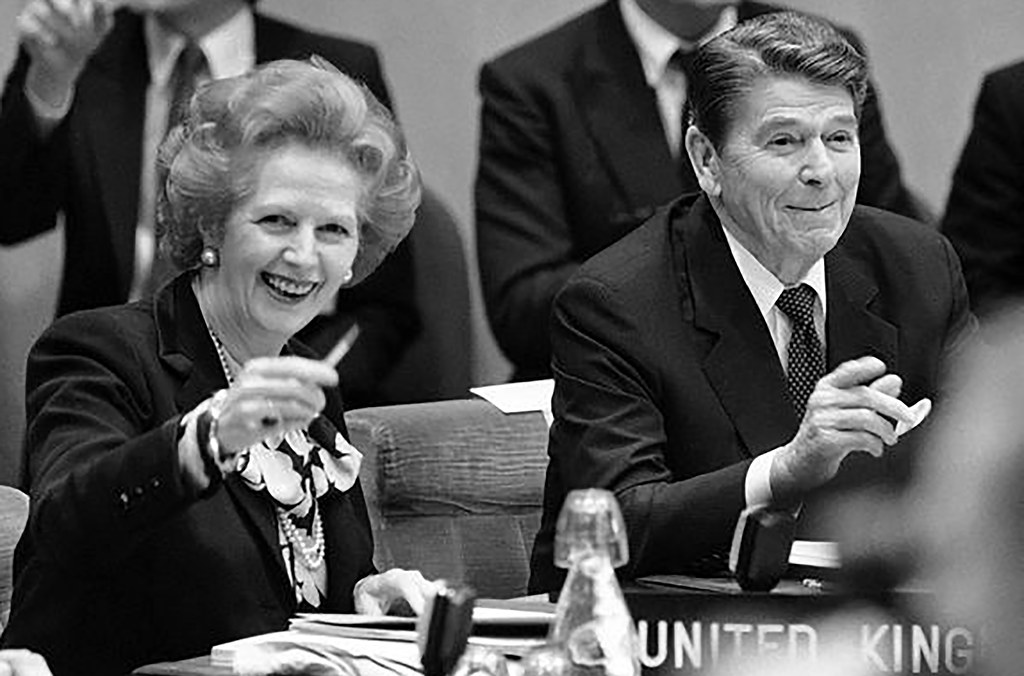
This guide brings together a series of essays exploring how neoliberalism emerged, how it shaped the modern world, and why it is increasingly challenged today. From Thatcher and Reagan to the IMF and populist backlash, this collection examines both the rise and the unraveling of neoliberal orthodoxy.
Origins and Global Adoption
What Is Neoliberalism? A Primer on Market Rule
Neoliberalism is a political and economic ideology that champions free-market capitalism as the primary engine of societal progress. Its core tenets include the privatization of state-owned enterprises, deregulation of the economy, and reductions in government spending. This approach seeks to expand the role of the private sector in the economy and society. While often used pejoratively, the term broadly describes the paradigm shift away from the post-war consensus of Keynesian economicsKeynesian Economics Full Description:The dominant economic consensus of the post-war era which argued that the government had a duty to intervene in the economy to maintain full employment and manage demand. Neoliberalism defined itself primarily as a reaction against and a dismantling of this system. Keynesian Economics underpinned the “Golden Age” of capitalism and the welfare state. It operated on the belief that unregulated markets were prone to collapse and that the state must act as a counterbalance—spending money during recessions and taxing during booms—to ensure social stability and public welfare.
Critical Perspective:From the neoliberal viewpoint, Keynesianism was a slippery slope to totalitarianism. However, critics argue the dismantling of this consensus broke the social contract between capital and labor. By abandoning the commitment to full employment and social safety nets, the state abdicated its responsibility to its citizens, prioritizing the health of the currency over the health of the population.
Read more and a strong welfare state.
The Intellectual Genesis: A Reaction to Crisis
The intellectual roots of neoliberalism can be traced back to the 1930s and 1940s, as a response to the Great Depression and the rise of totalitarianism. Thinkers like Austrian economists Friedrich Hayek and Ludwig von Mises laid the groundwork for this new ideology. Hayek’s influential 1944 book, The Road to Serfdom, argued that government control of economic decision-making through central planning inevitably leads to tyranny and the loss of individual freedom.
In 1947, Hayek convened the first meeting of the Mont Pelerin SocietyMont Pelerin Society Full Description:An exclusive international organization founded by Friedrich Hayek and others to combat the rise of state planning and social democracy. It served as the primary intellectual incubator for neoliberal thought, playing a long-term strategic role in shifting global economic consensus. The Mont Pelerin Society was the “thought collective” behind the neoliberal counter-revolution. Established when free-market ideas were politically marginalized, it brought together economists, philosophers, and historians to refine and propagate individualist economic theories.
Critical Perspective:Critically, this group exemplifies the “long game” of ideology. They understood that to change policy, they first had to change the intellectual climate. By building a network of think tanks and academic departments, they successfully waited for a crisis (stagflation) to present their pre-packaged ideas as the only viable solution, effectively manufacturing a new “common sense” that favored the elite.
Read more in Switzerland, bringing together a group of scholars, including Milton Friedman and Karl Popper, who were united in their belief that individual freedom was under threat from collectivist trends. This society became a crucial hub for the development and dissemination of neoliberal ideas, though for decades these concepts remained on the fringes of mainstream political and economic thought. Early neoliberals sought a “middle way” between classical laissez-faire economics and the growing trend of government intervention.
Thatcher and Reagan: The Political Architects of Neoliberalism
The economic crises of the 1970s, particularly the “stagflationStagflation Full Description:A portmanteau of “stagnation” and “inflation,” describing a period of high unemployment coupled with rising prices. This economic crisis in the industrialized West shattered faith in the post-war order and provided the “window of opportunity” for neoliberalism to ascend. Stagflation was the crisis that Keynesian economics could not explain or fix. Triggered in part by oil shocks, it created a situation where traditional state spending only fueled inflation without creating jobs. This failure paralyzed the political left and allowed the neoliberal right to step in with radical new solutions focused on breaking unions and shrinking the money supply. Critical Perspective:Naomi Klein and other critics view this moment as the first major application of the “Shock Doctrine.” The crisis was used to justify painful structural reforms—such as crushing labor power and slashing social spending—that would have been politically impossible during times of stability.” of high inflation and high unemployment, created an opening for neoliberal ideas to move from theory to practice. The post-war Keynesian consensus, which had dominated Western economies for decades, appeared unable to address these new challenges.
In the United Kingdom, Margaret Thatcher, elected Prime Minister in 1979, became a key figure in the implementation of neoliberal policies. Her government pursued a monetarist approach to control inflation, which involved high-interest rates and cuts in government spending. This was followed by a wave of privatization of state-owned industries, including British Telecom, British Airways, and British Gas. Thatcher’s government also took a hard line against trade unions, most notably during the 1984-85 miners’ strike, which significantly weakened the power of organized labour. While these policies were credited with reducing inflation and stimulating economic growth in some sectors, they also led to a sharp rise in unemployment and income inequality.
Across the Atlantic, Ronald Reagan’s presidency (1981-1989) marked a similar shift in the United States. “Reaganomics,” as his economic policies came to be known, was built on four pillars: reducing the growth of government spending, cutting taxes, reducing regulation, and controlling the money supply to curb inflation. The Economic Recovery Tax Act of 1981 enacted significant tax cuts for individuals and corporations, with the top marginal rate on individual income falling from 70% to 28% over the course of his presidency. His administration also aggressively pursued deregulation, particularly in the financial sector. Supporters of Reaganomics point to the end of stagflation and a period of sustained economic growth. Critics, however, highlight the tripling of the national debt and a widening gap between the rich and the poor.
Neoliberalism Goes Global
The IMF, Structural Adjustment, and the Global South
The influence of neoliberalism extended far beyond the US and the UK, largely through the policies of the International Monetary Fund (IMF) and the World Bank. The debt crisis that engulfed many developing nations in the early 1980s gave these institutions significant leverage to impose what became known as Structural Adjustment ProgramsStructural Adjustment Programs Full Description:Structural Adjustment Programs (SAPs) are the enforcement mechanism of neoliberalism in the developing world. When countries face debt crises, international lenders provide bailouts only if the government agrees to restructure its economy according to free-market principles. Consequences: Erosion of Sovereignty: National governments lose control over their own budgets and priorities. Social Impact: Requirements to cut deficits frequently lead to the introduction of user fees for health and education, excluding the poor from essential services. Export Orientation: Economies are forced to focus on extracting resources for export to pay off debts, rather than growing food or goods for domestic consumption. Critical Perspective:Critics describe SAPs as a form of “debt peonage,” where developing nations remain perpetually indebted to Western financial institutions. The programs often result in a net flow of wealth from the poor global South to the rich global North, exacerbating underdevelopment. (SAPs). In exchange for loans, countries were required to implement a raft of neoliberal reforms, including currency devaluation, privatization of state-owned enterprises, and deep cuts in public spending, often on essential services like healthcare and education.
These “one-size-fits-all” conditions were applied to over 70 developing countries throughout the 1980s, fundamentally restructuring their economies away from state-led development models. Proponents argued that these reforms were necessary to instill financial discipline and create the conditions for long-term economic growth. However, critics contend that SAPs often led to increased poverty, unemployment, and economic polarization, with the burden of adjustment falling disproportionately on the most vulnerable populations.
The EU and the Spread of Market Orthodoxy in Europe
In Europe, the European Union (then the European Community) became a key vehicle for the dissemination of market-oriented policies. The creation of the Single Market in 1993, based on the “four freedoms” of movement for goods, services, capital, and people, was a cornerstone of this project. The underlying principle was to foster greater competition among member states, which was believed to enhance economic efficiency and consumer welfare.
The EU’s competition policy, enforced by the European Commission, has played a significant role in promoting a market-based approach, including the liberalization of public services. The establishment of the Economic and Monetary Union and the introduction of the euro further embedded neoliberal principles by prioritizing price stability and placing constraints on national fiscal policies. While the EU’s approach has been characterized by some as a “social market economySocial Market Economy Full Description:An economic model combining free-market capitalism with social policies to establish fair competition and a welfare state. It was the “Third Way” designed to provide the prosperity of capitalism while blunting the appeal of socialism among the working class. The Social Market Economy rejects both the laissez-faire capitalism of the 19th century and the command economy of the Soviet bloc. The state actively intervenes to prevent monopolies and provide a robust social safety net (pensions, healthcare, unemployment benefits), arguing that the market must serve society, not just capital. Critical Perspective:Structurally, this system was a Cold War weapon. It was designed to sedate the labor movement, offering workers a “slice of the pie” to prevent radical political organizing. By integrating unions into corporate decision-making, the state effectively neutralized class struggle, transforming the working class into stakeholders in the capitalist system rather than revolutionaries. Further Reading Rising from the Ruins: The Anatomy of the Wirtschaftswunder The Adenauer Era: Integration, Stability, and the Invention of “Chancellor Democracy” The Great Silence: Collective Amnesia and the Legacy of the Holocaust Wiedergutmachung: The Luxembourg Agreement and the “Entry Ticket” to the West The Long Road Home: The Return of the POWs and the Visit to Moscow Wandel durch Annäherung: Willy Brandt, Ostpolitik, and the Silent Revolution 1968 and the Revolt Against the Fathers The Americanization of the Bonn Republic: Coca-Cola and Rock ‘n’ Roll The German Autumn: The Red Army Faction and the Crisis of 1977 From Crisis to Kohl: Stagnation, the Greens, and the End of the Bonn Republic ,” the emphasis on market-making and competition has been a powerful force in shaping the economic landscape of the continent.
Crisis, Resistance, and Decline
The 2008 Financial Crisis and the Cracks in the System
The global financial crisis of 2008 represented a major turning point in the trajectory of neoliberalism. Many analysts argue that the crisis was a direct result of the deregulation of the financial industry that had been a central tenet of the neoliberal agenda. The repeal of the Glass-Steagall ActGlass-Steagall Act Full Description:A key piece of banking legislation passed as part of the New Deal financial reforms. It separated commercial banking (taking deposits) from investment banking (speculating on the stock market), designed to prevent banks from gambling with ordinary people’s money. The Glass-Steagall Act was established to restore public confidence in the banking system. It built a firewall between the boring, necessary utility of storing money and the high-risk, high-reward world of Wall Street speculation. For decades, it prevented the kind of financial contagion that triggered the crash.
Critical Perspective:The repeal of this act in the late 20th century (under neoliberal deregulation) is often cited as a major cause of the 2008 financial crisis. Its history illustrates the cyclical nature of regulation: a disaster forces the state to curb the excesses of finance, but over time, the financial lobby erodes those protections, leading inevitably to the next disaster.
Read more in the US in 1999, which had separated commercial and investment banking, is often cited as a key example of this trend.
The crisis exposed the inherent risks of a financial system driven by speculation and a lack of oversight. The collapse of major financial institutions and the subsequent global recession led to widespread questioning of the prevailing economic orthodoxy. As French President Nicolas Sarkozy declared at the time, “Laissez-faire is finished.” The crisis also revealed the deep interconnectedness of the global financial system, a product of the very globalization that neoliberalism had championed.
Populism, ProtectionismProtectionism Full Description:Protectionism involves the erection of trade barriers ostensibly to “protect” domestic industries from foreign competition. As the global economy contracted, nations panicked and raised tariffs to historically high levels in a desperate attempt to save local jobs. Critical Perspective:This created a “beggar-thy-neighbor” cycle of retaliation. When one dominant economy raised tariffs, others followed suit, causing international trade to grind to a halt. Instead of saving industries, it choked off markets for exports, deepening the crisis. It illustrates how the lack of international cooperation and the pursuit of narrow national interests can exacerbate a systemic global failure., and the Neoliberal Backlash
The aftermath of the 2008 crisis saw a surge in populist and protectionist movements across the globe, in what many have described as a backlash against neoliberalism.[10] Decades of rising inequality, stagnant wages for many, and the perceived dominance of a global elite created fertile ground for politicians who promised to challenge the established order.
The election of Donald Trump in the United States in 2016 and the Brexit vote in the United Kingdom in the same year are often seen as the most prominent examples of this trend. Trump’s “America First” agenda, with its emphasis on tariffs and trade protectionism, was a direct rejection of the free-trade consensus that had been a hallmark of neoliberalism. Similarly, the campaign to leave the European Union was fueled by concerns about immigration and a desire to reclaim national sovereignty, both of which can be seen as a reaction against the borderless world promoted by neoliberals.
This populist backlash has not been confined to the Anglo-American world. Across Europe and in other parts of the globe, political parties on both the right and the left have gained support by tapping into public discontent with the perceived negative consequences of globalization and free-market policies.
The End of an Era?
The combined impact of the 2008 financial crisis and the subsequent rise of populism has led many to declare the end of the neoliberal era. The COVID-19 pandemic further challenged neoliberal orthodoxies, as governments around the world implemented massive stimulus packages and intervened in the economy in ways that would have been unthinkable just a few years earlier.
However, the future of neoliberalism remains a subject of debate. While some argue that it is in terminal decline, others suggest that it is more resilient and may simply be adapting to new circumstances. The core tenets of neoliberalism, such as a belief in the power of markets and a skepticism of state intervention, continue to hold sway in many quarters.
What is clear is that the consensus that underpinned the neoliberal era has fractured. The coming years will likely be characterized by a continued struggle over the direction of economic and social policy, as societies grapple with the legacy of neoliberalism and search for new models to address the challenges of the 21st century.

Leave a Reply