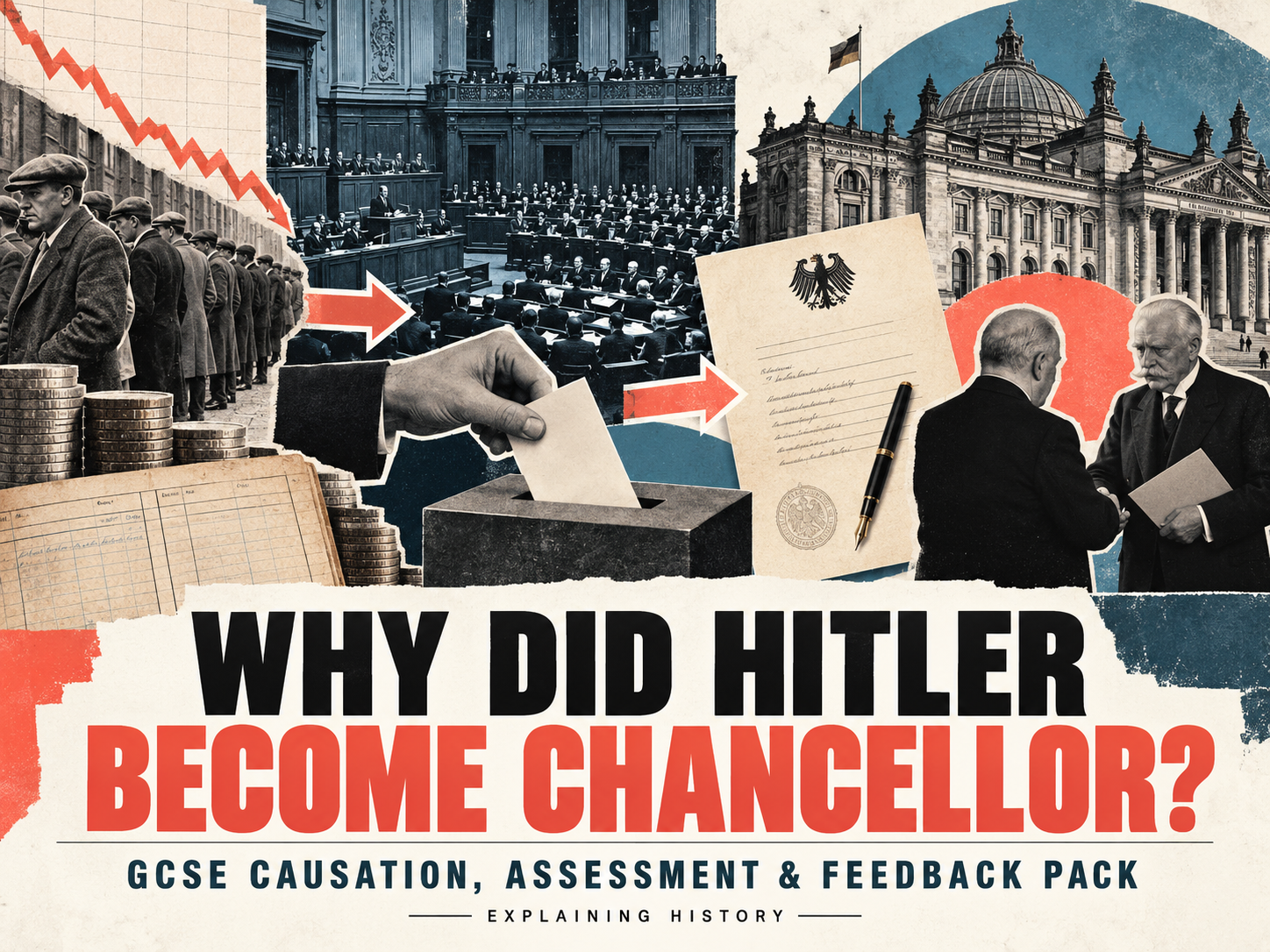

Seven stages. One connected explanation. No disconnected factor list.
Teach why Hitler became Chancellor — not the shortcut myth.
Help pupils connect economic crisis, Brüning’s policy response, parliamentary erosion, Nazi mobilisation and the January 1933 decision — without confusing election with appointment, 1923 with 1929, or Chancellor with dictator.
61 editable slides. Seven-stage journey. No pupil accounts. Built for GCSE.
One digital purchase. No subscription. A4, US Letter and structured HTML alternatives included.

The real problem
Pupils know the factors. They still cannot explain the process.
The problem is rarely another missing worksheet. It is the chain between the facts. Correcting it means rebuilding chronology, mechanisms, constitutional change, causal interaction, assessment planning and feedback.
The transformation
Diagnose. Teach. Connect. Practise. Respond. Redraft.
Diagnose the shortcuts
Baseline questions and misconception codes show exactly where explanations break down.
Teach the process
Sixty-one pupil-facing slides introduce vocabulary, model thinking and guide every numbered task.
Connect the causes
Causal chains and an interaction map replace disconnected factor lists.
Practise the right route
Select the separate AQA or Pearson Edexcel pathway rather than a generic hybrid.
Respond precisely
Answers, exemplars and misconception-led feedback show what to correct next.
Redraft with purpose
Pupils return to their first explanation and make improvement visible.
What will I still have to make?
Nothing essential.
Confirm the class examination board, remove the unused assessment route from pupil copies, choose the teaching route and make your normal adaptations. You should not have to invent the explanation, lesson sequence, causal model, assessment practice, answers, feedback system or cover work before the product becomes usable.
A coherent learning journey
Seven stages, already sequenced.
1. Diagnose
Separate 1923, 1929, election, appointment and dictatorship.
2. Crisis and policy
Connect Depression, austerity, hardship and declining confidence without automatic causation.
3. Parliamentary erosion
Explain why presidential appointment became increasingly important.
4. Mobilisation
Test the effectiveness and limits of propaganda, organisation and violence.
5. January 1933
Connect Schleicher’s failure, Papen’s proposal, Hitler’s leverage and Hindenburg’s decision.
6. Assessment
Use the separate AQA or Pearson Edexcel practice route, planners and models.
7. Redraft
Improve the explanation and distinguish appointment from the later dictatorship process.
Choose the route that fits
Use the complete journey or a focused intervention.
Seven lessons
The full route from diagnosis to purposeful redrafting.
Four lessons
Consolidation for pupils who know the content but need a connected explanation.
Three lessons
A focused assessment intervention using diagnosis, synthesis and redrafting.
Ready cover
A self-contained causal-synthesis lesson with clear stopping points and answers.
The complete value stack
Everything needed to teach, check and keep the sequence working.
Teach it
- 61-slide editable pupil-facing PowerPoint
- Editable Word student workbook
- A4 and US Letter pupil resources
- Editable teacher guide
- Foundation and further-depth pathways
Check and improve it
- Ten-question entry diagnostic
- Retrieval and exit checks
- Complete indicative answers
- Five misconception codes
- Separate AQA and Edexcel practice
- Planners, models and annotated exemplars
Keep it working
- Self-contained cover lesson
- Editable inspection-ready plan
- Structured HTML alternatives
- Sources and rights record
- Licence, support and version information
- Department implementation tools
Choose the right licence
One teacher or the whole department.
Individual educator
£19
For one purchasing teacher and the pupils they personally teach.
Includes reasonable editing, printing and authenticated-platform use for that teacher’s classes.
Department
£59
For all history teaching staff at one school site.
Adds the department briefing, deployment routes, curriculum map, exemplars, moderation routine, adoption review, procurement summary and version-control guidance.
3 teachers: £19.67 each
5 teachers: £11.80 each
8 teachers: £7.38 each
Cost-per-teacher figures are simple allocations, not promised savings. Cross-site or trust-wide use is not included.
Designed for scrutiny because it was designed for learning
The historical and educational thinking is visible.
The inspection-ready plan sets out curriculum position, prior knowledge, disciplinary purpose, sequencing, checks, inclusion, misconceptions and evidence of learning. Historical claims, numerical examples, chronology, constitutional references and answer parity have been checked. AQA and Pearson routes are kept separate.
This is an independent resource. It is not produced or endorsed by AQA, Pearson Edexcel or Ofsted and cannot guarantee a grade or inspection outcome.
Questions answered before checkout
Know exactly what you are buying.
Is this a complete Weimar and Nazi Germany course?
No. It is a substantial consolidation, causation, assessment and feedback pack focused on why Hitler became Chancellor. It assumes prior teaching of the relevant Germany course.
Is it just a collection of worksheets?
No. It connects diagnosis, historical teaching, causal synthesis, board-specific practice, feedback and redrafting.
Which examination boards does it support?
It contains separate original practice routes based on the published structures of AQA Paper 1 Section A Question 6 and Pearson Edexcel Paper 3 Section A Question 2. It is not board-endorsed.
Can I edit it?
Yes. The teaching deck, student workbook, teacher guide and inspection-ready lesson plan are editable within the purchased licence.
What support exists for different starting points?
Every lesson has a visible route and move-on check. Foundation pathways rebuild the necessary step; further-depth tasks extend the same enquiry.
Is it accessible?
The PDFs are not tagged. Complete structured HTML student and teacher alternatives are included, and reasonable accessibility modifications are permitted within the purchased licence.
Can colleagues use my Individual edition?
No. Choose the Department licence if other history teachers at the same school site may use the files.
Do pupils need an account?
No. Resources can be printed or distributed through the school’s authenticated learning platform within the licence.
What purchase support is included?
Support covers payment, download, refund, accessibility and correction issues. It does not include tutoring, essay marking, homework answers or general historical research.

