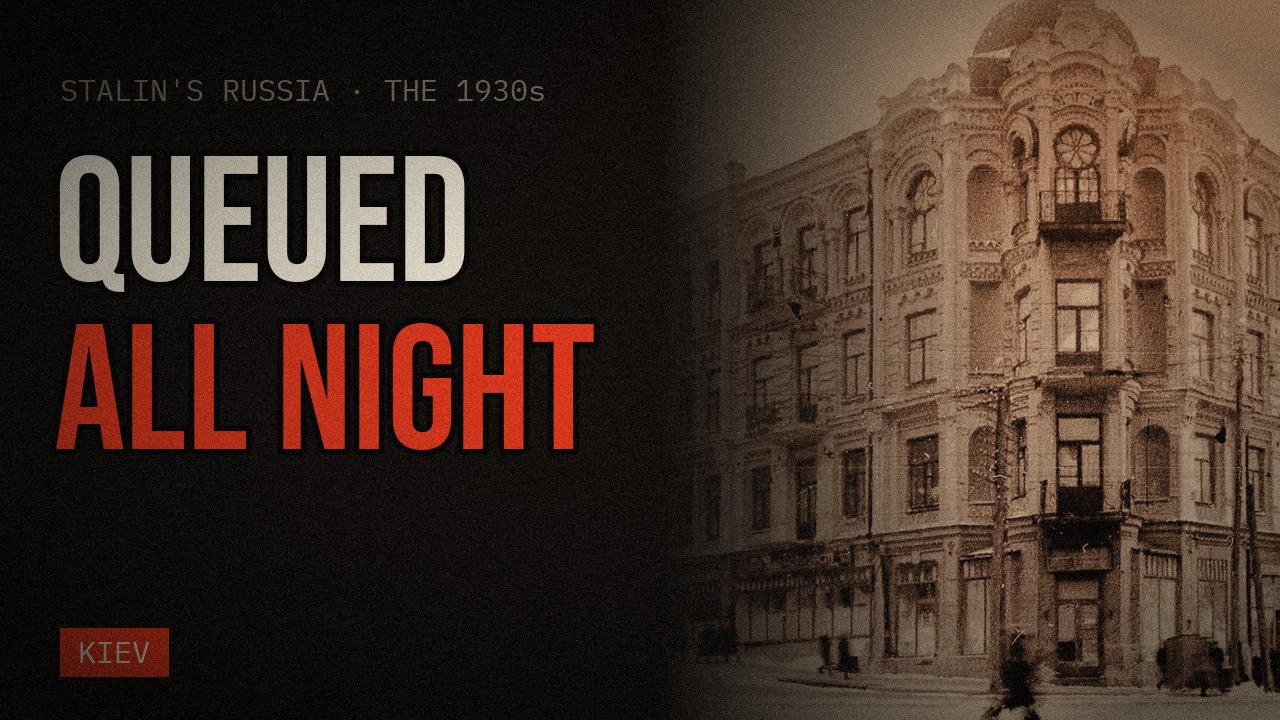


Life under Stalin in the 1930s was, for most city people, a daily struggle with shortage: queues that lasted all night, one family to a room in a shared flat, and a constant hunt for the connections that made things possible. It was also, for some, a decade of real promotion and genuine belief, and for millions it ended in the Terror of 1937 and 1938. This video and article follow Sheila Fitzpatrick’s groundbreaking book Everyday Stalinism (Oxford University Press, 1999), which used the Soviet archives opened after 1991 to look at Stalinism from the queue rather than from the top of Lenin’s tomb.
Why was there so much shortage in Stalin’s Russia?
The shortages of the 1930s were made by policy. In 1928 Stalin launched the first five-year plan, a crash programme of industrialisation that poured resources into heavy industry (what the five-year plans set out to do, and what they achieved). At the same time, forced collectivisation drove the peasantry into collective farms and wrecked food production (collectivisation and the Soviet famines, 1930–33). Private shops and craftsmen were closed down, and millions of people moved into the towns to work in the new factories: the urban population roughly doubled between the censuses of 1926 and 1939. Fitzpatrick calls her chapter on these years simply “Hard Times”.
What were the queues like?
Queuing was the basic skill of Soviet city life. In Kiev in the late 1930s, people queued all night outside clothing shops, and one citizen complained that in the morning the police let customers in a few at a time with their “arms linked … like convicts”. By the end of the decade there were queues of up to 6,000 people in Leningrad. Shoes were the worst problem of all: private shoemaking was banned in 1931, state shoes often fell apart at the first wearing, and in Iaroslavl, when the school year began in 1935, not one pair of children’s shoes could be bought. Bread rationing ended on 1 January 1935 and other food rationing later that year, but the queues did not.
How did people live? Communal flats and the “square metre”
Most city families lived one family to a room in a communal flat, sharing the kitchen, sink and toilet with strangers. According to Fitzpatrick, average living space in Moscow was 5.5 square metres per person in 1930 and just over 4 by 1940; in Krasnoiarsk in 1933 it was 3.4. Divorced couples often went on sharing a room because neither had anywhere else to go, and from December 1932 internal passports and residence permits decided who was allowed to live in the big cities at all. The building superintendent and the yardman registered residents and kept an eye on them for the police.
What was blat?
Blat meant getting things through contacts, favours and friends: Fitzpatrick translates it roughly as “pull”. Officially it was a disgrace (a 1935 Soviet dictionary called it “thieves’ jargon”), but almost everyone used it to get a room, a train ticket or a pair of shoes, alongside the illegal trade in scarce goods known as speculation. In 1940 a Novgorod citizen, Petr Gattsuk, wrote to Andrei Vyshinsky complaining that to be without blat was to have no civil rights at all. We look at blat in more detail in using blat to survive in Stalinist Russia.
Could ordinary people complain to the Soviet state?
Yes, and they did in huge numbers. Soviet citizens wrote petitions, complaints and denunciations to newspapers, officials and leaders, and the authorities often replied. The formal head of state, Mikhail Kalinin, was said to have received more than one and a half million petitions between 1923 and 1935. One Leningrad worker who had lived for five years in a corridor wrote to Molotov that a room of his own was “as necessary to me as air”. But the same system that listened to complaints also listened to denunciations.
Did anyone benefit from Stalinism?
This is the most controversial part of Fitzpatrick’s argument: Stalinism had beneficiaries as well as victims. Workers’ and peasants’ children became engineers, managers and factory directors. The Stakhanovites, record-breaking workers named after the miner Aleksei Stakhanov, who reportedly cut 102 tons of coal in a single shift on 31 August 1935, were rewarded with flats, cars and holidays. Many young people believed sincerely in building socialism. These are public voices, from speeches, memoirs and newspapers, so they tell us what people were supposed to feel as much as what they felt, but some believed completely.
How did the Great Terror reach ordinary people?
On 30 July 1937, NKVD Order No. 00447 set regional quotas for arrests and executions of “anti-Soviet elements”. By the regime’s own records, about 1.5 to 1.7 million people were arrested in 1937–38 and around 680,000 to 700,000 were shot; some historians believe the true figures were higher. For many families the Terror arrived through the same channels as everyday life: a neighbour, a denunciation, a sealed door in a block of flats. The mass operations ended in November 1938. For the wider story, see spreading Stalin’s Terror, 1937–1938, the Gulag and the Great Terror and the show trials of 1936–37.
Why did Western historians ignore everyday life for so long?
During the Cold War, the archives were closed, and the dominant “totalitarian” model pictured an all-powerful state ruling a passive population, so historians studied the leadership. From the 1970s the revisionist social historians, led by Fitzpatrick, began to argue that state and society were engaged in a kind of informal negotiation. Critics still argue that the revisionists went too easy on the regime. For a closer look at the book’s argument and its critics, read our overview of Sheila Fitzpatrick’s Everyday Stalinism.
Free Case File: sources, timeline and fact-check notes
Everything behind the video in one free four-page PDF: Fitzpatrick’s argument in brief, a timeline from the first five-year plan to the end of the Terror, every voice we quoted with its page reference, the corrections we made while checking the script, and suggestions for further reading. No sign-up needed.
More on Stalin’s Russia from Explaining History
- Sheila Fitzpatrick’s Everyday Stalinism: an overview
- Using blat, or connections, to survive in Stalinist Russia
- What were Stalin’s five-year plans? Goals, methods and results
- Stalin’s collectivisation and the Soviet famines, 1930–33
- Spreading Stalin’s Terror, 1937–1938
- Stalin’s double game: Soviet intervention in the Spanish Civil War
Leave a Reply