
In the latest episode of the Explaining History Podcast, we explore a little‑known chapter of American history: the establishment of California’s penal system as a form of coerced labour that replaced chattel slavery.
When we think of slavery in America, we think of the southern states. We think of cotton, plantations, the Civil War. We rarely think of California. But as Jean Felser argues in her book California, a Slave State, the Golden State has a far more complex and underexplored history of forced labour – a history that begins with the gold rush and continues to the present day.
The Lawless Frontier
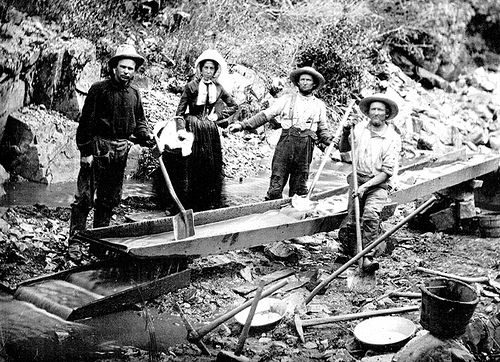
In 1849, California had no state laws and collected no taxes. During the first six years of the gold rush, 4,000 new residents were murdered in California – 1,200 of them in San Francisco alone. Meanwhile, the genocide of Native American peoples continued unabated.
With no police, no courts and no jails, vigilantes served up justice with fists, guns and ropes. Wealthy ranchers invented their own judicial codes and built their own pens to jail prisoners, compelling them to construct fences and breed cattle. Due process was inconvenient.
Under US rule, Indigenous people had lost the judicial protection of Mexican citizenship. They were now fair game. In the gold fields, white miners formed “tribunals” and rushed to punish men accused of everything from murder to stealing gold dust. It was not uncommon to hang Native people for petty pilfering.
The Hounds
White paramilitary groups like the Hounds – veterans of the US‑Mexican War – terrorised California’s minority communities. The Hounds vowed to rid California of anyone who spoke Spanish. They robbed Latino miners, burst into brothels and raped prostitutes. Witnesses saw them shear off the ears of a Black man and rip out the tongue of a Mexican man who dared to confront them.
The Hounds were eventually overthrown – not by the forces of law and order, but by wealthy merchants who viewed them as a threat to business. A Committee of Vigilance, described by one poet as “a gentleman’s lynching club”, rounded up 20 of the Hounds and threw them into the hold of a US ship. An impromptu court sentenced their leaders to 10 years in prison at hard labour.
The Birth of Penal Slavery
California’s first legislature delivered an organised system of mass punishment. Convict labour would pay for itself – and generate profit by leasing prisoners to businesses. The first convicts had to build San Quentin prison, the famous penitentiary that would later house Johnny Cash and inspire his song.
Convict labour offered legal cover wrapped in virtue to deliver an unpaid workforce to a state that would not tolerate chattel slavery. As Felser puts it, “California became a high‑density slave holder and prolific slave broker for the cities, the state and the private farms and factories.”
From the 1850s forward, legions of shackled prisoners shuffled up and down the state carving road beds, breaking granite for government buildings, paving sidewalks, laying pipes for sewers and canals – and building their own windowless prison. Merchants rented convicts from town jails and locked them at night in abandoned ships. California had become a slave trader.
The Racialisation of Crime
The California penal system was built on the assumption that certain groups of people were deficient, aggressive, and destined to a life of crime. State prisons were likely Black, Indian, Chinese, foreign and expendable. Arrested for violating the harmony and moral codes of the new towns, they were quickly charged and proven guilty by courts.
White settlers sought cooks and launderers, ranchers sought field hands and cowboys. They began to kidnap Native prisoners from local jails, legally available for forced labour under the 1850 Act for the Government and Protection of Indians. Urban gangs became efficient employment agencies, raiding jails and leasing prisoners to businessmen and ranchers.
The 13th Amendment and the Exception
The 13th Amendment abolished slavery – but with a crucial concession: “except as a punishment for crime.” That exception would move California from the periphery of a global economy towards its powerful centre. The prison as business model gave legitimacy to the marriage of human bondage and merchant capitalism.
Crime and punishment reproduced notions of white order and ethnic disorder. From 1850 to the present, California’s penal system has been an organised grid of forced labour. When an insatiable need for labour arose, prisons begat prisons in an unending and profitable system of coerced labour.
The Legacy
The system never went away. The American prison‑industrial complex extracts labour for free from captive inmates, raising huge questions about what we mean by “free societies” and the extent to which America can truly be seen as one.
The state of California, built on the backs of Native American, Black, immigrant and poor prisoners, became an economic colossus. Its penal system, rooted in the racism and violence of the gold rush, endures to this day. Understanding this history is essential to understanding the present.
If you enjoyed this piece, please consider supporting the Explaining History Podcast. We are migrating from Patreon to Substack – details in the show notes.
Transcript
Hi there and welcome again to the Explaining History podcast. Now, a few years ago I had the great pleasure to interview – we did a two‑parter interview – a brilliant historian, Jean Felser, on the history of California and the history of slavery in California. When we talk about slavery, we talk about the Civil War, we think of the southern states on the other side of the country. Rarely do we think of California, but California has a far underexplored history of slavery. And the crossover that I’m going to talk about today is that moment of the establishment of the carceral state, following the abolition of slavery, when actual chattel slavery becomes impossible, forced coerced labour is extracted from minority groups mainly, through other means.
And that’s what I want to talk about today. The issue of the carceral state in America is such a fundamental one to our sense of liberties and freedoms, and to the idea of human rights, so much touted by America and its allies, and yet the vast, vast prison population in America, made up of violent offenders and people caught by the Clinton‑era three‑strikes rules, now poses real, real challenges, I think, to America’s claims to be a land of the free. But anyway, let’s dive in. We’re going to look today at Jean Felser’s book, California, a Slave State. So it’s chapter 13, and the chapter is called “Acceptors Punishment for Crime”.
Jean writes: “In 1849, California had no state laws and collected no taxes. During the first six years of the gold rush, 4,000 new residents were murdered in California. 1,200 of them, mostly white and Latino men, were killed in San Francisco alone. And the mass Indian genocide went on.” The genocide of Native American peoples in California was one of the most comprehensive, and the gold rush is largely the cause of the mass murder of Native peoples in their lands. There are extraordinary numbers of genocide sites in California.
The Daily Alta California complained: “Without money we have no police, no organisation for preventing and extinguishing fires, no jail, no courts for proper trial and punishment of offenders. Wealthy ranchers and vigilantes serve up justice with fists, guns and ropes.”
Under US rule, Indigenous people lost the judicial protection of Mexican citizenship. Ranchers invented their own judicial codes and built their own pens on new estates to jail their own prisoners and compelled them to construct fences and breed cattle. Due process was inconvenient.
So 1849, obviously this is a year after Mexico ceded California to the United States in the Treaty of Guadalupe Hidalgo. It’s a year after gold was discovered in the 1848 gold rush, one of the most destructive moments in the history of California. And in 1849, the settlers actually write a state constitution applying for admission to the United States as a free non‑slavery state. And that meant the kind of chattel slavery that you saw in the South. But it didn’t cover the kinds of abuses that we were seeing as a kind of like a frontier society that’s just been described there. And California actually becomes a state in 1850. So where we are starting point is at the kind of this sort of intersection of acquisition by America, of statehood and this kind of capacious orgy of extraction of gold from California.
Jean writes: “Gold dust and nuggets went to banks in the East and overseas, never remaining in San Francisco to pay for a new city or found a new system of justice. There were no sheriffs, police or miners in the gold fields who were willing to protect Mexican and Chilean miners when vigilantes stole their nuggets or gold dust, smashed their tools or lynched them. Latinos knew that they were on their own.”
“When a white miner broke into the cabin of a young Mexican woman, she stabbed him to death. She was seized by a white mob that chanted, ‘Give her a fair trial and hang her.’ The mob hanged her in Downieville.”
San Francisco was crude and makeshift. The base seeped into the town with tides and flooded the streets. The drinking water was putrid. Sanitation was nonexistent. With few houses in the haphazard port city, new immigrants lived in tents and on chilly hills where ocean winds tore through the straits of the Golden Gate. For anyone that hasn’t been there, it’s quite often cold despite what one imagines about California. It’s quite a cold city. I have been there when winds come in from the bay. I can imagine what it’s like living there in a tent.
Wealthy residents had wildly prospered from Mexico’s corrupt distribution of mission lands and paid no taxes to build the state. No other large city in the United States came into being as suddenly as San Francisco, yet the city was growing. The population of San Francisco was 1,000 in January 1848 and 25,000 in December 1849. So it’s the kind of explosive growth rates that you would see in China during the 1990s. Meanwhile no one was designing a municipal government. No one knew how to adjudicate crime and punish wrongdoers.
The solution was to arrest wrongdoers and put them to work. And this is something we see time and time again through human history. The answer almost automatically is extract labour from them. When you look at the gulags before around 1924, these are just dumping grounds for political troublemakers as far as the Bolsheviks are concerned until supposedly the story goes a prisoner called Tali Frenkel saw the economic potential in mass incarceration and basically writes in the mid‑1920s to Stalin saying here’s what you could do, and the gulags transform in the 1920s and into the 1930s as sites of labour extraction.
In the summer of 1849, the Hounds, a white paramilitary group of veterans from the US‑Mexican war, swaggered into the lawless breach with the motto “we can get away with it”. After meeting in a large tent near the city hotel, they adjourned to hound Chileans out of California and steal whatever they might get from the residents of San Francisco. Wearing old uniforms scrounged up from the war, Hounds paraded around the city plaza on Sunday afternoons brandishing clubs and loaded pistols. They vowed to rid California of anyone who spoke Spanish. They robbed Latino miners, burst into brothels in the Chilean neighbourhood and raped the prostitutes. Witnesses saw the Hounds shear off the ears of a black man then rip out the tongue of a Mexican man who dared to confront them. The Hounds elbowed into taverns with revolvers raised demanding free liquor and food and seized the customers’ money and jewels. They robbed the new stores and destroyed the furniture that had been carried over land from the east.
In the summer of 1849, the Hounds demanded that the city pay them for protection against foreigners. Chilean miner Vincent Perez Rosales wrote in his diary that “the city was young, vicious and shameless.”
So it was that in 1851, over 200 white merchants, clerks and workers rose at a mass meeting in Portsmouth Square to form the San Francisco Committee of Vigilance, led by the future city councilman Sam Brannan. The members of the committee organised themselves into self‑appointed forces, special constables. Poet Stephen John Hartnett named it “a gentleman’s lynching club”. Wealthy merchants donated rifles and the committee of vigilance managed to round up 20 of the Hounds and in a grand display marched their captives to the harbour and threw the Hounds down the hatches of the US ship Warren. With no judicial system or secure prison, an impromptu court with a self‑appointed judge was called to order and sentenced the leaders of the Hounds to serve 10 years in prison at hard labour. A system of convict labour was in place.
In the gold fields, bands of white miners called themselves tribunals and rushed impromptu justice to men accused of murder, gambling debts, violations of water rights or land claims, theft of shovels and axes and worst of all stealing gold dust. It was not uncommon to hang natives for petty pilfering from tent camps. A committee of vigilance of 6,000 men held its own trials for the assaults on the Chileans. Sentences include whipping and the deportation of Irish Catholics. On the 22nd of May 1856, the San Francisco committee of vigilance lynched James P. Casey and Charles Cora on Sacramento Street.
So what we see here is a system of justice, if you can call it that, a system of order at least violently establishing itself primarily to protect property rights, which is what police systems in capitalist societies are basically there to do. They’re there to protect property rights and to stop people being such unbelievable nuisances that the workings of capitalism, the workings of capital accumulation and extraction aren’t disrupted.
The aforementioned Hounds, these former soldiers who much like the Ku Klux Klan at the end of the Civil War established themselves to kind of racially police but also just to thieve and to act like brigands. They finally get overthrown by merchants and townspeople, people who are far more established as part of the prevailing economic system and they are finally viewed as being such a nuisance that they are crushed by the rising power of a new more organized and formalized capitalism emerging in California.
California was unready for statehood. Helter skelter, the state lacked any infrastructure to finance or build rights of schools, hospitals, sewage systems. Roads were remnants of ancient Indian trails and municipal offices took over decrepit Franciscan missions. There were crimes and there were elites but there were no prisons. Led by the southern plantation owners and a motley assortment of merchants and miners, of course this is one thing that came within my conversation with Jean previously was that California is pioneered, the development of California is pioneered by former plantation owners or existing plantation owners who’ve moved westwards. Led by southern plantation owners and a motley assortment of merchants and miners, the new legislature wrestled to write a vision of white justice into law and retrofit vigilante deeds into its codes.
California began to look at unpaid convicts for a labour force to build public works projects but as yet there was no pool of prisoners. California’s first legislature delivered an organised system of mass punishment of penal slavery. Convict labour would pay for itself, it would also generate profit by leasing prisoners to new businesses. In the first contract the state offered to build a penitentiary, pay for food, guards, clothing and medical care for the prisoners and pay the profit, but the first convicts had to build San Quentin prison of Johnny Cash fame.
Convict labour offered legal cover wrapped in virtue to deliver an unpaid workforce to a state that would not tolerate slavery. And this is the supreme irony – that the kind of slavery that it wouldn’t tolerate. The kind of slavery that was the product of the very southern plantation owners that were now building the new California was a kind of agrarian slavery. It was a slavery that was in opposition to the north, a new capitalist industrial capitalism. It’s the wrong kind of slavery. The issue of slavery and abolition probably meant less to the people we’re talking about than the idea that forced labour needs to achieve different things.
Convict labour offered legal cover wrapped in virtue to deliver an unpaid workforce in a state that would not tolerate slavery. Most new towns had only one or two rudimentary cells often in the basement of the courthouse or even a school. As refined theories of confinement, retribution and criminal rehabilitation were taking hold in the east, California was building rickety jails, a wooden cabin, an iron door and a lock and sending prisoners out to build the state.
From the 1850s forward, legions of shackled prisoners shuffled up and down the state carving road beds. They broke granite boulders for government buildings, paved sidewalks, laid pipes for sewers and canals and they built their own windowless prison. By propagating the mass incarceration of Native Americans, Blacks, immigrants and poor people, the state of California became a high‑density slave holder and prolific slave broker for the cities, the state and the private farms and factories. So it’s a very attractive place to settle, to build a business because of the abundance of free labour there.
White settlers sought cooks and launderers, ranchers sought field hands and cowboys for their vast land grants. The settlers began to kidnap native prisoners from local jails, legally available for forced labour under the 1850 Act for the Government and Protection of Indians. Urban gangs such as the Los Angeles Rangers, notorious vigilantes, became efficient employment agencies. They raided the jails and then leased Native American prisoners to businessmen and ranchers who agreed to provide food and shelter and guard the convicts in cattle pens. Money for the use of these early prison labourers was handed to a warden as a bribe or it was sent to the state treasury as rent for a human being. Slavery. This is slavery.
In Stockton, Sacramento and San Francisco, merchants rented convicts from the town jails and locked them at night in abandoned ships or hulks. California had become a slave trader.
The California penal system was built on the assumption that certain groups of people were deficient, aggressive, undeveloped and destined to a life of crime. In 1850, state prisons were likely Black, Indian, Chinese, foreign and expendable. Arrested for violating the harmony and moral codes of the new towns, they were quickly charged and proven guilty by courts.
One of the key features of the parallel systems of criminal justice established in Nazi Germany – the systems designed to bypass the normative structures of law – was the idea that there was a racial element to all crime, that a person’s racial origins determined the likelihood of them having committed the crime that they were accused of and at a certain point they became more important than any or all other evidence.
Convicts helped fuel California’s breakneck growth in agriculture and manufacturing. Their involuntary labour readied an economic colossus. From virtually the moment of statehood in 1850, private businesses built financial empires by leasing or just appropriating unpaid prisoners, selling their products and subcontracting their services, while California taxpayers provided food, cells and surveillance. The prison as business model gave legitimacy to the young marriage of human bondage and merchant capitalism.
In 1851, San Francisco had grown from a Spanish fort and cow town built for the trade in cattle hides which were drenched, stenched and dried for boots and saddles. The rough‑hewn waterfront boom town was now a thriving commercial and residential hub of 34,000 people. Construction quickly drove the city into a $30,000 debt, almost $2 million today. The only place to incarcerate thieves, murderers and rapists was in the basement of the old city hall. The cheapest way to handle a prisoner was to hang him. “Away with all mock sentimentality and false mercy,” wrote the Daily Alta California in 1851. The city purchased iron to forge balls and chains for the prisoners who built San Francisco in conditions akin to slavery.
The Eighth Amendment bans cruel and unusual punishments that violate standards of decency that mark the progress of a maturing society. Did the founders anticipate the blistering pain endured by men and boys chained together, dragging iron links soldered to shackles about their ankles? Was this medieval contraption a fair punishment for crimes such as pickpocketing or petty theft? Regardless, the noisy clatter and drag of the heavy metal was another way to generate money for the impoverished state. Where did the punishment fit the crime?
Ankle chains rattled as convicts crushed granite to pave the streets of gold rush San Francisco. Shuttles screamed as prisoners stood silent, working for 12 hours at looms in a jute mill inside San Quentin prison. Sitting behind rows of industrial sewing machines at the Richard J. Donovan correctional facility in the Wiger desert, convicts clipped “Made in Honduras” labels off cotton t‑shirts as armed guards patrolled from a mezzanine overhead.
From 1850 to the present, California’s penal system has been an organised grid of forced labour. Crime paid to the state of California, private factories and the prison industry itself. When an insatiable need for labour arose in California, prisons begat prisons in an unending and profitable system of coerced labour. In cruel symmetry, crime and punishment also reproduced notions of white order and ethnic disorder. The 13th Amendment abolished slavery but contained a crucial concession: “except as a punishment for crime.” That exception would move California from the widening periphery of a global economy towards its powerful centre. Each empire that reigned over California added bricks to build a state.
On April 25, 1851, the legislature passed a law to allow private leases to run a prison system for the new state.
Okay, so I’m going to finish there, but there’s so much more to say and it has such a huge contemporary relevance. None of this ever went away. The American system runs in an entirely similar fashion and the for‑profit prison system extracts labour for free at almost zero cost from captive inmates. So it raises these huge questions about what we refer to as free societies and the extent to which America can be seen as one.
Anyway, I’ll leave you there and more on that soon. Bye bye.

Leave a Reply