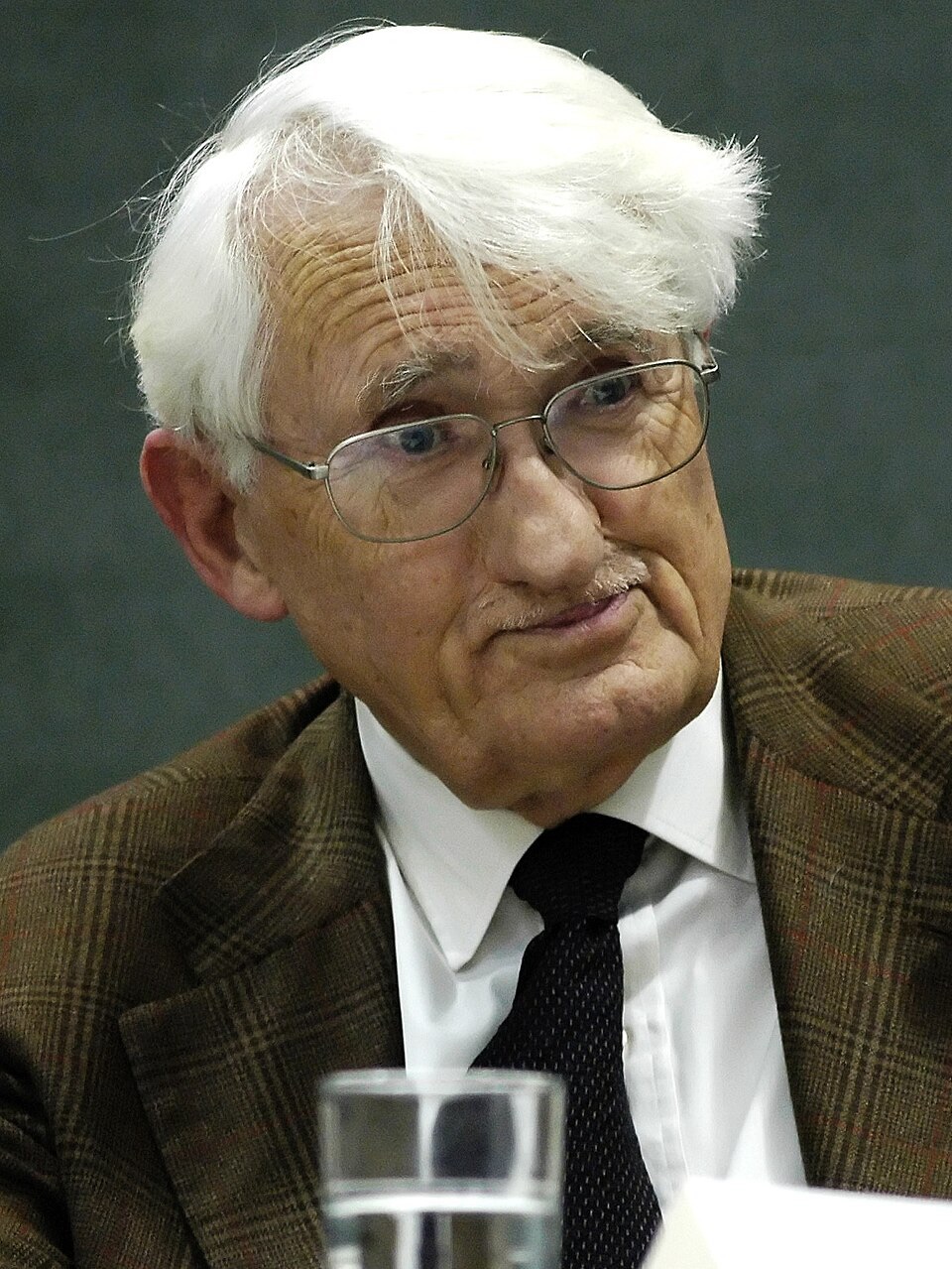

Jürgen Habermas, who died on March 14, 2026, at the age of 96, was the most significant German philosopher and social theorist of the post-war era. For more than seven decades, his work addressed a single persistent question: under what conditions can modern societies govern themselves democratically through reasoned argument rather than violence, coercion, or tradition? This obituary assesses his intellectual trajectory, major contributions, public interventions, and the critical reception that has accompanied his work throughout his long career.
Formative Years and Intellectual Context
Habermas was born in Düsseldorf on June 18, 1929, into a middle-class Protestant family. His father Ernst, a businessman and economist, joined the Nazi Party in 1933 and was what historians later termed a “passive sympathiser” with the regime. The young Habermas joined the Hitler Youth, as was mandatory, and near the war’s end avoided conscription into the Wehrmacht by hiding from military police—a fact he rarely discussed but which marked his generation’s ambiguous relationship to complicity and resistance.
A congenital cleft palate, surgically corrected in infancy and childhood, left him with a noticeable speech impediment. This personal experience of communicative difficulty may have contributed to his lifelong preoccupation with the conditions that enable and disable human understanding. He later described feeling a “distance” from others that made him attentive to the fragility of communication.
The experience of Nazism and the Holocaust defined his intellectual project. Like many Germans of his generation, he confronted the question that haunted post-war thought: how could a civilized nation produce Auschwitz? His answer, developed gradually across decades, was that democracy requires not merely institutions but a specific form of public communication—one that Nazism had systematically destroyed. The silence of his parents’ generation about the crimes committed in their name reinforced his conviction that critical public discourse was essential to preventing recurrence.
He studied philosophy, history, and psychology at Göttingen, Zurich, and Bonn, completing a doctorate in 1954 with a dissertation on the German idealist philosopher Schelling. His intellectual home became the Frankfurt Institute for Social Research, where from 1956 he worked as Theodor Adorno’s research assistant. This placed him within the “Frankfurt School” tradition of critical theory, developed in the 1920s and 1930s by Max Horkheimer, Adorno, Herbert Marcuse, and others. Critical theory combined Marx’s analysis of capitalism with Freud’s psychology and Weber’s sociology to diagnose the pathologies of modern society.
Yet Habermas’s relationship with his mentors was never comfortable. Horkheimer and Adorno, in their wartime Dialectic of Enlightenment, had argued that reason itself had become a tool of domination, transforming the Enlightenment’s promise of freedom into technological control and administrative manipulation. Their vision was profoundly pessimistic. Habermas, while sharing their concern, could not accept their conclusion. He saw in their work what he called a “performative contradiction”: they used reason to argue that reason was irredeemable, leaving no ground for critique or hope. His entire subsequent work can be understood as an attempt to rescue the rational potential of the Enlightenment from this pessimistic verdict.
The Public Sphere and Democratic Foundations
Habermas’s habilitation thesis, completed in Marburg in 1961 and published as The Structural Transformation of the Public Sphere (1962), established his distinctive approach. The book reconstructed the historical emergence of a “bourgeois public sphere” in eighteenth-century Europe. In coffee houses, salons, and literary societies, private individuals gathered to debate matters of public concern, subjecting state authority to rational criticism. This sphere was not a place but a practice: reasoned debate among participants bracketing social status, oriented toward consensus rather than strategic advantage.
The public sphere, Habermas argued, mediated between civil society and the state. It transformed subjects into citizens by creating a space where public opinion could form through rational-critical debate. This was not democracy in its fully developed form—the public sphere was bourgeois, male, and excluded propertyless workers and women—but it contained a normative ideal that could be extended and radicalized.
The book then traced this sphere’s decline in the twentieth century. Mass media, corporate power, and the interventionist welfare state transformed the public from active participants into passive consumers. Public debate became managed display, with organized interests presenting pre-packaged positions rather than engaging in genuine deliberation. Habermas called this process “refeudalization”: a return to the pre-modern condition where public representation replaces public debate.
The book resonated powerfully with post-war Germany’s effort to build stable democratic institutions. It offered both a historical account of democracy’s origins and a diagnosis of its contemporary crisis. Young Germans seeking to understand how democracy could fail and how it might be rebuilt found in Habermas a framework that was historically grounded and normatively ambitious.
Constructing Communicative Reason
Throughout the 1960s and 1970s, Habermas engaged in extended debates with positivism, systems theory, and hermeneutics. He defended the distinctive character of critical theory against those who would reduce social inquiry to either empirical science or interpretive understanding. This period produced a series of methodological works, including On the Logic of the Social Sciences (1967) and Knowledge and Human Interests (1968), which argued that knowledge is always guided by underlying interests: technical control, practical understanding, or emancipation.
His magnum opus, the two-volume Theory of Communicative Action (1981), synthesized these insights into a comprehensive social theory. Habermas distinguished two fundamental forms of action that correspond to different dimensions of social life.
Instrumental action concerns manipulating the objective world to achieve goals. It follows technical rules and strategic calculation. This is the logic of work, technology, and what Habermas called “systems”—most importantly, the market economy and state bureaucracy. Systems coordinate action through impersonal media: money and power. They operate independently of participants’ conscious intentions, following their own logic.
Communicative action concerns reaching understanding with others. It operates in the “lifeworld”—the shared background of cultural meanings, social norms, and personal identities that makes mutual understanding possible. When we engage in communicative action, we raise implicit validity claims: that our statements are true (corresponding to facts), right (appropriate to normative contexts), and sincere (expressing genuine intentions). Successful communication depends on these claims being accepted, at least provisionally.
Modern societies, Habermas argued, are characterized by increasing rationalization in both spheres. Scientific progress, economic development, and bureaucratic administration all represent advances in instrumental rationality. Cultural modernization and the extension of rights represent advances in communicative rationality. The problem is not rationalization as such but imbalance between the spheres.
Pathology arises when system logic “colonizes” the lifeworld—when money and power replace understanding as the medium of social integration. A family governed by market calculation ceases to be a family. A citizen treated as a consumer of state services ceases to be a citizen. Social movements, from feminism to environmentalism to regional autonomy movements, can be understood as resistance to this colonization: attempts to defend ways of life against bureaucratic and market imperatives.
This framework gave Habermas a way to diagnose contemporary social conflicts without reducing them to class struggle or irrational backlash. It also preserved the critical impulse of Marxism while abandoning its economic determinism and revolutionary teleology.
Discourse Ethics and Democratic Theory
From communicative action, Habermas derived a distinctive moral theory. “Discourse ethics” holds that moral norms are valid only if they could command the assent of all affected parties in a practical discourse. This is not a substantive moral principle but a procedural one: it specifies how moral questions should be decided, not what the decisions should be.
Any attempt to reach understanding through argument, Habermas argued, implicitly presupposes an “ideal speech situation.” Participants must be free from coercion, have equal opportunity to speak, and be oriented only toward the better argument. This is not a description of actual communication—actual discourse always involves power, deception, and distortion. But it is a critical standard implicit in the very practice of argumentation. When we argue, we assume that consensus could, under ideal conditions, be reached.
This translates into a theory of democracy. Legitimate law is not whatever a majority happens to want, but what free and equal citizens could agree to under fair conditions of deliberation. Democratic procedures are institutionalized forms of communicative action. They transform the informal opinions formed in civil society into formally binding decisions.
His 1992 Between Facts and Norms developed this into a comprehensive legal and political theory. Modern complex societies cannot be governed by direct democratic assembly. But they can be governed by law that emerges from properly structured public deliberation. Habermas proposed a “two-track” model: informal opinion-formation in civil society and the public sphere, and formal will-formation in parliamentary institutions. The two tracks are linked through elections and public debate, with civil society feeding concerns into the political system and the political system remaining responsive to public discourse.
This model rejected both liberal minimalism (democracy as mere aggregation of preferences) and republican communitarianism (democracy as expression of a unified popular will). It sought to preserve the normative ambition of democracy while acknowledging the realities of complex, pluralistic societies.
Public Intellectual Interventions
Habermas was never merely an academic philosopher. Throughout his career, he intervened in German and European political debates with unusual frequency and intellectual rigor. These interventions were not occasional comments but sustained engagements that shaped public discourse.
His most famous intervention came during the 1986 Historikerstreit (historians’ dispute). Conservative historians, most prominently Ernst Nolte, sought to relativize the Holocaust. Nolte argued that the Holocaust was not unique but comparable to other twentieth-century atrocities, particularly StalinStalin Joseph Vissarionovich Stalin (18 December 1878 – 5 March 1953) was a Soviet politician, dictator and revolutionary who led the Soviet Union from 1924 until his death in 1953. Read More’s crimes, and could be understood as a defensive reaction to the Bolshevik threat. This was an attempt to normalize German national identity by placing Nazi crimes in a broader context of European violence.
Habermas responded with a blistering newspaper article arguing that such attempts aimed to restore a conventional national identity unburdened by guilt. He proposed instead “constitutional patriotism” (Verfassungspatriotismus): allegiance not to ethnic nationhood but to universalist democratic principles embodied in the Basic Law. Post-war German identity, he insisted, must be based on conscious commitment to democracy, not suppressed memory. The dispute established Germany’s distinctive “culture of remembrance” (Erinnerungskultur) and shaped public discussion of national identity for decades.
He became a leading advocate of European integration, arguing that only a federal Europe could tame globalized capitalism and preserve social solidarity beyond the nation-state. In a series of essays and interviews, he defended the European project against both nationalist opposition and technocratic reduction. European integration, he argued, was the “lesson” of war and totalitarianism: a way to overcome the nationalism that had produced catastrophe.
He supported Emmanuel Macron in 2017 as the only candidate with genuine European vision. He criticized the Iraq War in 2003 as a violation of international law. He engaged with the student movement of 1968, supporting its democratic aspirations while criticizing its anti-democratic fringes.
His interventions continued into his nineties. In 2022, he criticized Germany’s response to Russia’s invasion of Ukraine, urging caution and negotiation. The Ukrainian ambassador called him “a disgrace for German philosophy,” a remark that itself generated debate about the limits of pacifism and the responsibilities of intellectuals during war. In 2023, he defended Israel’s right to respond militarily to Hamas’s October 7 attacks, describing the violence as “extreme brutality” and drawing criticism from those who saw this as inconsistent with his commitment to negotiated resolution of conflict.
His final book, A New Structural Transformation of the Public Sphere (2025), returned to his earliest concerns. Digital communication, he argued, has fragmented public discourse into echo chambers, undermining the shared communicative space democracy requires. Social media platforms do not create a public sphere but destroy it, replacing reasoned debate with affective polarization and algorithmic manipulation. The diagnosis was pessimistic, but it reflected his enduring conviction that the public sphere remains the essential condition for democratic life.
Critical Perspectives
Any serious assessment must acknowledge substantial critiques of Habermas’s work that have accumulated over decades.
From within critical theory, some argue his “linguistic turn” abandoned the earlier Frankfurt School’s focus on material domination and economic structure. By privileging consensus and mutual understanding, he may underestimate irreconcilable social antagonisms. Class conflict, racial hierarchy, and gender oppression are not resolvable through better argument alone—they are built into the structure of society and require structural transformation, not just improved communication.
From feminist theory, Nancy Fraser and others argue that Habermas’s public sphere model historically excluded women and theoretically obscures power within the private sphere. His distinction between system and lifeworld can render family power relations invisible, treating the family as a sphere of communicative action while ignoring the gender inequalities structured into it. The public sphere he celebrates was constituted through the exclusion of women and their relegation to the private realm.
From poststructuralism, Michel Foucault and Jean-François Lyotard rejected Habermas’s universalism. The search for rational consensus, they argued, imposes a homogenizing framework on radical difference. What counts as a “better argument” is always determined within specific power relations. Consensus can itself be a form of domination, silencing those whose experience cannot be expressed within dominant frameworks.
From political theory, Raymond Plant argued in 1982 that Habermas’s solution to legitimation crisis—rational consensus on values—is unworkable. While rational discussion about values is possible and necessary, demanding ultimate agreement exceeds what moral argument can deliver. Modern societies are characterized by reasonable pluralism: people can disagree about fundamental values while remaining committed to democratic procedures. Habermas’s demand for consensus may be too demanding.
From practice, critics note the gap between Habermas’s deliberative ideals and actual political functioning. His model may better describe how academics argue in seminars than how mass democracies operate, where interest, emotion, and strategic calculation are ineradicable. Actual democratic politics involves bargaining, compromise, and aggregation of interests, not just reasoned consensus.
Some critics also note the paradox of Habermas’s public role. He defended the public sphere while intervening in it with unusual authority, speaking as the voice of reason against irrationality. His interventions often carried the implicit claim that he, unlike his opponents, occupied the position of undistorted communication. This created tension between his theory’s procedural humility and his practice’s substantive ambition.
Assessment and Legacy
These critiques have force. Yet Habermas’s achievement remains extraordinary. He constructed the most ambitious systematic social theory since the mid-twentieth century, integrating philosophy, sociology, law, and political theory into a coherent framework addressing modernity’s central problems.
His concepts have become indispensable analytical tools across humanities and social sciences. “Public sphere” now appears in thousands of studies across disciplines. “Communicative action” informs research in sociology, communication studies, and organization theory. “Constitutional patriotism” shapes debates about citizenship and identity. “Deliberative democracy” has generated an entire research program in political theory and empirical political science.
More importantly, he posed the right questions. Can complex modern societies govern themselves democratically without shared religion or tradition? Can reason replace violence as the basis for social order? These questions were urgent in post-war Germany, confronting Nazism’s aftermath. They remain urgent in contemporary societies facing polarization, digital fragmentation, and resurgent authoritarianism.
His answer was fundamentally hopeful: yes, but only under conditions we must deliberately create and defend. Democracy requires institutional design and cultural practice—spaces where citizens encounter each other as equals, argue about common affairs, and make decisions accountable to public reason. These conditions are fragile, constantly threatened, and worth defending.
His final years brought pessimism. He saw his intellectual and political legacy threatened by resurgent nationalism, militarism, and the far-right Alternative für Deutschland. Digital fragmentation, he believed, was undermining the communicative infrastructure democracy requires. The European project he championed appeared stalled. The constitutional patriotism he advocated faced challenge from revived ethnic nationalism.
.

Leave a Reply