
In 1928, the Soviet Union faced a choice. It could continue with the New Economic Policy (NEP), using market mechanisms to encourage peasants to grow grain, or it could return to the methods of the Civil War: force, requisitioning, and terror.
StalinStalin Joseph Vissarionovich Stalin (18 December 1878 – 5 March 1953) was a Soviet politician, dictator and revolutionary who led the Soviet Union from 1924 until his death in 1953. Read More chose the latter. In this week’s podcast, I continued my exploration of Robert Conquest’s The Harvest of Sorrow, focusing on the pivotal moment when the Soviet leadership decided to declare war on the countryside.
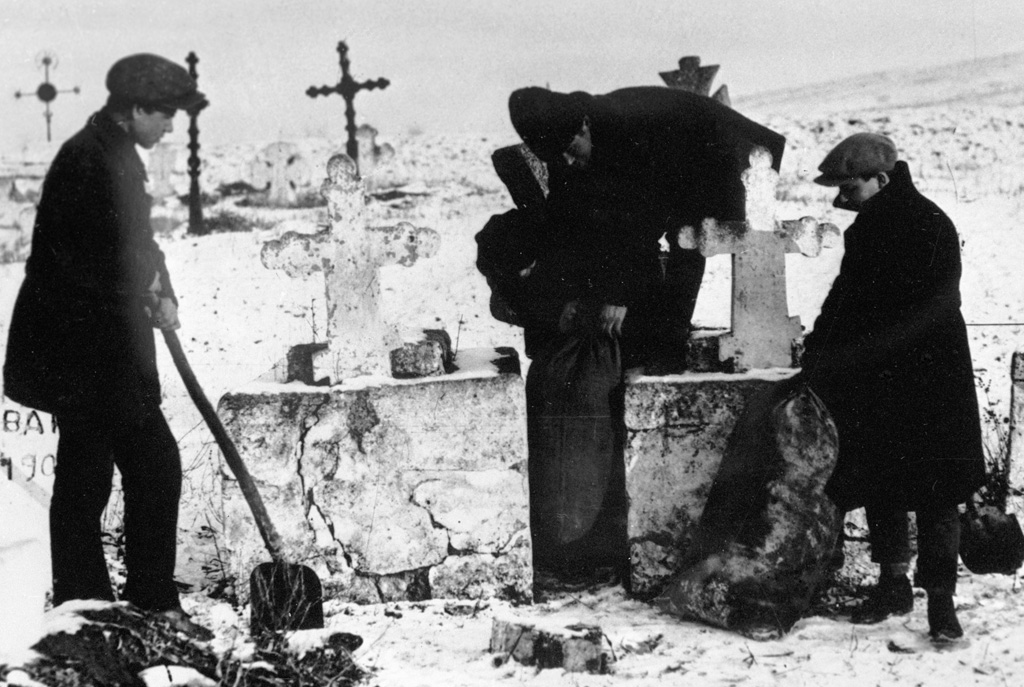
Image Attribution: RIA Novosti archive, image #79113 / Alpert / CC-BY-SA 3.0
The Emergency Measures
In January 1928, facing a shortfall in grain procurement, the Politburo voted for “extraordinary measures.” These were sold to the party as a limited, temporary strike against “kulak” hoarders. In reality, they became a mass confiscation of grain from the peasantry as a whole.
This decision was fatal. As Conquest notes, by seizing grain that had been produced for profit under the NEP, the state shattered the trust of the producers. Peasants realized that the market was no longer safe; if they grew a surplus, the state would simply take it. The rational response was to stop producing surplus.
The Spiral of Violence
The regime, blinded by ideology and bad data, interpreted this drop in production not as a rational economic response, but as sabotage. Stalin sent 30,000 activists into the villages to purge local party organizations and close grain markets. The “emergency troikas” overruled local authorities, imposing quotas that were impossible to meet.
Because the mythical “kulak hoards” didn’t exist, officials had to take grain from the middle and poor peasants to meet their targets. This alienated the very class—the poor peasants—that the Bolsheviks claimed to represent.
The “Tribute”
Perhaps the most chilling aspect of this period is Stalin’s own justification. In a speech of “breathtaking frankness” to the Central Committee in July 1928, he admitted that the peasantry was being exploited. He called it a “tribute”—a super-tax levied on the countryside to pay for rapid industrialization.
He argued that the peasants could bear this burden because their standard of living was rising (a lie) and because a socialist state couldn’t possibly be exploitative by definition (a delusion). In reality, the “tribute” was a death sentence. It stripped the countryside of the capital and food it needed to survive, leading directly to the famine of 1932-33.
The Lesson of 1928
The tragedy of 1928 is the tragedy of a state that believed it could override basic economic laws with political will. By destroying the market mechanism, the Bolsheviks didn’t solve the grain crisis; they institutionalized it. They created a system where food production was a battle, and the farmer was the enemy.
Student Announcement:
If you are studying this period, don’t miss our Russian Revolution Masterclass on Sunday, January 25th. We will go deep into how to structure essays on Stalinism, collectivization, and the terror.
Transcript
Nick: Welcome again to the Explaining History podcast.
First, a bit of feedback required—I’m using a new microphone today, so let me know if the sound quality is better!
Before we get into our core topic, a key announcement: our Russian Revolution and Stalinism Masterclass is on Sunday, January 25th at 3pm UK time. This is for students who want to learn top-grade essay structure, master exam mindset, and understand what the examiner is looking for. We’ll be packing all my game-changing ideas into 90 minutes. There are only 100 places, so get your ticket via the link in the show notes to avoid disappointment.
In the last couple of days, I’ve talked a lot about the shocking events in Venezuela, and I’ll return to that geopolitical picture soon. But today, we’re bringing it back to history, looking at the lead-up to the Soviet famine.
We are looking again at Robert Conquest’s The Harvest of Sorrow. Last time, we discussed the poor data that led Stalin to believe there were grain shortages caused by hoarding. This had disastrous consequences because Stalin assumed the grain was there, just hidden.
Conquest writes:
“In January 1928 came what the American scholar Stephen F. Cohen rightly called the ‘pivotal event’. Faced with a grain shortage, the Politburo voted unanimously for ‘extraordinary measures’. The Rightists saw these as a limited expropriation of Kulak grain… but it developed into a mass confiscation from the peasantry as a whole.”
Even though these measures were meant to be temporary, the decision was fatal. By seizing grain that had been produced for profit under the New Economic Policy (NEP), the party destroyed the economic incentive to produce. It demonstrated that market conditions could not be relied upon.
At the same time, the success in confiscating grain gave the party the false idea that force was a simple solution. It taught them that if you requisition once, you can do it again. But this is simply cannibalizing the food system.
The methods employed reminded peasants of War Communism. 30,000 activists were sent to the villages. Emergency “troikas” overruled local authorities. Grain markets were closed. Stalin’s policy of attacking the Kulak was close to the extreme variants of the Left Opposition’s program.
War Communism (1918-1921) had involved mass expropriation to feed the Red Army, leading to famine and hatred of the Bolsheviks. Now, in 1928, the regime was returning to those methods.
The attack on the “middle peasant” was significant. A law in January 1928 changed the rules for village communes so that a minority of poor peasants could bind the rest. This was the end of the commune’s independence. The state was empowering poor peasants to discipline the middling sorts, based on the fantasy that the middle peasants were capitalists.
Conquest notes:
“Though Ukraine, the North Caucasus and the Volga were singled out… Siberia was the main target. Stalin personally went there… He denounced local officials for incompetence bordering on sabotage.”
Stalin claimed that Kulaks were hoarding huge reserves—50,000 to 60,000 poods per farm. This was pure guesswork. Since Kulaks didn’t actually have these surpluses, officials had no choice but to seize grain from the middle and poor peasants to meet quotas.
In a letter to party organizations, Stalin admitted that the Kulak was not the major source of grain but was to be combated as the “economic leader” of the peasantry. He viewed the wealthier peasants as an enemy class capable of organizing against the party.
In April and May 1928, despite the emergency measures, there was still a shortfall. Stalin admitted with “breathtaking frankness” that the regime had fallen into “administrative arbitrariness” and illegal searches. The major legal weapon was Article 107, originally intended for speculators, now used against peasants.
In July 1928, it was revealed that in typical districts, Article 107 was being used against poor and middle peasants far more than Kulaks. Why? Because the poor peasants knew that these measures would eventually be used against them too. They didn’t support the government’s crackdown.
Stalin then articulated his theory of the “tribute.” He argued that the peasantry had to pay a “super-tax”—overpaying for manufactured goods and underpaid for grain—to fund industrialization. He claimed this was temporary and acceptable because under the Soviet system, exploitation was “out of the question.” This was flim-flam. He knew exactly what he was doing.
The result was that peasants stopped producing. By autumn 1928, grain and livestock production began to decline. Grain production per capita fell significantly. The government had destroyed the market mechanism, but the “success” of forced requisitioning blinded them to the reality: it wasn’t hoarding that was the problem, but low production caused by their own policies.
I’ll leave you there. Remember, if you are studying this topic, join our masterclass on Sunday, January 25th. And if you want to listen ad-free, join us on Patreon.
Thanks very much, and catch you on the next Explaining History podcast. Bye.

Leave a Reply