
The post-war era in the West is often viewed through a lens of nostalgia. It was a time of unprecedented growth, rising living standards, and the expansion of the middle class. But this “Golden Age” rested on a single, precarious foundation: cheap oil.
In this week’s podcast, I explored how that foundation crumbled in the 1970s, paving the way for the neoliberal revolution that followed. Drawing on Gary Gerstle’s The Rise and Fall of the Neoliberal Order, we looked at the pivotal moment when the flow of cheap energy stopped.
The Commodity Trap
Between 1948 and 1972, global oil production quintupled. This glut of energy fueled everything from the Marshall Plan to the American suburban dream. But by the early 70s, the balance of power had shifted. The formation of OPEC (Organization of the Petroleum Exporting Countries) signaled that the nations controlling these resources were no longer content to let Western companies dictate terms.
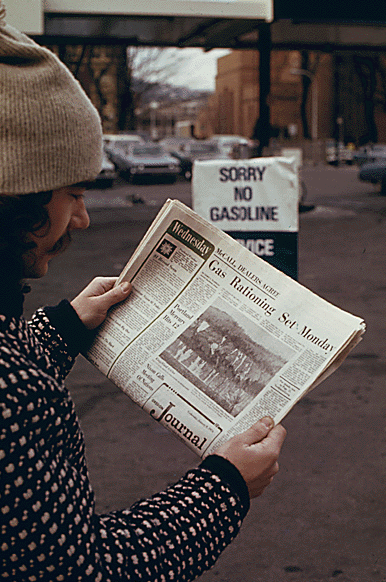
The trigger was the Yom Kippur War of 1973. When the US resupplied Israel with weapons, Arab nations retaliated with an oil embargo. The price of crude quadrupled overnight. For the first time in the petroleum age, Americans faced gas shortages. The psychological shock was immense; the economic shock was fatal to the New DealThe New Deal Full Description:A comprehensive series of programs, public work projects, financial reforms, and regulations enacted by President Franklin D. Roosevelt. It represented a fundamental shift in the US government’s philosophy, moving from a passive observer to an active manager of the economy and social welfare. The New Deal was a response to the failure of the free market to self-correct. It created the modern welfare state through the “3 Rs”: Relief for the unemployed and poor, Recovery of the economy to normal levels, and Reform of the financial system to prevent a repeat depression. It introduced social security, labor rights, and massive infrastructure projects.
Critical Perspective:From a critical historical standpoint, the New Deal was not a socialist revolution, but a project to save capitalism from itself. By providing a safety net and creating jobs, the state successfully defused the revolutionary potential of the starving working class. It acknowledged that capitalism could not survive without state intervention to mitigate its inherent brutality and instability.
Read more order.
The Collapse of the Auto Industry
Nowhere was this felt more acutely than in Detroit. The American auto industry had bet everything on the idea that gas would always be cheap. They built massive, inefficient cars that were symbols of American virility and excess.
When prices spiked, consumers didn’t just stop buying cars; they changed what they bought. They turned to fuel-efficient Japanese imports. By 1980, Japan had cornered 25% of the US market, and American car production had collapsed to levels not seen since the 1930s. This wasn’t just an industrial crisis; it was an identity crisis. The American worker, the backbone of the middle class, was suddenly vulnerable.
The Neoliberal Opportunity
The crisis of the 1970s—stagflationStagflation Full Description:A portmanteau of “stagnation” and “inflation,” describing a period of high unemployment coupled with rising prices. This economic crisis in the industrialized West shattered faith in the post-war order and provided the “window of opportunity” for neoliberalism to ascend. Stagflation was the crisis that Keynesian economics could not explain or fix. Triggered in part by oil shocks, it created a situation where traditional state spending only fueled inflation without creating jobs. This failure paralyzed the political left and allowed the neoliberal right to step in with radical new solutions focused on breaking unions and shrinking the money supply. Critical Perspective:Naomi Klein and other critics view this moment as the first major application of the “Shock Doctrine.” The crisis was used to justify painful structural reforms—such as crushing labor power and slashing social spending—that would have been politically impossible during times of stability., unemployment, and industrial unrest—created an opening for a new political ideology. Figures like Ronald Reagan and Margaret Thatcher argued that the problem wasn’t a geopolitical shock, but the structure of the economy itself: big government, strong unions, and excessive regulation.
As I argued in the podcast, the 1970s were actually a time of peak equality in Britain and the US. But the chaos caused by inflation allowed the right to frame social democracy as a failure. They offered a solution: crush the unions, deregulate finance, and unleash the market.
We are still living with the consequences of that shift. The hollowing out of the industrial base, the stagnation of wages, and the rise of inequality can all be traced back to the moment the pumps ran dry in 1973.
Transcript
Nick: Welcome again to the Explaining History podcast. We have an exciting week ahead. On Wednesday, my good friend Dr. Rachel Morris will be joining us to talk about austerity—a policy that has devastated Great Britain for the past 16 years.
Today, however, I want to talk about oil, specifically oil prices, and how they shape macroeconomic currents.
People often talk about the 1970s in Britain and America as a living hell. Proponents of what came after—Thatcher and Reagan—say, “You don’t remember the 70s; it was awful.” I was born in the 70s, so my memories are distinct. But if you look at the data, the 1970s were actually a golden age of social democracy. By 1975, income inequality in Britain was at its lowest. House building was robust, and living standards grew.
What destabilized this decade were two energy shocks: one in 1973 and one in 1979. These shocks, combined with the “Nixon Shock” of 1971 (taking the dollar off the gold standardGold Standard Full Description:The Gold Standard was the prevailing international financial architecture prior to the crisis. It required nations to hold gold reserves equivalent to the currency in circulation. While intended to provide stability and trust in trade, it acted as a “golden fetter” during the downturn. Critical Perspective:By tying the hands of policymakers, the Gold Standard turned a recession into a depression. It forced governments to implement austerity measures—cutting spending and raising interest rates—to protect their gold reserves, rather than helping the unemployed. It prioritized the assets of the wealthy creditors over the livelihoods of the working class, transmitting economic shockwaves globally as nations simultaneously contracted their money supplies.), fueled inflation and unrest.
The political right in America focused less on trade unions and more on a “culture war” against the gains of the 1960s—civil rights, women’s rights, and the counterculture. In Britain, the enemy was the trade union movement. Margaret Thatcher’s primary achievement, as David Edgerton notes, was the destruction of the British left.
Today, we are looking at Gary Gerstle’s The Rise and Fall of the Neoliberal Order. He writes that cheap energy underwrote the New Deal economic order. The flow of cheap oil fueled the recovery of the West and Japan after WWII. In fact, cheap energy was what made WWII winnable for the Allies.
By the 1970s, the US—once the world’s largest oil producer—was importing 35% of its oil. Europe and Japan were almost totally dependent on imports. The formation of OPEC in 1960 signaled that producing nations wanted to control their own resources.
The trigger for the 1973 crisis was the Yom Kippur War. When the US resupplied Israel to prevent its defeat by Soviet-backed Arab armies, Saudi Arabia cut off the oil.
King Faisal of Saudi Arabia essentially told the US to sit this one out. But Nixon viewed it through a Cold War lens: a victory for Soviet client states like Syria and Egypt would be catastrophic for US power. So, the US supported Israel, and the oil stopped flowing.
For the first time, Americans faced gas shortages. The price of oil quadrupled. The Dow Jones lost 40% of its value. When the oil started flowing again in 1974, it was on OPEC’s terms. This represented the greatest non-violent transfer of wealth in human history.
This disrupted the American way of life, which was built on the assumption that cheap oil would last forever. Suburbia, with its sprawling commutes and gas-guzzling cars, relied on cheap gasoline. When that disappeared, the “suburban dream” went into crisis.
The crisis hit the US auto industry hard. In 1980, domestic car production plunged to its lowest level since the 1930s. Chrysler required a massive government bailout. Consumers shifted to fuel-efficient Japanese cars. By 1980, Japan had cornered 25% of the US market. The era of unassailable US industrial dominance had ended.
This created the conditions for the neoliberal revolution. The crisis of the 70s—stagflation and industrial decline—allowed ideologues to argue that the real problem was big government, high taxes, and unions. They used the crisis to dismantle the New Deal order.
The middle class created by the New Deal—the skilled worker with a house, a car, and a pension—began to see their living standards deteriorate. The de-industrialization of the 80s and 90s accelerated this trend.
Commodity prices have huge geopolitical effects. The oil shock created a crisis that neoliberals had been waiting for, allowing them to argue that the solution was to unshackle capital.
That’s our start to the week. Stay with us for the interview with Rachel on Wednesday. Take care, everyone. Bye-bye.

Leave a Reply