
Introduction: The Guardian’s Betrayal
In the annals of institutional collapse, few are as stark and consequential as the metamorphosis of the Yugoslav People’s Army—the Jugoslovenska Narodna Armija (JNA). For 45 years, it stood as the ultimate guardian of the socialist federation and the “Brotherhood and Unity” of its peoples. Funded collectively by all six republics, staffed by a conscripted and professional corps drawn from every nationality, and celebrated as the fourth-largest military in Europe, the JNA was more than an army; it was the central pillar of the Yugoslav state and the ultimate symbol of its sovereignty. Its doctrine was one of “Total National Defense,” a decentralized, partisan-style strategy designed to defend every inch of Yugoslav territory from external aggression, particularly from the Warsaw Pact.
Yet, between 1990 and 1992, this formidable institution did not merely fracture under the stress of political disintegration. It underwent a systematic, deliberate, and decisive capture by a single nationalist project, transforming from the army of all Yugoslavs into the primary military instrument of Slobodan Milošević’s Serbia and the Bosnian Serbs. This transformation was not a passive symptom of the state’s collapse but an active catalyst for war. The JNA’s unraveling is the critical military-political narrative that explains how a political crisis escalated into a full-blown war of territorial conquest. This essay charts that unraveling, arguing that the JNA’s fate was sealed by a confluence of ideological purges, ethnic polarization from within, and a calculated political strategy in Belgrade that repurposed federal assets for nationalist ends. In its fall, it provided the weapons, the officers, and the organizational backbone for the wars in Croatia and Bosnia, making it the single most important military factor in the violent dissolution of Yugoslavia.
Foundations and Fault Lines: The JNA in Tito’s Yugoslavia
To understand its collapse, one must first appreciate the JNA’s unique and paradox-laden position in the socialist system. Created from the Partisan victory in World War II, it was the child of the Communist Party (the League of Communists of Yugoslavia, or SKJ). Its officer corps was deeply political, indoctrinated to protect the socialist order and the territorial integrity of the federation. The principle of “brotherhood and unity” was drilled into recruits, and ethnic balance was a conscious policy: the officer corps and the conscript base were carefully mixed, and commands were often given in Serbo-Croatian with a “military dialect” to avoid regional linguistic favoritism.
However, inherent fault lines lay beneath this unified surface.
- Structural Tension with Territorial Defense (TO): Alongside the JNA existed the Territorial Defense (Teritorijalna odbrana), a separate, republic-based militia network established as part of the “Total National Defense” doctrine. The TO was controlled by republican leaderships, not the federal army. This created a dormant dual-power structure that would prove explosive once republics began seceding.
- Demographic Disparity: Despite quotas, Serbs and Montenegrins were historically overrepresented in the professional officer corps. This was partly a legacy of the Partisan struggle (which had strong Serb and Montenegrin participation) and partly a self-perpetuating tradition. By the 1980s, Serbs constituted over 60% of the generals and a majority of key command positions, fostering a perception, real or imagined, of the JNA as a “Serb” institution.
- The Crisis of Ideology: As the SKJ’s authority disintegrated along republican lines in the late 1980s, the JNA’s guiding political compass shattered. The army’s High Command viewed multi-party democracy and rising nationalism as existential threats to the state they were sworn to protect. Their instinct was to intervene as a praetorian guard, but they increasingly lacked a clear political master beyond a disintegrating federal presidency.
The Purge and the Political Turn (1987-1991)
The ascent of Slobodan Milošević in Serbia proved the watershed. Milošević did not initially seek to destroy the JNA but to control it. His weapon was the “anti-bureaucratic revolution” and a relentless campaign against the JNA’s leadership for failing to protect Serbs in Kosovo. Simultaneously, he cultivated allies within the upper echelons of the army, particularly among senior Serbian and Montenegrin officers who shared his centralist vision of Yugoslavia and his suspicion of secessionism.
The pivotal mechanism of capture was the “Follow-Up” Purge.
· In September 1987, the JNA’s highest-ranking Croat, Admiral Branko Mamula, was replaced as Federal Secretary for People’s Defense by General Veljko Kadijević, a Serb from Croatia whose loyalty to the federation was increasingly interpreted as alignment with a Serbia-dominated federation.
· Over the next three years, a quiet but systematic removal of non-Serb and politically unreliable officers accelerated. Slovene and Albanian officers were the first targets, followed by Croats and Bosniaks deemed sympathetic to republican autonomy. Promotions were skewed. The political officer network, once the enforcer of party unity, was retooled to enforce a new, Serbian-inflected Yugoslav patriotism. As scholar James Gow notes in Legitimacy and the Military: The Yugoslav Crisis, the JNA’s leadership “ceased to be Yugoslav in any meaningful sense and became an extension of the Serbian political leadership.”
This internal coup was ideological as much as ethnic. The JNA High Command, led by Kadijević and his hardline Chief of Staff, General Blagoje Adžić, became the last true believers in a unitary, socialist Yugoslavia—a vision that, by 1990, only Milošević’s Serbia publicly endorsed. In this tragic irony, the JNA’s devotion to preserving Yugoslavia led it into a de facto alliance with the leader whose actions were doing the most to destroy it.
The Test of Secession: Slovenia and the “War of Ten Days”
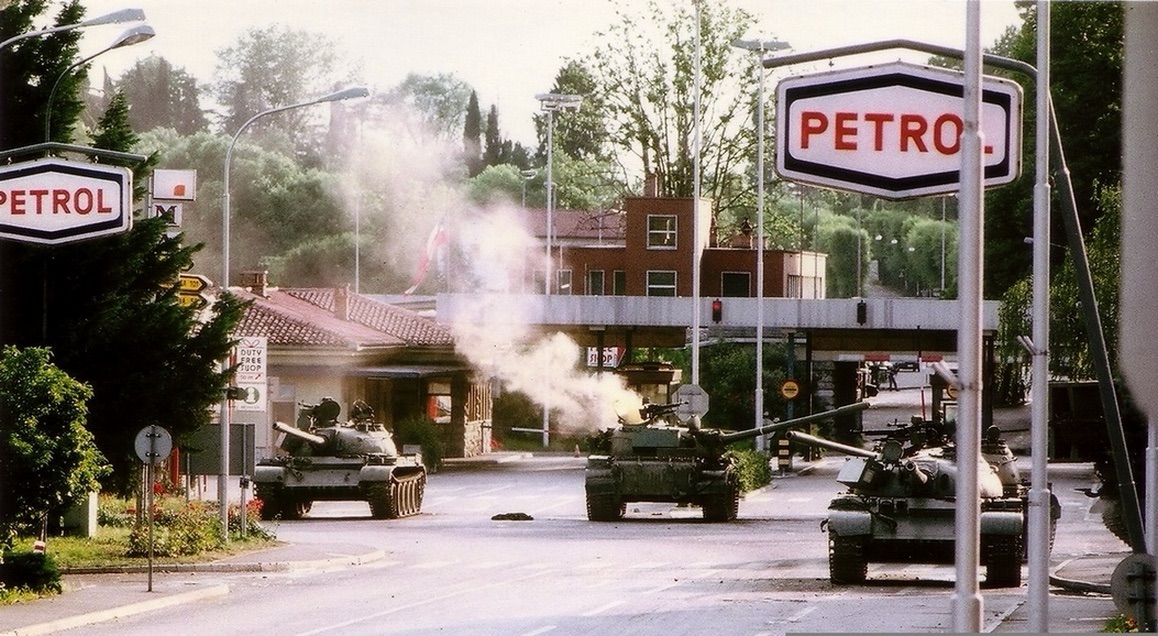
The JNA’s existential crisis became operational with Slovenia’s declaration of independence on 25 June 1991. The Slovene government, anticipating conflict, had secretly transferred weapons from the JNA-controlled TO warehouses to its newly formed police and militia. When the JNA—under orders from the paralyzed federal presidency—moved to secure Yugoslavia’s international borders, Slovene forces blockaded barracks and attacked JNA columns.
The ten-day conflict was a fiasco for the JNA, revealing its profound weaknesses.
· Morale and Legitimacy: Conscripts, particularly non-Serbs, were confused and unwilling to fight Slovene “civilians.” Many surrendered without a fight. The war lacked any clear, legitimizing political objective from Belgrade that resonated with the rank and file.
· Strategic Ineptitude: The JNA, trained for large-scale armored warfare against a foreign invader, was ill-suited for low-intensity conflict in mountainous terrain against a motivated local force.
· International Backlash: Televised images of burning JNA tanks humiliated the army and galvanized European diplomatic intervention.
The Brioni Agreement, brokered by the EC in July 1991, ended the fighting but mandated the JNA’s complete withdrawal from Slovenia. For the High Command, this was a traumatic defeat. It convinced Kadijević and Adžić that the EC was anti-Yugoslav and that the core of the state had to be defended elsewhere: in the “Serb lands” of Croatia and Bosnia. The Slovenian debacle was the moment the JNA effectively gave up on Yugoslavia as a six-republic federation and redefined its mission as the protector of Serbs and the borders of a rump state. As historian Mile Bjelajac puts it, the army “ceased to be Yugoslav and embarked on a Serbian national mission.”
The Croatian Crucible: From Federal Army to Army of the Krajina
In Croatia, the slide to war was more gradual and insidious. Throughout 1990 and early 1991, as tensions rose between Franjo Tudjman’s nationalist government and the Serb minority, the JNA positioned itself as a “neutral” interposer. In reality, it was actively facilitating the Serb insurrection.
· It stood by as Serb paramilitaries, often led by former JNA officers, seized police stations and municipalities.
· It enforced disarmament of the Croatian TO (as per federal law) while turning a blind eye to the arming of Serb militias.
· Most critically, in a series of massive, clandestine operations, it transferred the entire weapons stockpiles of the Croatian TO from republic-controlled warehouses to Serb-held areas in the Knin Krajina and Slavonia. This operation, known colloquially as “RAM,” provided the firepower for the soon-to-be-proclaimed Republic of Serbian Krajina (RSK).
By the time full-scale war erupted in the fall of 1991 (with the siege of Vukovar and the bombardment of Dubrovnik), the JNA was openly the combat arm of the RSK. Its officers planned and led operations; its artillery and air force pounded Croatian cities. Yet, this exposed the final internal contradiction: its conscript base remained multi-ethnic. The result was mass desertions, mutinies, and the effective ethnic bifurcation of the army. Non-Serb conscripts were sent home or allowed to desert; Croatian and Bosnian Serb conscripts were often directed to fight in their home regions. The institution was shedding its Yugoslav skin in real-time.
The formal transition occurred in the spring of 1992. Under international pressure and as part of a negotiated ceasefire, the JNA officially withdrew from Croatian territory. But this was a legalistic sleight of hand. Its personnel born in Bosnia or Serbia proper simply went home. However, the estimated 80,000 Bosnian Serb soldiers and officers serving in the JNA, along with nearly all the heavy equipment stationed in Bosnia, remained behind. On 4 May 1992, in a ceremony in Banja Luka, this force was formally reconstituted as the Army of the Republika Srpska (VRS), under the command of General Ratko Mladić, a career JNA officer. The JNA had not withdrawn; it had seeded its successor.
The Bosnian Inheritance and the Final Dissolution
In Bosnia, the JNA’s role was even more decisive and destructive. Throughout 1991, under the guise of “withdrawing” from Croatia, it positioned the bulk of its forces inside Bosnia. Its Second Military District, headquartered in Sarajevo, effectively became the occupying force of a republic still ostensibly part of Yugoslavia. When Bosnia held its independence referendum in February-March 1992, the JNA, in coordination with Bosnian Serb political leaders, completed the final stages of its plan: it secured strategic hills around Sarajevo, carved out corridors of control linking Serb-majority areas, and provided the organizational framework for the VRS.
The final act of the JNA’s dissolution was its formal reconstitution. In April 1992, the rump Federal Republic of Yugoslavia (Serbia and Montenegro) was proclaimed. The remaining JNA forces—now overwhelmingly Serbian and Montenegrin—were simply renamed the Army of Yugoslavia (Vojska Jugoslavije, VJ). The name change was a bureaucratic formality acknowledging a completed reality: the “Yugoslav” army was now the national army of a new, smaller Yugoslav state with exclusively Serbian leadership. The assets, the doctrine, and the chain of command of the old JNA lived on, first in the VRS for the conquest of Bosnia, and later in the VJ for the conflicts in Kosovo in the late 1990s.
Historiographical Debates: Inevitable Decay or Conspiratorial Takeover?
The interpretation of the JNA’s collapse fuels ongoing scholarly debate, centering on agency versus structure.
The “Institutional Decay” or “Last Yugoslav” Thesis:
Some historians and many former JNA officers frame the army’s actions as a tragic, if flawed, attempt to hold the state together. In this view, articulated by Veljko Kadijević in his memoirs, the JNA was a victim of circumstances—abandoned by the international community, betrayed by secessionist republics, and forced into a series of impossible choices. The ethnic purges are downplayed as a natural result of republican disloyalty, and the army’s alignment with Serbia is seen as a pragmatic necessity after Slovenia and Croatia seceded. This narrative portrays the JNA leadership not as conspirators but as the last guardians of a failed idea.
The “Conspiratorial Takeover” or “Instrument of Aggression” Thesis:
The dominant scholarly view, supported by extensive documentation from the ICTY, is far more critical. Scholars like James Gow (The Serbian Project and Its Adversaries) and Florian Bieber argue that from at least 1987, a faction within the JNA High Command, in active collaborationCollaboration
Full Description:The cooperation of local governments, police forces, and citizens in German-occupied countries with the Nazi regime. The Holocaust was a continental crime, reliant on French police, Dutch civil servants, and Ukrainian militias to identify and deport victims. Collaboration challenges the narrative that the Holocaust was solely a German crime. across Europe, local administrations assisted the Nazis for various reasons: ideological agreement (antisemitism), political opportunism, or bureaucratic obedience. In many cases, local police rounded up Jews before German forces even arrived.
Critical Perspective:This term reveals the fragility of social solidarity. When their Jewish neighbors were targeted, many European societies chose to protect their own national sovereignty or administrative autonomy by sacrificing the minority. It complicates the post-war myths of “national resistance” that many European countries adopted to hide their complicity.
Read more with Milošević, worked to subvert the army’s federal character. The purge, the RAM plan, and the strategic deployments were not reactive but proactive elements of a coordinated political-military strategy to create a “Greater Serbia.” The ICTY’s convictions of senior JNA officers for crimes in Croatia and Bosnia, based on command responsibility, legally cemented this interpretation: the JNA was part of a Joint Criminal Enterprise.
A nuanced synthesis acknowledges both perspectives. The JNA High Command likely began with a genuine, if anachronistic, commitment to Yugoslav unity. However, as the political center vanished, their commitment morphed into a strategic alliance with the only power offering a coherent vision and resources: Milošević’s Serbia. In that alliance, they surrendered their institutional independence and became the executioners of a nationalist project they may not have originally conceived but were perfectly suited to enable.
Conclusion: The Arsenal of Dissolution
The unraveling of the JNA is the master key to understanding the military trajectory of the Yugoslav wars. It was not an institution that fractured into six equal parts. Instead, it was systematically hollowed out and its immense power—its warehouses of Soviet-era weaponry, its command structure, its trained officers—funneled into a single, devastating channel. It provided the decisive edge that allowed Serb nationalist forces to initiate and sustain wars on multiple fronts.
Its story is a profound case study in the militarization of politics and the ethnicization of the state. A professional army, created to transcend nationality, became the vehicle for its most violent expression. The JNA’s barracks, once microcosms of Brotherhood and Unity, became the breeding grounds for the militias that would lay siege to Vukovar and Sarajevo. In the end, the guardian did not just fail in its duty; it became the primary agent of the state’s destruction. The wars were not fought after the army collapsed; they were fought with the army, as it was being transformed from a federal into a nationalist force. The trajectory from the JNA to the VRS is the most concrete possible illustration of how Yugoslavia did not simply dissolve—it was violently dismantled, using its own most powerful institution as the chief tool of demolition.

Leave a Reply