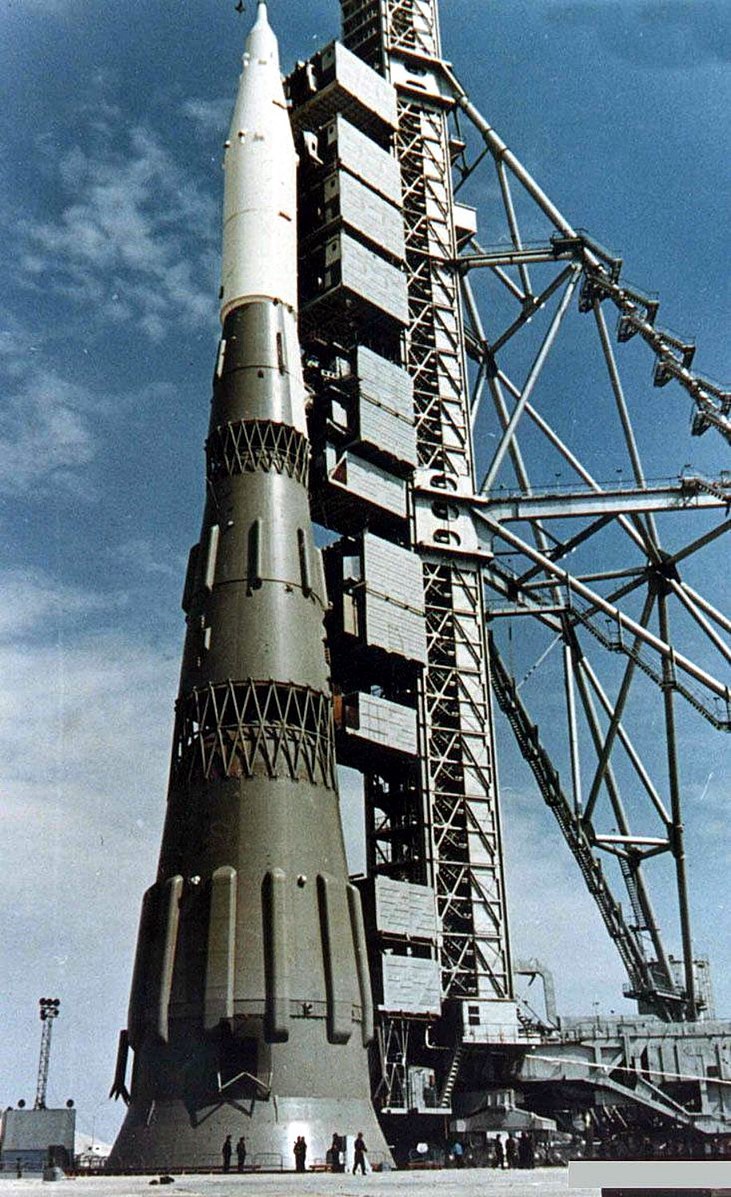

While the world watched Neil Armstrong’s “giant leap for mankind” in July 1969, a different, silent drama was unfolding on the other side of the planet. At the Baikonur Cosmodrome, the Soviet Union was preparing its final, desperate bid for lunar glory. The vehicle for this attempt was the N1, a colossal rocket that stood as a stark, brutalist counterpoint to the sleek, industrial elegance of the American Saturn V. Its four consecutive catastrophic failures between 1969 and 1972 were not merely technical setbacks; they were the violent, explosive autopsy of the entire Soviet technopolitical system. The N1 program, conducted in utter secrecy and ultimately abandoned and denied, represents the “grey zenith” of the Soviet space effort—the point at which its early, brilliant improvisation met its systemic limits. The story of the N1 is not one of a lack of ambition or intelligence, but of a system so riddled with internal contradictions, rivalries, and structural flaws that it could not marshal its resources to achieve its most profound goal.
This article argues that the failure of the N1 rocketThe N1 Rocket
Full Description:The Soviet Union’s secret counterpart to the American Saturn V. A behemoth rocket intended to carry cosmonauts to the Moon, the N1 suffered four catastrophic explosions during test launches between 1969 and 1972. Its existence and failure were kept as a state secret for decades.
Critical Perspective:The failure of the N1 exposes the structural weaknesses of the Soviet program. Unlike the unified “Systems Approach” of NASA, the Soviet effort was plagued by internal rivalries between lead designers like Korolev and Glushko. This “shadow race” proves that the outcome of 1948–1969 was decided as much by organizational management and funding as by scientific genius.
Read more was overdetermined by the very nature of the late Soviet state. It was doomed not by a single miscalculation, but by a perfect storm of technopolitical failures: the paralyzing rivalry between its chief design bureaus, the crippling absence of systemic testing infrastructure, the devastating loss of its indispensable leader, and the political imperative for secrecy that prevented the open error-correction so vital to NASA’s success. By dissecting the anatomy of the N1’s failure, we can move beyond the simplistic narrative of “American triumph, Soviet defeat” and instead uncover a more tragic and instructive story: how a system that had once bested the United States in the early space race ultimately proved incapable of the sustained, integrated, and transparent collaborationCollaboration
Full Description:The cooperation of local governments, police forces, and citizens in German-occupied countries with the Nazi regime. The Holocaust was a continental crime, reliant on French police, Dutch civil servants, and Ukrainian militias to identify and deport victims. Collaboration challenges the narrative that the Holocaust was solely a German crime. across Europe, local administrations assisted the Nazis for various reasons: ideological agreement (antisemitism), political opportunism, or bureaucratic obedience. In many cases, local police rounded up Jews before German forces even arrived.
Critical Perspective:This term reveals the fragility of social solidarity. When their Jewish neighbors were targeted, many European societies chose to protect their own national sovereignty or administrative autonomy by sacrificing the minority. It complicates the post-war myths of “national resistance” that many European countries adopted to hide their complicity.
Read more required to win its final, most demanding chapter.
The Political Genesis: A Late and Fractured Response to Apollo
The Soviet moon program was not born from a clear, national imperative like President Kennedy’s challenge. It was a reactive, politically fractured, and fatally delayed enterprise from its inception.
- The Lagging Mandate: While Sergei KorolevSergei Korolev
Full Description:The anonymous mastermind behind the Soviet space program, responsible for Sputnik and Yuri Gagarin’s flight. A survivor of Stalin’s gulags, Korolev was so essential to the USSR’s success that his identity was kept secret by the state until after his death in 1966.
Critical Perspective:Korolev’s life embodies the tragic paradox of the Soviet system. Though he was the primary architect of their greatest triumphs, he was also a victim of the state’s paranoia and repression. His premature death is often cited as the definitive turning point that cost the Soviets the Moon, illustrating how heavily their program relied on a single “irreplaceable” individual compared to the institutionalized NASA model.
Read more, the brilliant chief designer of OKB-1, had dreamed of a lunar mission for years, he received no official state commitment until 1964, a full three years after Kennedy’s declaration. This delay was critical. The Soviet leadership, initially skeptical of the moon race’s value and confident in their lead after Gagarin’s flight, only fully mobilized when the scale of the American challenge became undeniable. They were already playing a desperate game of catch-up. - A House Divided: The Korolev-Glushko Schism: The program was fractured at its very core by one of the most damaging personal and professional rivalries in the history of engineering. Korolev and Valentin Glushko, the USSR’s premier rocket engine designer, were locked in a bitter feud. Korolev needed massive, powerful engines for the N1’s first stage. Glushko, however, was a staunch advocate for using hypergolic (self-igniting) propellants, which were highly toxic but manageable. Korolev, haunted by the volatile nature of such fuels, insisted on the cleaner, more powerful liquid oxygen and kerosene. Their disagreement was so profound that Glushko refused to build the engines for Korolev’s N1, a act of sabotage from within that had no parallel in the integrated NASA structure.
- The Faustian Compromise: The 30-Engine Cluster: With Glushko’s bureau closed to him, Korolev was forced to turn to a less experienced design bureau, led by Nikolai Kuznetsov, to design the N1’s first-stage engines. Kuznetsov’s NK-15 engines were competent, but they were smaller and less powerful than the F-1 engines powering the Saturn V. To achieve the necessary thrust, Korolev’s team had to cluster 30 of these engines together in a complex, tightly packed arrangement. This was the N1’s original sin. While the Saturn V used five massive, meticulously tested F-1 engines, the N1 relied on a bewildering orchestra of 30 smaller engines, whose complex interactions—the vibration, the fluid dynamics of pumping fuel, the acoustic waves—created a problem of nightmarish complexity. It was a compromise born not of engineering optimality, but of political and personal intransigence.
The Engineering Crucible: A Culture of “Test-in-Flight”
The technical flaws of the N1 were severe, but they were exacerbated by a Soviet engineering culture that, lacking the vast resources of its American rival, often relied on riskier development practices.
- The Missing Test Stand: The Systemic Failure of Infrastructure: The most glaring technical omission was the lack of a ground test stand capable of firing the N1’s entire first stage. The United States had built the massive Marshall Space Flight Center test stands and the mammoth B-2 test stand at the Mississippi Test Facility for the Saturn V. There, the entire rocket stage could be fired full-duration while anchored to the ground, allowing engineers to identify and solve problems like combustion instability and pogo oscillations in a controlled environment. The Soviet Union built no such equivalent for the N1. The reasons were a mix of cost, time, and a cultural acceptance of higher risk. The result was that the first full-scale test of the N1’s first stage was its first launch attempt. They were, in effect, conducting the most dangerous part of their testing program with live, flight-ready vehicles.
- The KORD System: A Complex Solution to a Catastrophic Problem: To manage the 30-engine cluster, the Soviets developed an incredibly complex engine control system called KORD (Kontrolia Raketnykh Dvigatelei). KORD was designed to shut down a failing engine and its symmetrically opposite partner to maintain thrust balance. However, the system was overly sensitive and slow. In the first launch in February 1969, vibrations caused KORD to mistakenly shut down all 30 engines merely 68 seconds into the flight. The system designed to save the rocket had instead doomed it before it had even left the atmosphere.
- The Cascading Catastrophes: Each of the four N1 launch failures told a similar story of unanticipated systemic interactions. The second launch, in July 1969, ended when a loose piece of metal debris was sucked into an oxygen pump, causing it to explode; the resulting fire severed control cables and led to the rocket crashing back onto the launch pad, creating one of the largest non-nuclear explosions in history. The subsequent failures had similar roots in the inherent complexity and poor survivability of the 30-engine design. Each failure was a data point, but without the ability to conduct comprehensive ground tests, the solutions were guesses, not certainties.
The Human Factor: The Death of Korolev and the Leadership Vacuum
The Soviet space program was, in its early years, a system built around a few indispensable men. The loss of the most indispensable of them was a blow from which the N1 program never recovered.
- Korolev: The Indispensable Sistemschik: Sergei Korolev was more than a designer; he was the system’s great integrator. He possessed the technical vision, the political cunning, and the personal authority to force cooperation between the warring design bureaus, to secure resources from a skeptical Politburo, and to maintain a coherent technical direction. He was the only figure who could potentially have navigated the N1’s immense challenges.
- A Fatal Surgery and a Fractured Legacy: Korolev’s death on the operating table in January 1966, during what was supposed to be a routine procedure, removed the program’s brain and heart. His successor, Vasily Mishin, was a capable engineer but lacked Korolev’s political stature and force of personality. The rival bureaus, particularly Glushko’s, became even more intransigent. The coherent, if flawed, vision for the N1 began to fragment under the weight of competing interests and without a strong hand to guide it. The program lost its direction and its driving force at the moment it needed them most.
The Aftermath: Silence, Denial, and a Lost Generation
The ultimate failure of the N1 was followed by one of the most comprehensive cover-ups of the Cold War, a final act that revealed the system’s prioritization of political image over technical truth.
- The Official Lie: The Soviet government never officially acknowledged the N1’s existence, let alone its failures. While the American press documented every Saturn V test and explosion, the N1’s cataclysmic failures were state secrets. This secrecy prevented not only the Soviet public from understanding the truth, but also insulated the program’s managers from the kind of public accountability that forced reform at NASA after the Apollo 1 fire.
- The Technological Hangover: The cancellation of the N1 program in 1974 had a chilling effect on Soviet space ambitions for a generation. The immense resources poured into the failed rocket were wasted. The energy and talent of a generation of Soviet engineers were directed away from human lunar exploration, a goal that was effectively abandoned. The Soviet space program pivoted to a more sustainable, but less glamorous, focus on space stations (the Salyut and Mir programs), ceding the symbolic high ground of the moon to the Americans.
Conclusion: The System as the Ultimate Failure
The story of the N1 is a tragic counterpoint to the story of Apollo. It demonstrates that technological achievement is not merely a function of brilliant individuals or bold ideas, but of the health of the system that nurtures them. The United States, with its integrated NASA structure, its culture of transparent failure analysis, its massive investment in testing infrastructure, and its political commitment, built a system capable of achieving the nearly impossible.
The Soviet Union, despite its early triumphs and the genius of Korolev, was hobbled by a system that fostered internal competition over collaboration, that valued secrecy over learning, that underinvested in critical infrastructure, and that was lethally vulnerable to the loss of key individuals. The N1 did not fail because Soviet engineers were inferior; it failed because they were operating within a technopolitical system whose internal contradictions were, quite literally, explosive. The grey zenith of the N1 was not just the height of a rocket, but the height of a system’s ambition—and the point at which its own flaws caused it to crumble back to earth.

Leave a Reply