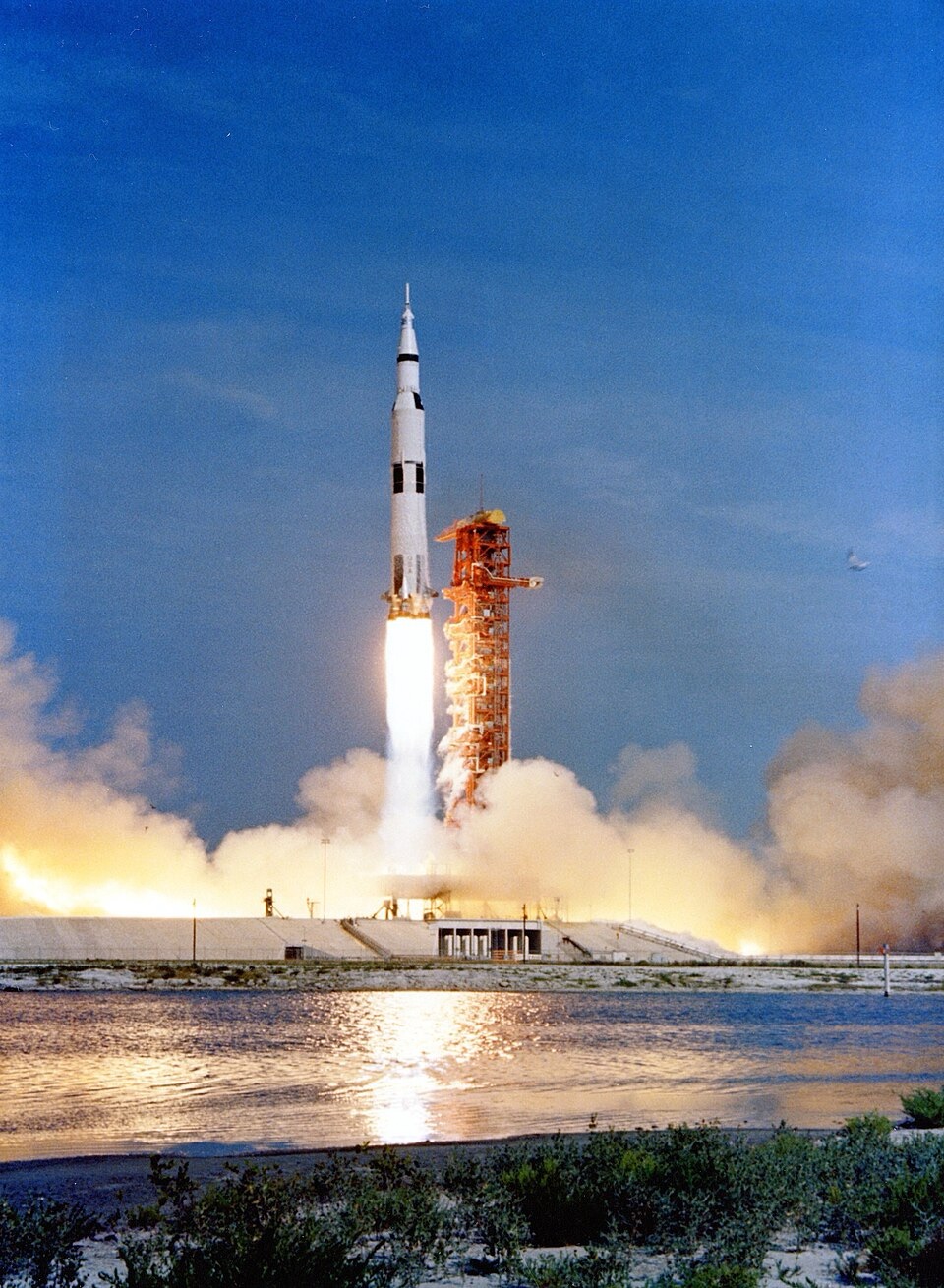

President John F. Kennedy’s 1961 call to land a man on the Moon before the decade was out is often portrayed as a galvanizing moment, a challenge that harnessed the nation’s collective energy and transcended its differences in a common, celestial goal. This narrative of consensus, however, is an oversimplification. Rather than standing apart from the turmoil of the 1960s, the U.S. space program served as a potent, high-profile arena where the era’s most profound social and political conflicts were projected, amplified, and debated. The “Moonshot” did not unite America; it held a mirror to its deepening fault lines, reflecting the fierce debates over racial justice, economic equity, military priorities, and the very soul of the nation’s future.
This analysis argues that the Apollo program was a central, contested symbol in the cultural and political wars of the 1960s and 70s. It was simultaneously a symbol of transcendent national ambition and a glaring symbol of misplaced priorities. By examining the critiques from the Civil Rights Movement, the anti-war and countercultural left, the feminist challenge to its masculine ideals, and the contentious political debates over its colossal cost, we can see that the journey to the Moon was not a unifying national pilgrimage. Instead, it was a journey that laid bare the profound divisions between black and white, rich and poor, hawk and dove, and the establishment and the counterculture. The space program, in its scale and symbolism, became a screen upon which Americans projected their deepest anxieties and highest hopes for the nation’s path.
“The Shame of America”: The Civil Rights Movement’s Moral Challenge.
For leaders of the burgeoning Civil Rights Movement, the vast expenditure and national attention devoted to the space program stood in stark, immoral contrast to the pervasive poverty and systemic racism endured by millions of African Americans. The rhetoric of national greatness ringing out from Cape Canaveral sounded like a cruel joke in Birmingham, Selma, and the urban ghettos of the North.
The Economic Argument: A Question of Priorities
The most direct critique centered on economics. With the Apollo program ultimately costing over $25 billion ($200 billion in today’s currency), civil rights leaders presented a powerful, damning comparison. In 1963, as NASA’s budgets soared, the NAACP’s executive secretary, Roy Wilkins, pointedly asked, “Why should a Negro, who can’t get a decent job or educate his children, be excited about putting a man on the moon?” The same year, Martin Luther King Jr. lamented in his book Why We Can’t Wait that the nation was guided by a “tortured philosophy” that could find “thousands of dollars to put one bomber in the air” but could not fund programs to lift children out of poverty.
This was not an abstract argument. Activists compiled stark comparisons: the cost of a single Saturn V launch ($185 million) could have built thousands of units of public housing or funded a year of free lunches for millions of schoolchildren. The famous “mule train” protest led by Ralph Abernathy at the launch of Apollo 11 in 1969 was the visceral embodiment of this critique. By bringing the nation’s poor to the gates of the spaceport, Abernathy forced a dramatic confrontation between what he called “the greatness of America” and its “shame.” The protest was not against science or exploration, but against a national hierarchy of values that seemed to prize symbolic victory over the Cold War above tangible justice for its own citizens. It was a challenge to the conscience of the white majority, asking whether a flag on the Moon was a worthy achievement for a nation that could not guarantee basic human dignity for all on Earth.
The Geographical Contradiction: Jim Crow’s Rocketry
The critique was further sharpened by the geographical reality of NASA’s major facilities. The Space Race was largely administered from the Deep South—the heart of Jim Crow. The Marshall Space Flight Center was in Huntsville, Alabama; the John F. Kennedy Space Center was in Florida; the Michoud Assembly Facility was in New Orleans, Louisiana; and mission control was in Houston, Texas. These were all states with deeply entrenched segregationist laws and cultures.
This created an unbearable contradiction. NASA presented itself publicly as a meritocratic, forward-looking institution, the vanguard of a new American century. Yet, it was operating in a region where Black engineers faced housing discrimination, where their children attended segregated schools, and where they were barred from the very restaurants and public accommodations that served their white colleagues. While Wernher von Braun in Huntsville eventually took steps to desegregate NASA events and facilities under federal pressure, he and other leaders were often reluctant to challenge local customs, fearing political backlash from powerful Southern congressmen who controlled their budgets. For civil rights activists, this demonstrated that the space program, for all its futuristic gloss, was deeply complicit in the nation’s oldest and most enduring sin. The “New South” it promised was being built on the foundations of the Old.
The Counterculture and the Anti-War Movement: Rejecting the Technocratic Establishment
If the Civil Rights Movement challenged the space program’s priorities, the white, largely youth-driven New Left and counterculture challenged its very soul. To them, NASA was not a symbol of hope, but the ultimate expression of a cold, dehumanizing, and militaristic technocracy.
The “Military-Industrial ComplexMilitary-Industrial Complex A term popularized by Dwight D. Eisenhower to describe the informal alliance between a nation’s military and the defense industry that supplies it. It warns of a structural danger where the profit motives of weapons manufacturers drive national policy toward perpetual war.
Read more” in Plain Sight
President Eisenhower’s 1961 farewell warning about the “unwarranted influence” of the “military-industrial complex” found its perfect embodiment in NASA. The agency’s origins were inextricable from the Pentagon; its first astronauts were military test pilots; its launch vehicles were direct descendants of intercontinental ballistic missiles; and its prime contractors—Boeing, North American Aviation, McDonnell Douglas—were the same giants that supplied the war machine in Vietnam.
For the anti-war movement, this connection was paramount. The same technological mindset that calculated trajectories to the Moon was calculating bombing runs over Hanoi. The same systems analysis that managed the Apollo program was being used to pursue a disastrous war of attrition in Southeast Asia. Protesters saw NASA not as a peaceful exploratory agency, but as the scientific and propaganda wing of the warfare state. They rejected the notion that Apollo was a “peaceful” competition with the Soviets, viewing it instead as the most glamorous front in the Cold War, a battle for “hearts and minds” that distracted from the physical and moral destruction being wrought in Vietnam. Chants like “No war in Vietnam, no rockets to the moon!” at demonstrations directly linked the two issues, framing the national resources poured into Apollo as blood money.
The Countercultural Rejection of “Straight” Technology
Beyond its military links, NASA’s ethos was anathema to the values of the emerging counterculture. The space program represented hierarchy, order, conformity, and a rigid, masculine, engineering-based rationality. The astronauts were clean-cut, short-haired, patriotic organization men—the ultimate “squares.” They were the antithesis of the countercultural ideals of personal liberation, psychedelic experience, communal living, and a return to nature.
While NASA was building sterile, metallic environments for space, the counterculture was seeking organic connection through folk music, psychedelic art, and a back-to-the-land movement. The iconic image of “Earthrise,” taken by the Apollo 8 crew, was adopted by the growing environmental movement not as a celebration of NASA’s achievement, but as a stark reminder of the planet’s fragility and interconnectedness—a holistic view that stood in opposition to the reductionist, engineering worldview that had created the camera. Figures like Stewart Brand, creator of the Whole Earth Catalog, used the NASA image to argue for a systems-thinking that valued ecological balance over technological conquest. The counterculture, in essence, co-opted NASA’s own imagery to critique the very philosophy that had produced it. They saw the Moonshot not as progress, but as the apotheosis of a dangerous and alienating technological hubris.
“The Righteous Stuff”? Feminism and the Masculine Culture of Apollo
The space program was, from its inception, a profoundly masculine enterprise. It was a realm of test pilots, engineers, and “the right stuff”—a culture of stoic, competitive masculinity that left little room for women. As the feminist movement gained momentum in the late 1960s and 1970s, it directly confronted this gendered exclusion.
The Astronaut as Male Archetype
The original Mercury Seven astronauts were canonized as all-American male heroes: fearless, competitive, and firmly embedded in a domestic ideal of wives and children cheering them on from the suburbs. This was a carefully curated image, but it reflected a deeper reality. The very language of space exploration was gendered: missions were about “penetrating” space, achieving “orbit,” and making “landings.” The technology itself—the powerful rockets, the daring pilots—was coded as male.
This created an almost insurmountable barrier for women. Though a private program known as the “Mercury 13” demonstrated in the early 1960s that women were physiologically well-suited for spaceflight (even outperforming men in some endurance tests), NASA and the military refused to entertain the idea of female astronauts. The official requirement that astronauts be graduates of military test pilot schools effectively excluded all women, as they were barred from such programs. This policy was not merely a practical barrier but an ideological one, reinforcing the notion that courage, technical skill, and the capacity to represent the nation were inherently male attributes.
The Feminist Critique and the Fight for Inclusion
As feminism moved into its “second wave,” activists began to directly challenge this institutional sexism. Figures like Betty Friedan and Gloria Steinem pointed to the space program as a glaring example of systemic discrimination. The near-total absence of women in visible, operational roles—as astronauts, flight directors, or senior engineers—was held up as proof of a society that channeled its highest aspirations and resources exclusively to men.
The fight for inclusion was long and arduous. It was not until 1978, long after the Apollo program had ended, that NASA selected its first astronaut class including women, in response to intense political and legal pressure. The persistence of the all-male, all-white image of the astronaut throughout the Apollo era served as a powerful symbol to the feminist movement of the work that still needed to be done. The space program, which claimed to represent all humankind, had in practice represented only a fraction of it.
IV. The Political Battle: Cost, Pragmatism, and the End of Consensus
Finally, the space program was itself a fierce political battleground, one where the bipartisan consensus that had launched it quickly disintegrated under the weight of other crises.
The Great Society vs. the Moon
From its inception, Apollo faced opposition from both the left and right on fiscal grounds. Conservatives, led by Senator Barry Goldwater, questioned the massive expansion of federal power and spending. More significantly, liberal Democrats who were champions of President Lyndon B. Johnson’s “Great Society” began to see the space budget as a direct competitor to their social programs. As the costs of the Vietnam War and the War on Poverty escalated simultaneously, something had to give.
By the late 1960s, figures like Senator William Proxmire of Wisconsin became famous for awarding his “Golden Fleece Award” to what he deemed government waste, frequently targeting NASA projects. He and others argued that the nation could not afford both a war in Asia and a mission to the Moon while also fighting poverty at home. This argument gained traction after the 1967 Apollo 1 fire, which raised troubling questions about the program’s management and urgency. The political will that had fueled Apollo was evaporating, replaced by a new pragmatism that asked hard questions about return on investment. The near-disaster of Apollo 13 in 1970, rather than renewing public support, seemed to confirm for many the fragility and risk of the entire endeavor.
The Post-Apollo Letdown and the Shift in National Mood
The success of Apollo 11 in many ways marked the beginning of the end for the ambitious, no-expense-spared vision of space exploration. The primary geopolitical goal—beating the Soviets—had been achieved. In the context of urban riots, a quagmire in Vietnam, economic stagnation, and a growing environmental consciousness, the public’s appetite for further grand cosmic gestures waned rapidly. NASA’s budgets were slashed, the final three Apollo missions were canceled, and the agency entered an era of diminished expectations with the Space Shuttle program—a reusable, pragmatic truck for low-Earth orbit, a far cry from the grandeur of the Moonshot.
This retrenchment was a direct reflection of the shifted national mood. The optimistic, forward-looking techno-optimism of the early 1960s had been replaced by a more cynical, complex, and inward-looking national identity. The fault lines that Apollo had mirrored were now dictating the nation’s course, and a journey to the stars no longer seemed like the most pressing destination.
Conclusion: A Reflection, Not a Unifier
The American Moonshot was not a project that stood above the fray of 1960s social conflict. On the contrary, it was plunged into the very center of it. It was condemned as a symbol of misplaced spending by civil rights leaders, rejected as an icon of a death-dealing technocracy by the New Left, critiqued as a bastion of patriarchal values by feminists, and dismantled as a fiscal extravagance by politicians. The gleaming rockets and heroic astronauts existed alongside, and in tension with, the mule trains, the anti-war marches, and the protests for gender equality.
To understand the Space Race in its full historical context, we must let go of the comforting myth of national unity. The true history of Apollo is not one of a nation seamlessly united in common purpose, but of a nation fiercely debating its purpose. The program’s great technological achievement was undeniable, but its social history reveals a more profound and enduring truth: that a nation’s reach into the cosmos will always be shaped, and limited, by its unresolved conflicts here on Earth. The Moon landing was a magnificent achievement, but it was an achievement of an America that was, and remains, a work in profound and ongoing progress.

Leave a Reply