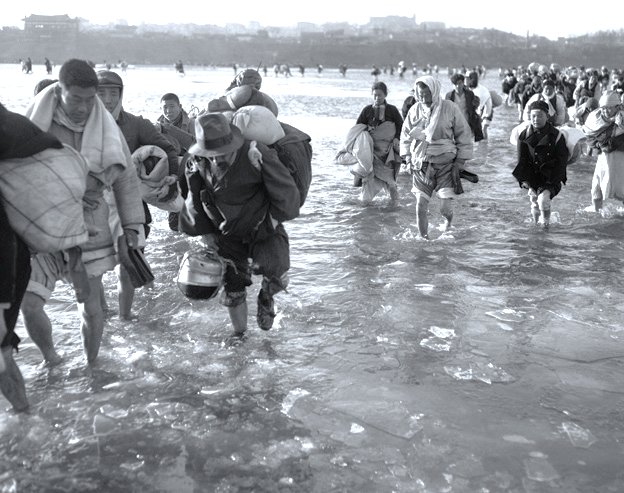

On October 19, 1950, units of the Chinese People’s Volunteer Army (PVA) quietly crossed the Yalu (Amnok) River into North Korea, dramatically altering the course of the Korean War. Only a year after its founding in 1949, the People’s Republic of ChinaRepublic of China
Full Description:The state established on January 1, 1912, succeeding the Qing Dynasty. It was the first republic in Asia, but its early years were plagued by political instability, the betrayal of democratic norms by Yuan Shikai, and fragmentation into warlordism. The Republic of China was envisioned by Sun Yat-sen as a modern, democratic nation-state. It adopted a five-colored flag representing the unity of the five major ethnic groups (Han, Manchu, Mongol, Hui, and Tibetan). However, the central government in Beijing quickly lost control of the provinces.
Critical Perspective:The early Republic illustrates the “crisis of sovereignty.” While it had the forms of a republic (a president, a parliament), it lacked the substance. It could not collect taxes efficiently or command the loyalty of the army. It remained a “phantom republic” internationally recognized but domestically impotent, existing in a state of semi-colonialism until the nationalist consolidation in the late 1920s.
Read more (PRC) plunged into a major conflict against the United States and United Nations forces. Why did China intervene in Korea, risking a confrontation with a far superior U.S. military? This question has fueled extensive historical debate. The Chinese leadership’s decision was shaped by a complex mix of political, military, and ideological motivations amid the early Cold War climate. Major battles from late 1950 to 1951 showcased Chinese tactics and resolve, while Mao Zedong’s personal role proved decisive. This article explores China’s intervention through multiple lenses – from the PRC’s nascent foreign policy and Mao’s strategic objectives to differing historiographical interpretations (orthodox, revisionist, post-revisionist, and Chinese perspectives). We will also consider how Chinese involvement in Korea impacted Sino-American relations and the broader Cold War landscape in Asia.
Early Cold War Context and China’s Foreign Policy Evolution
The outbreak of the Korean War in June 1950 occurred at a pivotal moment for Chinese foreign policy. The Chinese Communist Party (CCP) had just won the Chinese Civil War, establishing the PRC on October 1, 1949. As a new revolutionary regime, China aligned itself with the Soviet Union against the Western bloc – a stance Mao Zedong dubbed “leaning to one side.” In February 1950, Mao secured a Sino-Soviet Treaty of Friendship, Alliance and Mutual Assistance with Joseph StalinStalin Joseph Vissarionovich Stalin (18 December 1878 – 5 March 1953) was a Soviet politician, dictator and revolutionary who led the Soviet Union from 1924 until his death in 1953. Read More’s USSR, cementing Beijing’s place in the socialist camp. This alliance formed the backdrop for China’s approach to the Korean conflict.
Chinese leaders viewed world events through the prism of both recent history and communist ideology. Mao and his comrades had come of age during China’s “Century of Humiliation,” when foreign powers dominated China. This imbued them with revolutionary nationalism – a determination to restore China’s sovereignty and status . Mao’s concept of revolution tied national rejuvenation to a worldwide anti-imperialist struggle. As historian Chen Jian observes, three interrelated themes drove Beijing’s foreign policy thinking: “the party’s revolutionary nationalism, its sense of responsibility toward an Asian-wide or worldwide revolution, and its determination to maintain the inner dynamics of the Chinese revolution” . In practice, this meant the PRC saw itself as not just defending Chinese national interests but also advancing global communism. Such a worldview set the stage for how China would respond to the war next door in Korea.
When North Korean communist leader Kim Il-sung launched an invasion of South Korea in June 1950 (with StalinStalin Joseph Vissarionovich Stalin (18 December 1878 – 5 March 1953) was a Soviet politician, dictator and revolutionary who led the Soviet Union from 1924 until his death in 1953. Read More’s approval), Mao’s government was immediately concerned. U.S.-led UN forces intervened on behalf of South Korea, and by October they had pushed Kim’s army out of the South and were advancing deep into North Korea, nearing China’s border at the Yalu River. These developments forced Beijing to weigh the risks and imperatives of getting involved. In the early Cold War context, China’s strategic interests and security calculations were evolving rapidly. The United States had pointedly excluded Taiwan and Korea from its pre-war Asian defense perimeter, but after war broke out, Washington moved the U.S. Seventh Fleet into the Taiwan Strait, thwarting PRC plans to “liberate” Taiwan . From Beijing’s perspective, the Korean conflict had merged with its own security and reunification concerns. As described below, Mao saw the war as a critical test of China’s foreign policy – one that could not be ignored without jeopardizing the revolution’s gains and China’s regional stature.
Motives for China’s Intervention: Security, Ideology, and Strategy
China’s decision to intervene in Korea in October 1950 was driven by a confluence of political, military, and ideological motives. Far from a rash impulse, the choice reflected Chinese leaders’ assessment of multiple threats and objectives. Mao famously summed up the intervention as “Resist America, Aid Korea” (抗美援朝), a slogan capturing both defensive and internationalist justifications. Key motivations included:
Border Security and Fear of Encirclement: The foremost military concern was the presence of U.S.-led forces on China’s doorstep. General Peng Dehuai (whom Mao appointed to command Chinese forces) warned that if American troops conquered North Korea and reached the Yalu, they might cross into Chinese territory . Having just secured Manchuria in the civil war, the CCP could not tolerate a hostile army massed across the Yalu River. Mao and others believed that allowing the U.S. to occupy all of Korea would gravely endanger northeast China . Thus, self-defense was a paramount motive – Chinese forces would strike to push the enemy back and create a buffer state in North Korea. Mao felt that “if we allow the U.S. to occupy all of Korea…we must be prepared for the U.S. to declare…war with China,” as he told Stalin in October . The specter of encirclement (with U.S. allies in South Korea, Japan, and Taiwan) made intervention seem like a necessity for China’s survival. Ideological Solidarity and Revolutionary Duty: Chinese leaders also framed their intervention in ideological terms. Mao saw the PRC as the champion of Asian revolution. The Chinese leadership felt a responsibility to aid a fellow communist state (North Korea) under attack by “imperialist” forces . In Mao’s eyes, Korea was part of a broader East Asian revolutionary front – losing Korea to the U.S. would be a setback for communism’s advance. Mao emphasized China’s duty as the leader of Asian revolutions, believing that “Korea’s fate concerned both the vital security interests of China and the destiny of an Eastern and world revolution” . This sense of internationalism and communist fraternity was a powerful motivator. Supporting Kim Il-sung was not just geopolitics; it was viewed as upholding the momentum of global communism. As Shen Zhihua (a leading Chinese historian) notes, Mao’s motivations were complex: he “saw China’s responsibilities for the socialist camp (especially for North Korea)” and felt that “a war between China and America had already begun” once the U.S. moved to block China’s unification of Taiwan . Protecting the Chinese Revolution’s Domestic Momentum: Intervention was also calculated in terms of Chinese domestic politics and the revolution’s consolidation. Fresh from victory in 1949, the CCP regime was still stabilizing a war-torn country. A major concern was to maintain the revolutionary fervor and unity of the Chinese people. Standing up to the United States could rally domestic support and legitimize the CCP’s authority. Historian Chen Jian argues that Mao was determined to maintain the “inner dynamics” of the revolution – meaning its ideological zeal and mobilizing force – and that entering the Korean War aligned with this goal . By casting the war as defending New China against American aggression, Mao could more easily implement mass mobilization (the “Resist America, Aid Korea” campaign) and suppress any internal dissent as unpatriotic. Indeed, Chinese military successes in Korea helped bolster the regime’s prestige at home, instilling pride that China had stood up to the world’s foremost superpower . Securing the Sino-Soviet Alliance: A critical political motivation – often underappreciated in early accounts – was Mao’s desire to strengthen ties with the Soviet Union. Mao understood that the young PRC desperately needed Soviet economic and military assistance for reconstructionReconstruction
Full Description:The period immediately following the Civil War (1865–1877) when the federal government attempted to integrate formerly enslaved people into society. Its premature end and the subsequent rollback of rights necessitated the Civil Rights Movement a century later. Reconstruction saw the passage of the 13th, 14th, and 15th Amendments and the election of Black politicians across the South. However, it ended with the withdrawal of federal troops and the rise of Jim Crow. The Civil Rights Movement is often described as the “Second Reconstruction,” an attempt to finish the work that was abandoned in 1877.
Critical Perspective:Understanding Reconstruction is essential to understanding the Civil Rights Movement. It provides the historical lesson that legal rights are fragile and temporary without federal enforcement. The “failure” of Reconstruction was not due to Black incapacity, but to a lack of national political will to defend Black rights against white violence—a dynamic that activists in the 1960s were determined not to repeat.
Read more and to offset U.S. hostility. By intervening in Korea, Mao aimed to prove to Stalin that China was a loyal and “genuine internationalist Communist” ally . At the time, Stalin was initially reluctant to have Soviet forces directly fight the Americans, preferring China to do the heavy lifting. Mao felt that if he abandoned North Korea, he would “totally lose Stalin’s trust,” undermining the alliance and China’s future security . Thus, Mao was partly fighting for Stalin’s confidence. Shen Zhihua explains that Mao was “determined to maintain the Sino-Soviet alliance, so as to consolidate the CCP’s new regime in China” . This meant taking great risks: even after Stalin backtracked on promises of immediate air support, Mao still sent troops, correctly gambling that a committed Chinese intervention would ultimately compel Soviet aid . Indeed, once Chinese forces crossed the Yalu and scored initial victories, Stalin did deploy Soviet air units (in disguise) to protect Chinese supply lines, and large Soviet military aid flowed to China thereafter . In Mao’s strategic calculus, intervening in Korea was a way to bind Moscow and Beijing closer together.
In summary, China’s intervention was not caused by a single factor but by an intersection of security imperatives, revolutionary ideology, alliance politics, and domestic considerations. Mao’s government perceived the UN advance into North Korea as an existential threat to China’s borders and revolution. Simultaneously, they embraced the ideological narrative of defending a brother communist nation and striking a blow against Western imperialism. This combination of defensive and offensive rationales helps explain why China, a relatively weak country in 1950, was willing to enter a costly war against the United States.
Mao Zedong’s Role and Domestic Political Factors
Mao Zedong’s personal leadership was central to China’s decision to enter the Korean War. As Chairman of the CCP and the newly founded PRC, Mao was the ultimate decision-maker – and he was inclined toward intervention even when many of his colleagues were hesitant. In early October 1950, as North Korean forces crumbled and UN troops crossed the 38th Parallel38th Parallel Full Description: An arbitrary latitude line chosen by American and Soviet officials to divide the Korean peninsula into two occupation zones. It sliced through natural geography, administrative districts, and ancient communities, creating an artificial border that remains one of the most militarized frontiers in the world. The 38th Parallel represents the imposition of Cold War geopolitics upon a unified nation. Following the liberation of Korea from Japanese colonial rule, the country was not granted immediate independence but was partitioned by foreign powers without consulting the Korean people. Two young American officers chose the line from a map in roughly thirty minutes, viewing it as a temporary administrative fix. Critical Perspective:This line illustrates the disregard Great Powers held for local sovereignty. The division was a geopolitical abstraction that ignored the economic interdependence of the industrial North and the agricultural South, as well as the deep cultural unity of the people. It transformed a singular nation into two hostile client states, setting the stage for a fratricidal war. into North Korea, Mao convened a series of emergency meetings of the Chinese Politburo (Oct 2–5, 1950) to debate whether to send the “People’s Volunteers” to Korea . There was considerable opposition among top leaders and generals: many were wary of provoking open conflict with the United States so soon after decades of civil war and Japanese occupation. China was exhausted and economically fragile; critics of intervention argued the risks were too high. Even the usually hawkish Stalin advised caution initially, reportedly telling Mao that the Soviet Air Force needed months of preparation and that China might reconsider if air cover was lacking .
Mao, however, pressed his case with force. He and Premier Zhou Enlai were among the few unequivocal supporters of intervention at the time . Mao believed that the ideological and security stakes outweighed the risks. He underscored two points above all in persuading the leadership: first, China had a duty to aid a communist neighbor and could not “abandon” Korea without betraying the revolution; second, if the U.S. won in Korea, China’s own security would be next . Mao argued that American intentions were clear – after Korea, they would turn on China (indeed U.S. officials had openly discussed “unleashing” Chiang Kai-shek against mainland China). By linking the fate of North Korea to the defense of China itself, Mao gradually won over the majority. General Peng Dehuai also spoke in favor, vividly describing the threat of U.S. troops massing at the Yalu and perhaps even seizing Chinese territory if unchecked . This dire scenario convinced the Politburo to approve intervention on October 5, 1950.
It’s important to note that Mao accepted personal responsibility for the gamble. Knowing the enormous challenges the Chinese forces would face (from air bombardment to logistics), Mao stated that if things went badly, he would step down from leadership . In effect, he staked his political career and the young regime’s fate on the Korean venture. Mao’s own son, Mao Anying, volunteered to serve in the war and was tragically killed by an airstrike in November 1950 – a sacrifice Mao stoically bore, symbolizing his commitment to the cause. Mao’s prestige and authority were such that once he set the course, the party and army rallied despite private misgivings. Domestically, the war served to galvanize patriotic unity. The CCP launched a massive propaganda and mobilization drive – rallies, donations, and production campaigns – under the banner of resisting American aggression. Dissenting voices were silenced or labeled traitors. Thus, the war also functioned as a tool for Mao to tighten domestic political control, at least in the short term.
Mao’s objectives extended beyond the battlefield. He was looking to the long game: securing China’s revolution in a hostile world. Shen Zhihua points out that Mao remained steadfast even when Stalin wavered, because Mao “realized that Stalin did not really mean to abandon North Korea” and that not intervening would leave China isolated between a U.S.-backed South Korea and a distrustful USSR . Mao calculated that a limited war with the “American imperialists” now – fought in Korea, not on Chinese soil – was a price worth paying to avert a larger war later on more disadvantageous terms. His confidence in the “people’s war” doctrine and the fighting spirit of Chinese soldiers led him to believe they could overcome U.S. technological superiority. Indeed, despite huge casualties, Mao held to the view that Americans “lacked the heart to sustain heavy losses” and could be worn down in a protracted war of attrition . This outlook guided Chinese strategy once the intervention began, demonstrating Mao’s heavy imprint on both the decision to enter the war and how it was fought.
Chinese Military Intervention and Major Battles
When Chinese forces intervened in October 1950, it transformed the Korean War almost overnight. The Chinese troops – officially termed the Chinese People’s Volunteers (CPV) to imply a limited, non-governmental force – were in fact battle-hardened units of the People’s Liberation Army. Up to 300,000 Chinese soldiers covertly crossed into North Korea in late October, moving at night and hiding by day to avoid detection by U.N. aircraft . Their sudden assaults took U.N. commanders completely by surprise. General Douglas MacArthur, leading the U.N. offensive, had been warned via intermediaries that China might intervene if U.N. forces neared the Yalu, but he arrogantly dismissed the possibility. This miscalculation proved costly.
In the last week of October 1950, Chinese forces struck with their First Phase Offensive. On October 25, 1950, the CPV ambushed South Korean troops near Unsan, in North Korea’s northwest . Over 12 days of fierce fighting, the Chinese drove ROK (South Korean) divisions back about 100 kilometers, inflicting heavy casualties (Chinese sources claim 15,000 ROK soldiers killed in this initial campaign) . This initial setback should have served as a warning to U.N. forces, but MacArthur, underestimating the Chinese, pressed on with a new “end-the-war” offensive in mid-November . Mao and General Peng Dehuai shrewdly exploited this. They ordered CPV units to feign weakness and retreat slightly, luring the U.N. troops into a trap .
On November 25, 1950, the Chinese launched their massive Second Phase Offensive across a broad front . Waves of Chinese infantry attacked U.S., Commonwealth, and South Korean units in the snow-bound mountains of North Korea. In the west, they encircled and decimated elements of the U.S. Eighth Army, forcing a chaotic retreat. In the east, at the infamous Battle of Chosin Reservoir (late Nov–Dec 1950), Chinese forces surrounded 30,000 U.S. Marines and Army troops. The Marines eventually broke out of encirclement in an epic fighting withdrawal to the coast, but only after destroying large parts of several Chinese divisions. Nonetheless, the overall U.N. retreat from North Korea was so harrowing that one scholar called it “the most infamous retreat in American military history” . By mid-December 1950, Chinese and North Korean forces had driven U.N. troops out of most of North Korea . Mao’s initial goal of preventing the enemy from reaching the Chinese border was achieved.
Buoyed by success, Mao ordered the CPV to press on and cross the 38th Parallel into South Korean territory in a bid to decisively expel U.S. forces from the peninsula . In the Third Offensive, on New Year’s Day 1951, hundreds of thousands of Chinese and North Korean troops surged southward. Seoul, the South Korean capital, fell to Communist forces on January 4, 1951 – the second time Seoul had changed hands in the war. It appeared possible that the Chinese might sweep the rest of the way through South Korea. However, by this point the CPV’s limits were showing. Their supply lines were overextended, fatigue set in, and U.N. forces, now under General Matthew Ridgway, regrouped and hit back with superior firepower. Peng Dehuai had to halt the offensive in late January due to exhausted troops and dwindling ammunition . Mao, initially unwilling to countenance a pause, learned that the war would not be a quick, total victory . The Chinese tried one more large Spring Offensive in April 1951, aiming to break U.N. lines, but it failed with heavy losses – one Chinese division was completely annihilated in May 1951 . Thereafter, the conflict settled into a bloody stalemate near the original border (around the 38th Parallel) for the next two years.
Throughout these campaigns, Chinese troops displayed extraordinary bravery and mastery of infantry tactics. They excelled in night attacks, camouflage, and infiltration, often moving on foot through harsh terrain to outflank UN positions. Lacking significant armor or air power, the Chinese relied on massed infantry assaults (pejoratively dubbed “human wave” attacks by U.N. troops) and sheer numerical superiority at chosen points. General Peng’s strategy was encapsulated in a phrase: “lure the enemy in deep, then strike at his flanks and rear.” This tactic worked brilliantly in late 1950 . However, the Chinese also paid a grievous price for their gains. Their logistics were primitive – many soldiers went without adequate winter clothing or food, and U.N. air supremacy wreaked havoc on supply columns. By mid-1951, approximately 40% of the CPV’s forces had been rendered combat-ineffective due to casualties and illness, losses they could not fully replace until later . Chinese sources later reported total PVA casualties of around 390,000 in the war (over 110,000 killed in action, with hundreds of thousands more wounded or missing) . Western estimates are similar, attesting to the war’s immense human cost for China. Mao himself grimly acknowledged that the Korean War was a draining struggle, but one that China could endure longer than the Americans.
In July 1951, armistice negotiations began, though fighting continued for two more years. By 1952–53, the war had become a grinding artillery and trench warfare contest, more reminiscent of World War I than the fluid campaigns of 1950. Ultimately, an armistice was signed on July 27, 1953, largely ratifying the pre-war status quo at the 38th Parallel. China had succeeded in its immediate military aim: North Korea survived as a communist buffer state, and U.S.-led forces were kept away from China’s Manchurian frontier. But these outcomes came at enormous cost and did not bring outright “victory” for either side. As the next section discusses, historians continue to debate why China entered this brutal war and how to interpret its consequences.
Mao Zedong (left) with Joseph Stalin in Moscow, December 1949. The forged Sino-Soviet alliance influenced China’s decision to intervene in Korea, as Mao sought to solidify Stalin’s support for the new Chinese regime.
Competing Historiographical Interpretations
Why exactly did China enter the Korean War, and how should one interpret the broader significance of that intervention? Over the decades, historians have advanced several schools of thought. The historiography can be broadly categorized into orthodox, revisionist, post-revisionist, and Chinese (including new Chinese scholarship) interpretations. Each offers a different emphasis – from viewing China as a pawn of Soviet expansion to highlighting Chinese agency and strategic reasoning. Below we contrast these perspectives and note key historians associated with each:
Orthodox (Early Cold War View): The earliest Western analyses (1950s) saw China’s intervention largely as an act of communist aggression orchestrated by Moscow. Influenced by Cold War attitudes, orthodox scholars and officials portrayed Beijing as a compliant junior partner following Stalin’s orders to spread communism. According to this view, the Korean War was fundamentally Stalin’s initiative, and China’s entry in late 1950 happened at Stalin’s “direction to expand Communism” in Asia . Mao’s actions were subsumed under a monolithic communist bloc strategy. This perspective dovetailed with U.S. government rhetoric at the time, which labeled China an aggressor and assumed Mao was doing Stalin’s bidding. For example, contemporary analysts like Philip Mosley (1952) argued that Stalin pulled the strings and the Chinese were essentially carrying out Soviet policy . While this orthodox interpretation acknowledged China’s manpower made a difference, it minimized distinctly Chinese motives; China was seen as a proxy in the Cold War rather than an independent actor. Revisionist (1960s–1970s): As more information and hindsight emerged, a revisionist interpretation gained influence, challenging the simplistic “Stalin’s puppet” idea. Pioneered by scholars such as Allen S. Whiting, revisionists argued that China’s intervention was essentially a defensive reaction to U.S. threats, not a pre-planned act of expansion. Whiting’s landmark 1960 study China Crosses the Yalu found that Chinese leaders were initially reluctant and entered the war only “after China had exhausted all political and diplomatic measures” to warn the U.N. away . He concluded that the American decision to cross the 38th Parallel and approach the Chinese border “gave Chinese leaders little choice but to intervene” . In Whiting’s words, Chinese troops fought to protect national security, “not as automatons following orders from the Soviet Union” . This revisionist view cast Chinese actions as reactive and precautionary – Mao was compelled by fear of encirclement and invasion, rather than aggressive ambition. By the 1970s, this interpretation was widely accepted in the West. Scholars like Melvyn Gurtov and others built on it, emphasizing how U.S./U.N. advances and MacArthur’s drive north triggered Chinese intervention when deterrence (like Zhou Enlai’s warnings via India) failed . The revisionists thus shifted the agency back to Chinese decision-making under perceived threat, a dramatic departure from the orthodox “Kremlin puppet” narrative. Post-Revisionist and Multi-Archive Research (1990s–2000s): With the end of the Cold War and the declassification of many archives (in the U.S., former USSR, and China), post-revisionist historians have developed a more nuanced synthesis. Scholars like Chen Jian, John Lewis Gaddis, and Odd Arne Westad incorporate both Chinese agency and the broader geopolitical context. Chen Jian’s influential 1994 book China’s Road to the Korean War argued that earlier scholarship was too “American-centered” – focusing only on U.S. actions and Chinese reactions . Chen emphasizes internal Chinese ideological drives: the Maoist revolutionary mission and the need to sustain revolutionary momentum at home. He contends that Mao’s “primary motivation was the global expansion of Communism” and the assertion of China’s revolutionary identity . In Chen’s view, Mao believed that Korea’s fate was entwined with China’s national security and its revolutionary destiny . This adds an important dimension: Chinese leaders were not just passively responding to threats; they actively sought to reshape regional order in line with their revolutionary ideals. Post-revisionists also factor in alliance politics. Historian Shen Zhihua (drawing on Chinese and Russian archives) highlights how maintaining the Sino-Soviet alliance was pivotal in Mao’s calculations . As discussed earlier, Mao entered the war partly to solidify Stalin’s support, even though Stalin initially dragged his feet. Shen writes that despite Stalin’s October 14, 1950 message that the Soviet Air Force could not aid the Chinese for months, Mao proceeded into Korea to secure long-term Soviet backing . This insight shows Mao’s strategic foresight and willingness to bear short-term costs for long-term gains. John Lewis Gaddis, a prominent Cold War historian, similarly portrays the Chinese as assertive players with their own agenda. Gaddis notes that the Chinese Communists were “eager to legitimize their revolution by winning Stalin’s approval” and were quite willing to support North Korea as part of Stalin’s larger plan in Asia . In other words, Mao wasn’t dragooned into the war by Stalin – he volunteered, seeing opportunity to boost China’s standing. Odd Arne Westad and others also re-assess the war’s impact. Westad stresses that the Korean War was disastrous for all sides, including China, even though China achieved some objectives . The PRC suffered immense casualties and economic strain; Westad calls the war “by far the worst” catastrophe Korea had endured in the 20th century and “a disaster for China” as well . Yet, paradoxically, it elevated China’s international stature as the first Asian nation to fight the U.S. to a standstill. Post-revisionists therefore paint a complex picture: China’s intervention stemmed from a mix of defensive fear, revolutionary ambition, and realpolitik alliance considerations. This interpretation integrates facets of both earlier views – acknowledging genuine security threats (as revisionists did) but also underscoring Mao’s ideological zeal and strategic agency beyond mere reaction. Chinese Perspectives: Within China, the official narrative for decades was relatively straightforward – the war was termed the “War to Resist America and Aid Korea” and depicted as a heroic defensive action. Chinese sources emphasized that China entered the war to safeguard national security and support a brotherly nation, stopping American aggression at its doorstep. Mao’s government portrayed the intervention as entirely forced by U.S. imperialism, with no mention of Chinese or Soviet culpability in escalating the conflict. This line, taught in Chinese textbooks, highlighted how the Chinese volunteers “defended the homeland” and fulfilled internationalist duty, eventually forcing the enemy to armistice – a propaganda victory for the CCP. However, since the 1980s, some Chinese scholars have adopted more critical or nuanced views, especially as archives opened. Historians like Shen Zhihua and Shen & Xia Yafeng have used newly available documents to analyze the Sino-Soviet dynamics and decision-making missteps. They argue, for instance, that Mao was driven in part by mistrust – he felt Stalin had not been fully candid about Kim Il-sung’s war plans and wanted to prove China’s worth . Chinese research has also probed the internal debates in Beijing, confirming that many Chinese leaders were initially opposed and had to be won over by Mao’s line of reasoning . Still, even these accounts often conclude that the intervention, while costly, secured China’s frontiers and elevated its status. In recent years, as the 70th anniversary of the war was commemorated, China’s state media and scholarship have balanced pride in the military achievement with acknowledgement of the war’s burdens. The enduring theme in Chinese perspective is that the sacrifice was justified to ensure a peaceful environment for New China to survive and develop – a view encapsulated by Mao’s famous phrase that fighting the U.S. in Korea “brought about decades of peace” for China.
In sum, historiographical interpretations have evolved from viewing China as a passive puppet of Moscow, to a reluctant defender reacting to U.S. provocation, to a confident revolutionary power asserting its interests. Modern scholarship (both Western and Chinese) tends to agree that **China’s intervention was a calculated move driven by both security fears and revolutionary goals – a decision in which Mao Zedong’s personal resolve was decisive. Key historians like Chen Jian and Shen Zhihua underscore Chinese agency and ideology, while Western analysts like John Lewis Gaddis and Odd Arne Westad integrate these findings into the global Cold War narrative. The debate is no mere academic quarrel; it informs how we understand Chinese foreign policy behavior even today.
Impact on Sino-American Relations and the Asian Cold War
China’s entry into the Korean War had profound long-term consequences for international relations in Asia, especially the bitter freeze in Sino-American relations. In effect, the war transformed the Cold War – which had largely been a Euro-centric standoff – into a truly global and Asian conflict. The immediate outcome was the cementing of China and the United States as avowed adversaries for a generation. The United States, shocked by China’s intervention, shifted to a hard-line containment posture in East Asia. The U.S. Seventh Fleet’s patrol in the Taiwan Strait became indefinite, blocking China from unifying Taiwan (which remained under Nationalist control) . Washington refused to recognize the PRC at the United Nations (keeping Taiwan’s regime as China’s representative) and imposed a trade embargo on mainland China. For its part, Beijing’s portrayal of the U.S. as a mortal enemy of the Chinese people hardened popular sentiment. The war set the stage for two decades of diplomatic isolation and hostility: from 1950 until the Nixon rapprochement in 1971–72, there were no official contacts between Beijing and Washington, and each backed opposing sides in other conflicts (such as Vietnam). The Sino-American estrangement born in Korea thus shaped the geopolitical map of East Asia for the entire Cold War period.
Another key impact was on the Sino-Soviet relationship. In the short term, the Korean War brought Mao and Stalin closer – as noted, Chinese sacrifices secured massive Soviet aid. Stalin, impressed by China’s commitment, provided weaponry, technical support, and even some air cover (Soviet pilots flying MiG-15 jets in Manchurian skies). By demonstrating China’s “internationalist” loyalty, Mao gained a reputation in the communist world as a formidable leader . Chinese participation in Korea convinced many (including Stalin) that the CCP was a co-guarantor of communist interests in Asia, not just a junior partner . However, cracks were beneath the surface. Mao never forgot that Stalin hesitated and effectively left China alone to face the initial onslaught in October 1950 . This seed of mistrust would later contribute to the Sino-Soviet split in the 1960s. After Stalin’s death, Mao felt China had borne disproportionate burdens; and when ideological and national interests diverged, Beijing was more willing to assert independence from Moscow. In hindsight, the Korean War was a bonding experience that gave way to growing Chinese confidence and, eventually, impatience with Soviet dominance.
The war’s regional fallout was significant. It entrenched the division of Korea, with the Demilitarized Zone (DMZ) still separating North and South Korea to this day. North Korea became heavily reliant on Chinese support (along with Soviet aid) to rebuild after the devastation. The PRC’s military performance – fighting the U.S. to essentially a draw – greatly boosted China’s stature among emerging post-colonial nations. China began to be seen as the champion of anti-imperialist struggle in Asia and beyond. At the same time, the Korean War devastated the Korean peninsula and caused tremendous suffering. As Westad emphasizes, “the Korean War created the framework for China-Korea relations for the rest of the twentieth century” by binding Beijing to Pyongyang, but it also was “a disaster for China” in terms of lives lost and resources expended . Approximately 2.5 million Koreans (about 10% of Korea’s population) were killed, and Chinese casualties were second only to those of the Koreans – grim numbers that underscore the war’s brutality . Mao later reflected that although the war was painful, it “helped train” the Chinese armed forces and populace in modern war and stiffened China’s resolve against superpowers.
For the broader Cold War in Asia, China’s intervention had the effect of militarizing U.S. containment strategy. The U.S. dramatically increased defense spending (fulfilling the prescriptions of NSC-68) and strengthened security alliances around Asia – signing a mutual defense treaty with South Korea, rearming Japan’s Self-Defense Forces, and later forming SEATO. East-West tensions in Asia remained high, with the Taiwan Strait Crises of the 1950s and then the Vietnam War, where China again provided support to a communist ally (North Vietnam) albeit more cautiously. In many ways, the Korean War set patterns that endured: an American military presence in East Asia, a divided Korean peninsula, and China’s exclusion from the U.S.-led international order until the 1970s.
Yet, the war also demonstrated limits – neither superpower was willing to escalate to nuclear confrontation (President Truman pointedly removed General MacArthur when the latter hinted at using atomic bombs on Chinese targets). The 1953 armistice, though not a peace treaty, allowed China a chance to refocus on domestic development after years of war. Mao’s China emerged from the conflict with a mix of confidence and caution. Confident, because they had stood up to the United States – as propaganda trumpeted, a poor, recently colonized nation fought the world’s strongest military to a standstill, boosting national pride. Cautious, because the heavy toll taught Beijing not to underestimate the costs of full-scale war. In the decades after, China generally avoided direct large-scale confrontations with the U.S., preferring proxy and political struggles until the diplomatic thaw that eventually occurred.
Conclusion
China’s intervention in the Korean War remains a defining episode of the Cold War, one that continues to fascinate historians and inform current strategic thinking. Through a historiographical lens, we can appreciate the layered motivations and consequences of China’s entry into the conflict in 1950. Politically and militarily, Mao Zedong intervened to secure China’s borders, assert its revolutionary identity, and fulfill obligations to the communist alliance – a decision that altered the balance in Korea and prolonged the war. Ideologically, the intervention underscored China’s self-assigned role as the vanguard of Asian revolution against Western imperialism. The battles fought by Chinese “Volunteers” – from the frigid heights of Chosin Reservoir to the recapture of Seoul – demonstrated China’s resolve and reshaped the strategic map of East Asia.
Historians continue to debate the weight of various factors: Was China’s move primarily defensive or driven by revolutionary zeal? The evidence suggests it was both – a fusion of security calculations and ideological aspiration. Orthodox interpretations gave way to richer understandings of Chinese agency, thanks in part to scholars like Chen Jian, John Lewis Gaddis, Odd Arne Westad, and Shen Zhihua. Their works highlight that China’s intervention was neither a blind following of Moscow nor an irrational act, but rather a considered (if risky) policy choice by Mao and the CCP leadership. That choice had enduring ramifications. It locked in a hostile U.S.-China standoff that lasted until the 1970s, it solidified the division of Korea, and it affirmed China’s arrival as a significant power in the Cold War bipolar world.
Seven decades later, the Korean War is often dubbed the “Forgotten War” in the West, but in China it is remembered as a foundational moment for the PRC’s national identity and military history. Chinese leaders today still invoke the spirit of “Resist America, Aid Korea” as a symbol of patriotic unity and resilience. The war’s legacy is evident in the armistice lines that persist in Korea and in the cautionary lessons both Washington and Beijing drew from their bloody encounter. Ultimately, China’s involvement in the Korean War can be seen as a turning point that not only changed the course of that conflict, but also helped define the geopolitical contours of the Cold War in Asia. By examining it through multiple perspectives, we gain a deeper understanding of how a newly founded China managed – through a potent mix of fear and conviction – to confront a superpower and alter the trajectory of 20th-century history.
Sources
Chen Jian, China’s Road to the Korean War: The Making of the Sino-American Confrontation (Columbia Univ. Press, 1994). Shen Zhihua, “Revisiting Stalin’s and Mao’s Motivations in the Korean War,” Wilson Center (June 22, 2020). Allen S. Whiting, China Crosses the Yalu: The Decision to Enter the Korean War (1960), via UCSD Modern Chinese History site. “China’s Intervention in the Korean War Revisited,” Diplomatic History, 40:5 (2016), p.1002-1004 (Oxford Univ. Press) John Lewis Gaddis, The Cold War: A New History (2005), excerpt on Korean War . Odd Arne Westad, Empire and Righteous Nation: 600 Years of China-Korea Relations (2021), as reviewed in H-Diplo Essay 389 .

Leave a Reply