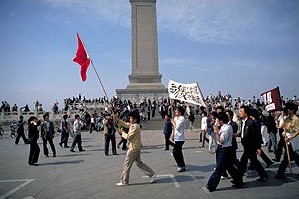

The protests in the year 1989 are popularly remembered as a moment of high political drama—the Goddess of Democracy, the hunger strikers, and the tragic finale of tanks rolling down Chang’an Avenue. However, to view the Tiananmen Square protests solely as an abstract demand for Western-style democracy is to misunderstand the fundamental drivers of the crisis. The explosion of unrest in the spring of 1989 was not merely an ideological dispute; it was the violent rupture of China’s reforming social contract.
Introduction: The Collision of Two Logics
For a decade, the Communist Party of China (CPC) had operated on a tacit bargain: the Party would retain its monopoly on political power, but in exchange, it would deliver rapid economic growth and egalitarian stability. By 1988, this bargain was fraying. The reform engine, which had produced miracles in the countryside, began to overheat and sputter in the cities.
The crisis of 1989 was born from the collision of two economic logics: the rigid, protected world of the socialist plan and the volatile, predatory world of the emerging market. This friction generated two distinct poisons that toxified the body politic: runaway inflation, which destroyed the economic security of the urban worker, and systemic corruption (guandao), which destroyed the moral legitimacy of the Party elite.
The Tiananmen movement was, at its core, a reaction to the “Limits of Reform.” It was a collective protest against a transition that seemed to be stripping ordinary citizens of their socialist protections while allowing a politically connected elite to loot the nation’s wealth. To understand the tank man, one must first understand the price of pork and the rise of the profiteer.
The End of the Honeymoon: The Exhaustion of the “Easy” Reforms
To comprehend the anger of 1989, one must contrast it with the euphoria of the early 1980s. The first phase of reform (1978–1984) was characterized by “Pareto improvements”—changes where almost everyone gained, and few lost. The de-collectivization of agriculture empowered peasants without hurting city dwellers. The rise of township enterprises provided goods that everyone wanted. The Party enjoyed high prestige; Deng Xiaoping was hailed as a savior.
By 1985, however, the reform agenda shifted to the cities, and the game changed. Urban industrial reform was a zero-sum game. To make State-Owned Enterprises (SOEs) efficient, the “iron rice bowl” (lifetime employment and welfare) had to be cracked. To balance the budget, subsidies had to be cut. To rationalize the economy, prices had to rise.
The urban working class, previously the coddled vanguard of the revolution, began to feel the ground shift beneath them. They saw their fixed incomes erode while a new class of private entrepreneurs (getihu) flaunted newfound wealth. The egalitarian ethos of MaoismMaoism Full Description:Maoism (or Mao Zedong Thought) emerged as a response to the specific material conditions of semi-feudal, semi-colonial societies. Unlike orthodox Soviet Marxism, which viewed the urban working class as the vanguard of history, Maoism argued that in colonized nations, the vast peasantry constituted the true revolutionary force. Key Theoretical Shifts: The Peasant Revolution: The rejection of the Eurocentric Marxist view that peasants were reactionary; instead, they are mobilized as the engine of socialist transformation. People’s War: A military-political strategy aimed at mobilizing the rural population to encircle and eventually capture the urban centers of power. Anti-Imperialism: The framing of the class struggle as inextricably linked to the struggle for national liberation against foreign colonial powers. Critical Perspective:Critically, Maoism represented a “sinification” of Marxism that de-centered the West. By asserting that the path to socialism did not require waiting for Western-style industrial capitalism to develop first, it provided a blueprint for insurgencies across the Global South (the “Third World”). However, this focus often justified the militarization of social life, where society was permanently organized on a war footing against real or imagined imperialist threats., still deeply embedded in the urban psyche, rubbed violently against the new reality of inequality. The government was attempting to “cross the river by feeling the stones,” but by 1988, they found themselves stuck in the middle of a torrential current, unable to go back and terrified to move forward.
“Crashing Through the Gate”: The Inflation Crisis of 1988
The immediate precipitant of the political crisis was a catastrophic error in economic policy. In the summer of 1988, Deng Xiaoping, frustrated by the slow pace of marketization, pushed for a radical solution: “Price reform.”
The dual-track price system, while useful for stability, was creating distortions. Deng urged the leadership to “crash through the price gate” (chuang jiage guan)—to lift price controls on most commodities and let the market dictate value. It was a bold attempt at shock therapy.
The result was disaster. The mere rumor of price liberalization triggered a nationwide panic. In August 1988, China witnessed the “panic buying” phenomenon (qianggou). Urban residents, terrified that their savings would be rendered worthless, rushed to withdraw cash from banks. They bought everything in sight—gold, color televisions, washing machines, and when those ran out, they bought salt, cotton sheets, and even matches.
The official inflation rate hit 18.5% in 1988, but for essential foodstuffs in major cities, it was closer to 30-50%. For a population accustomed to thirty years of frozen prices (where a box of matches had cost 2 fen for decades), this was psychologically traumatizing.
The inflation hit the intelligentsia and the bureaucracy the hardest. Unlike private merchants who could raise prices, or factory workers who might get bonuses, teachers, professors, and junior cadres were on fixed state salaries. Their standard of living collapsed. The “brain-body inversion” became a common grievance: a university professor earned less than a taxi driver; a surgeon earned less than a barber. This economic anxiety turned the intellectual class—the traditional allies of the state—into its fiercest critics.
Guandao: The Cancer of Official Profiteering
If inflation provided the economic anxiety, corruption provided the moral outrage. The unique structure of the transitional economy—specifically the dual-track price system—birthed a specific form of corruption known as guandao (official profiteering).
Because goods had two prices (a low state price and a high market price), anyone with the political power to acquire goods at the state price could instantly become rich by reselling them on the market. This was not the petty bribery of slipping a cigarette to a policeman; this was the structural looting of state assets by the political elite.
Steel, timber, coal, and foreign exchange quotas were diverted by officials and their children. The most visible beneficiaries were the “Princelings” (taizidang)—the children of high-ranking revolutionary veterans. In the late 1980s, companies linked to the sons of Deng Xiaoping and Zhao Ziyang were widely rumored to be involved in massive profiteering schemes.
To the average citizen, guandao was a betrayal of the revolution. It signaled that the Communist Party was no longer the vanguard of the proletariat, but a self-enriching oligarchy. The visual contrast was stark: while ordinary workers queued for rationed oil and watched their savings evaporate, the children of the elite were seen driving imported Mercedes-Benzes and dining in exclusive hotels.
A popular doggerel from the time captured the mood:
“The ten-thousand-yuan households are phony;
The one-hundred-thousand-yuan households are barely adequate;
Only those with official connections are the true heroes.”
This corruption delegitimized the reform process. It made “marketization” synonymous with “theft.” When the students eventually marched to Tiananmen, their most resonant slogans were not about the separation of powers, but “Down with Guandao” and demands for leaders to publicize their family assets.
The Intellectual Ferment: From Culture Fever to Disillusionment
Parallel to the economic deterioration was a profound intellectual awakening. The mid-1980s saw the “Culture Fever” (Wenhua Re), a period of intense exploration of Western ideas. Scholars translated Heidegger, Sartre, and Friedman; students debated democracy, human rights, and the nature of Chinese civilization.
This ferment culminated in the 1988 television documentary River Elegy (He Shang). The series offered a scathing critique of traditional Chinese culture (symbolized by the Yellow River and the Great Wall), portraying it as stagnant, inward-looking, and despotic. It contrasted this with the “blue civilization” of the oceanic West—open, scientific, and democratic.
River Elegy was implicitly a critique of the Party’s authoritarianism. It suggested that China’s backwardness was not just economic, but cultural and political. It resonated deeply with university students, who felt a historic responsibility to save the nation.
However, by 1989, the optimism of the “Culture Fever” had turned to cynicism. The failure of political reform to keep pace with economic change created a sense of suffocation. Intellectuals like the astrophysicist Fang Lizhi began openly calling for “The Fifth Modernization”—democracy—arguing that economic modernization was impossible without political freedom. The Party’s expulsion of Fang and other liberals in 1987 only deepened the alienation of the campus elite.
The Trigger: The Death of Hu Yaobang
By the spring of 1989, the tinder was dry. The spark arrived on April 15, with the death of Hu Yaobang.
Hu, the former General Secretary, had been deposed in 1987 for being too lenient on student protesters and for pushing political reforms too aggressively. To the students and intellectuals, he was the “conscience of the Party,” a symbol of the possibility of a liberal, humane socialism.
His death allowed students to occupy the moral high ground. Under the guise of mourning a Party leader (an act the state could not easily suppress), students from Peking University and other elite institutions marched to Tiananmen Square.
The initial “Seven Demands” issued by the students reveal the hybrid nature of the movement. They did not call for the overthrow of the Communist Party. Instead, they asked for:
- A reassessment of Hu Yaobang’s legacy.
- The disclosure of the private assets of party leaders and their families.
- Freedom of the press.
- Increased funding for education and better pay for intellectuals.
- The lifting of restrictions on demonstrations.
Notice the intermingling of economic grievances (funding, assets) with political ones (press freedom). It was a petition for the Party to live up to its own ideals, to cleanse itself of corruption, and to treat its citizens with respect.
The Escalation: The April 26 Editorial and the Loss of Control
The movement might have fizzled out if not for the Party’s catastrophic mishandling of the situation. As students gathered, the Party leadership was paralyzed by a split between the conciliatory General Secretary Zhao Ziyang and the hardline Premier Li Peng.
While Zhao was on a state visit to North Korea, Li Peng and the conservative elders persuaded Deng Xiaoping that the protests were not a patriotic petition, but a “counter-revolutionary rebellion” aimed at overthrowing the socialist system.
On April 26, the People’s Daily published a harsh editorial titled “We Must Take a Clear Stand Against Turmoil.” It labeled the students as conspirators causing “chaos” (dongluan).
The editorial was a massive miscalculation. Instead of cowing the students, it enraged them. It transformed a disparate group of mourners into a unified political movement. On April 27, in a stunning display of defiance, over 100,000 students broke through police lines to march to the square. They were cheered on by workers and citizens—the “laobaixing”—who saw the students as proxies for their own anger against inflation and corruption.
This was the turning point. The protests ceased to be a student movement and became a people’s movement. The involvement of the Beijing Workers’ Autonomous Federation signaled the Party’s nightmare: the Polish scenario, a union of intellectuals and the working class (Solidarity).
The Hunger Strike and the Gorbachev Visit
In May, the students escalated their tactics. With the historic Sino-Soviet summit approaching—marking the first visit by a Soviet leader in 30 years—the students launched a hunger strike on May 13.
The hunger strike was political theater of the highest order. It juxtaposed the frail, self-sacrificing bodies of the youth against the callousness of the aging leadership. It galvanized the entire city of Beijing. Doctors, nurses, journalists, and even Party cadres marched in support. The sense of a “Beijing Commune” emerged; the police retreated, and crime dropped as citizens managed the city themselves.
When Mikhail Gorbachev arrived on May 15, the humiliation for Deng Xiaoping was total. The welcoming ceremony had to be held at the airport rather than the Great Hall of the People because the square was occupied. The international press corps, there to cover the summit, turned their cameras on the students. The “Gorbachev Effect” was palpable; the Soviet leader represented the possibility of political reform (glasnost) from within a communist system, further highlighting the rigidity of the CPC.
The Fracture at the Top: Zhao vs. The Elders
Behind the scenes, the Party leadership fractured. Zhao Ziyang argued that the only way to defuse the crisis was to address the legitimate grievances of the people: corruption and the lack of democracy. In a televised speech on May 4, he struck a sympathetic tone, acknowledging the students’ patriotism.
However, Zhao was outmaneuvered. The conservative elders—Chen Yun, Li Xiannian, and eventually Deng himself—viewed any concession as the first step toward the collapse of Party rule. They believed that inflation and corruption were secondary to the existential threat of “bourgeois liberalization.”
The deciding factor was the control of the military. Deng, as Chairman of the Central Military Commission, held the gun. On May 17, at a tense meeting at Deng’s residence, the decision was made to impose martial law. Zhao Ziyang refused to support the order and effectively resigned. His tearful appearance in the square on the morning of May 19 (“I have come too late”) was the final act of the liberal wing of the CPC.
The Tragedy of June Fourth
The declaration of Martial Law on May 20 resulted in a stalemate. For two weeks, the citizens of Beijing blocked the army trucks from entering the city center. The grandmothers and workers pleaded with the soldiers, feeding them and lecturing them.
However, the logic of the hardliners dictated that a retreat was impossible. To retreat would be to admit that the Party had lost the mandate of heaven. On the night of June 3 and the morning of June 4, the People’s Liberation Army cleared the square with lethal force.
The tragedy was not just the loss of life, but the foreclosure of a political possibility. The crackdown was a decisive rejection of the idea that economic reform required political liberalization. It established a new, grim reality: the Party would ensure stability at any cost.
Conclusion: The Bargain of 1989
The events of 1989 were the violent resolution to the contradictions of the 1980s. The movement was driven by the collision of rising expectations and deteriorating economic reality. It was a protest against the “Limits of Reform”—the point where market mechanisms unleashed inflation and inequality, but political institutions remained too rigid to process the resulting grievances.
The aftermath of the crackdown shaped the China we know today. The Party learned two lessons. First, that inflation must be controlled at all costs; the hyper-focus on stability and growth in the 1990s was a direct response to the panic of 1988. Second, that corruption could not be eradicated by democracy, but must be managed by party discipline.
In the years following 1989, the CPC offered the Chinese people a new, implicit social contract, often termed “Performance Legitimacy.” The Party would deliver relentless economic growth, national strength, and consumer comforts. In exchange, the people would relinquish their demands for political participation. The generation of 1989, who marched against guandao and inflation, eventually became the middle class of the 2000s—beneficiaries of the stability that was purchased with blood.
Historiographical Note: Re-interpreting the “Turmoil”
The historiography of the 1989 movement has shifted significantly over the last three decades, moving from a focus on high politics and student idealism to a broader analysis of socioeconomic structural causes.
1. The Elite Split and the “Tiananmen Papers”
For years, the dominant narrative focused on the power struggle within Zhongnanhai. The publication of The Tiananmen Papers (edited by Andrew Nathan and Perry Link in 2001) confirmed the deep schism between the “reformist” camp (Zhao Ziyang) and the “hardline” camp (Li Peng, backed by the Eight Elders). This perspective emphasizes that the tragedy was not inevitable, but the result of specific tactical errors and the aging leadership’s paranoia regarding “Polish-style” collapse.
2. The Economic Turn: “The Price of Reform”
Scholars like Andrew Walder and Gong Xiaoxia revolutionized the field by shifting the gaze from the students to the workers. They argued that while students spoke of “democracy” (an abstract concept), the massive participation of the urban citizenry was driven by the concrete grievances of inflation and corruption. In this view, 1989 was less a liberal revolution and more a “moral economy” protest—a defense of the socialist social contract against the ravages of marketization.
3. The New Left Critique
Intellectuals like Wang Hui have argued that 1989 has been misunderstood by the West as a pro-capitalist movement. Wang suggests that the movement was, in many ways, critical of the nature of the reforms—specifically the asset stripping and inequality caused by the dual-track system. In this reading, the protests contained elements of a socialist critique against the emerging neoliberal order, demanding economic justice rather than just parliamentary procedure.
4. The “Safety Valve” Theory
Joseph Fewsmith analyzes the intellectual ferment leading up to 1989. He argues that the movement was the result of a “participation crisis.” As the economy modernized, society became more complex, but political institutions remained frozen. With no institutional channels (like a free press or independent unions) to process grievances, the pressure built up until it exploded on the streets.
Further Reading
- Nathan, Andrew J., and Perry Link (eds.). The Tiananmen Papers (PublicAffairs, 2001).
- A collection of leaked internal party documents (minutes, speeches, intelligence reports) that provides a fly-on-the-wall account of the decision-making process leading to the crackdown.
- Zhao Ziyang. Prisoner of the State: The Secret Journal of Premier Zhao Ziyang (Simon & Schuster, 2009).
- The posthumous memoirs of the deposed General Secretary, recorded secretly during his house arrest. It offers his defense of his actions and his critique of the hardliners.
- Walder, Andrew G., and Gong Xiaoxia. “Workers in the Tiananmen Protests: The Politics of the Beijing Workers’ Autonomous Federation.” The Australian Journal of Chinese Affairs, no. 29 (1993).
- A crucial paper that examines the role of the gongzilian (workers’ union), arguing that the regime feared the workers far more than the students.
- Brook, Timothy. Quelling the People: The Military Suppression of the Beijing Democracy Movement (Stanford University Press, 1998).
- The definitive account of the military operation itself. Brook reconstructs the logistics, the failures, and the violence of the PLA’s advance on the city.
- Wang, Hui. “The 1989 Social Movement and the Historical Roots of China’s NeoliberalismSupply Side Economics Full Description:Supply-Side Economics posits that production (supply) is the key to economic prosperity. Proponents argue that by reducing the “burden” of taxes on the wealthy and removing regulatory barriers for corporations, investment will increase, creating jobs and expanding the economy.
Key Policies:
Tax Cuts: Specifically for high-income earners and corporations, under the premise that this releases capital for investment.
Deregulation: Removing environmental, labor, and safety protections to lower the cost of doing business.
Critical Perspective:Historical analysis suggests that supply-side policies rarely lead to the promised broad-based prosperity. Instead, they often result in massive budget deficits (starving the state of revenue) and a dramatic concentration of wealth at the top. Critics argue the “trickle-down” effect is a myth used to justify the upward redistribution of wealth..” in China’s New Order (Harvard University Press, 2003).
- A dense but rewarding theoretical analysis that reframes 1989 as a reaction against the inequalities of marketization.

Leave a Reply