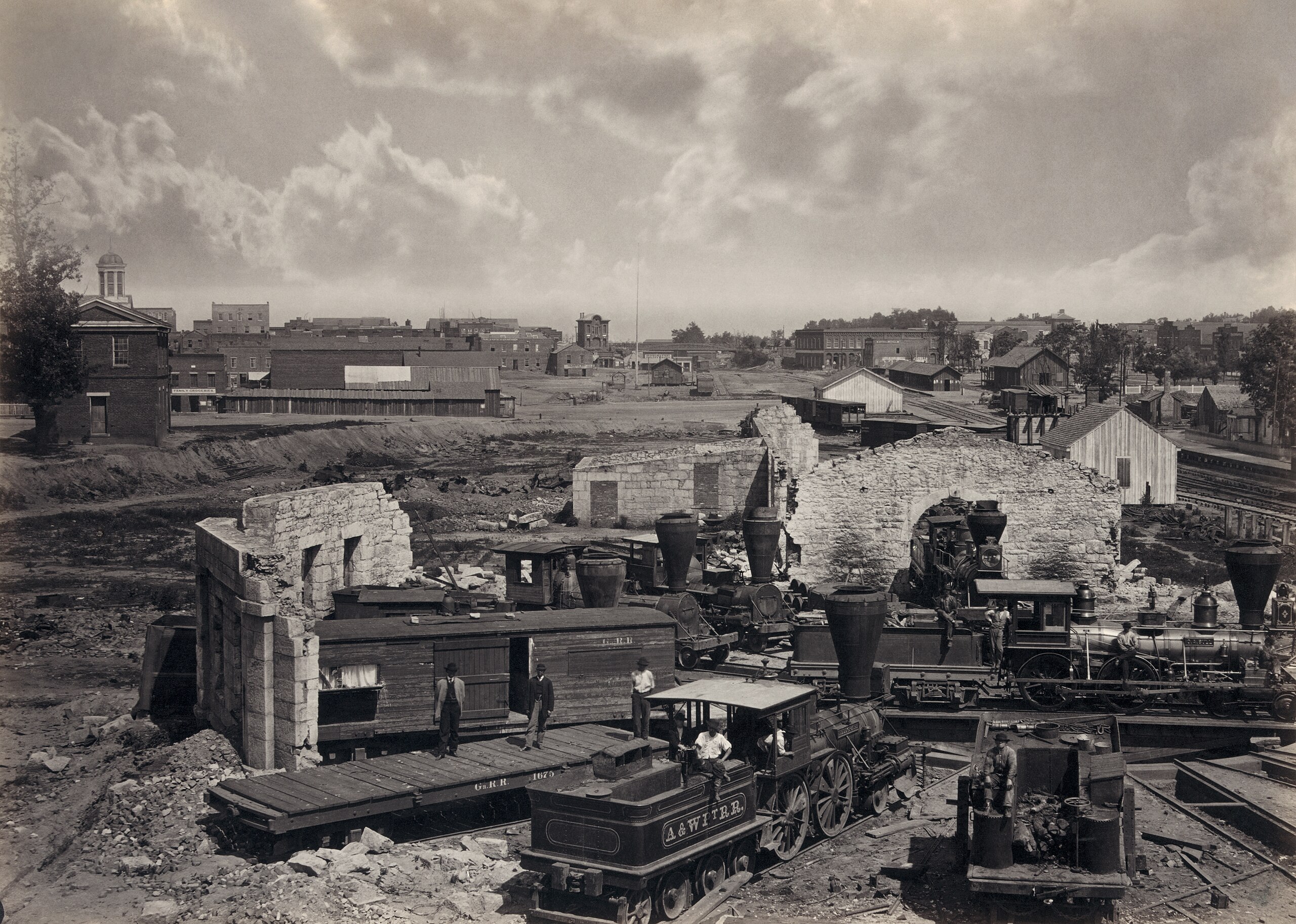

The ReconstructionReconstruction
Full Description:The period immediately following the Civil War (1865–1877) when the federal government attempted to integrate formerly enslaved people into society. Its premature end and the subsequent rollback of rights necessitated the Civil Rights Movement a century later. Reconstruction saw the passage of the 13th, 14th, and 15th Amendments and the election of Black politicians across the South. However, it ended with the withdrawal of federal troops and the rise of Jim Crow. The Civil Rights Movement is often described as the “Second Reconstruction,” an attempt to finish the work that was abandoned in 1877.
Critical Perspective:Understanding Reconstruction is essential to understanding the Civil Rights Movement. It provides the historical lesson that legal rights are fragile and temporary without federal enforcement. The “failure” of Reconstruction was not due to Black incapacity, but to a lack of national political will to defend Black rights against white violence—a dynamic that activists in the 1960s were determined not to repeat.
Read more Era (1865–1877) was a brief but turbulent attempt to remake Southern society and secure rights for formerly enslaved African Americans after the Civil War. Despite early achievements – including the abolition of slavery, constitutional amendments establishing Black citizenship and suffrage, and the advent of the South’s first interracial governments – Reconstruction is widely judged by historians to have ended in failure. By 1877, white supremacists had “Redeemed” the South, restoring almost total white Democratic control and ushering in nearly a century of segregation and disenfranchisement. The question of why this far-reaching experiment in interracial democracy failed has long been a subject of intense scholarly debate .
Researchers have identified a complex interplay of contributing factors, from political opposition and violent resistance to economic upheaval, judicial reversals, Northern fatigue, and the intransigence of Southern racism. At the same time, interpretations of Reconstruction’s failure have evolved dramatically over the past century. Historians have approached the era from varying ideological perspectives – from the openly racist Dunning School of the early 1900s to mid-20th-century revisionists, later post-revisionists, and the neo-abolitionist scholars influenced by the civil rights movement. Each school of thought has offered a distinct narrative of what went wrong during Reconstruction and why. This literature review will examine both the major factors behind Reconstruction’s collapse and the historiographical evolution of how those factors have been understood. Drawing on classic works and recent interdisciplinary studies, the review will synthesize key arguments – including political, social, and economic explanations – and critically analyze how interpretations of Reconstruction’s failure have changed over time. The goal is to provide a comprehensive overview of the scholarly conversation, noting major historians’ contributions (with publication years) and highlighting how newer cultural and sociological perspectives have enriched our understanding of this “unfinished revolution.”
Major Factors in the Failure of Reconstruction
Historical evidence suggests that no single cause doomed Reconstruction; rather, several interlocking factors undermined the effort to build a lasting multiracial democracy in the postwar South . Contemporary scholars generally point to a combination of political opposition, racial violence, economic challenges, adverse judicial decisions, waning Northern commitment, and unyielding Southern resistance as the main reasons Reconstruction fell short. Each of these factors reinforced the others, creating a context in which the promises of equal citizenship and racial justice could not be fully realized. This section reviews each major factor and the role it played in the collapse of Reconstruction.
Political Opposition and Leadership Conflicts
One critical factor was fierce political opposition to Reconstruction, both at the national level and within the South. President Andrew Johnson – who assumed office after Lincoln’s assassination in 1865 – emerged as a deeply obstructionist leader at the very outset of Reconstruction. Historians widely consider Johnson “the worst possible person” to lead the nation after the Civil War . A former slaveholder and a Democrat, Johnson was openly hostile to Black civil rights and aligned himself with former Confederates’ interests. He quickly implemented a lenient plan to restore ex-Confederate states with minimal changes, vetoed key Republican legislation (such as the Freedmen’s Bureau Bill and Civil Rights Act of 1866), and “eliminated all hope” of using executive power to expand Black rights . Instead of pressuring the South to reform, Johnson pardoned rebel leaders and acquiesced in the creation of restrictive Black Codes, angering Northerners who feared that the “Southern elite would regain its political power” and nullify the Union’s wartime achievements . By refusing to compromise and by “obstructing political and civil rights for blacks,” Johnson fundamentally undermined early Reconstruction efforts . Historian Elizabeth Varon concludes that Johnson’s actions were “principally responsible for the failure of Reconstruction to solve the race problem in the South” . Lacking presidential support, the task of Reconstruction fell entirely to Congress, leading to a politicized struggle between Radical Republicans (who sought robust changes in the South) and Johnson’s allies (who preferred the status quo). Johnson’s eventual impeachmentImpeachment Full Description:The constitutional mechanism by which a legislative body levels charges against a government official. It serves as the ultimate political remedy for “high crimes and misdemeanors,” designed to prevent the executive branch from becoming a tyranny. Impeachment is not the removal from office, but the formal accusation (indictment) by the legislature. In the context of the crisis, it represented the reassertion of congressional power against an executive branch that had grown increasingly unaccountable. The process forces the political system to decide whether the President is above the law.
Critical Perspective:While designed as a check on power, the process highlights the fragility of democratic institutions. It reveals that the remedy for presidential criminality is fundamentally political, not legal. Consequently, justice often relies on the willingness of the President’s own party to prioritize the constitution over partisan loyalty, a reliance that makes the system vulnerable to factionalism.
Read more in 1868 (though he was not removed) was a measure of how far out of step he was with Reconstruction’s goals .

Opposition also arose from Northern Democrats and conservative Republicans who grew wary of radical policies. In the 1866 midterm elections, Radical Republicans won large Congressional majorities and took charge of Reconstruction policy . But over time, a faction of Republicans known as “Liberal Republicans” (including figures like Horace Greeley) became disillusioned with military enforcement in the South and federal corruption under President Ulysses S. Grant. They began advocating reconciliation with “best men” of the South and an end to federal intervention. This split in Northern political will weakened the coalition for continued Reconstruction. Meanwhile, Southern white Democrats – often former Confederates barred from office at first – bitterly opposed the Republican-led state governments. They depicted Republican officials as illegitimate “carpetbaggers” (Northerners in the South) or “scalawags” (southern unionists), and they worked relentlessly to oust them. By the 1870s, Southern Democrats had rebranded themselves as “Redeemers” committed to “restoring white supremacy” and “reestablishing… Democratic Party control” of Southern states . Through a combination of violence, election fraud, and political organizing, these opponents picked off Republican state regimes one by one. For example, in Arkansas an armed Democratic uprising in 1874 (the Brooks–Baxter War) overthrew the Republican governor . The contested presidential election of 1876 then provided the final political blow. In the Compromise of 1877, Republican Rutherford B. Hayes received the presidency in exchange for agreeing to withdraw the last federal troops from South Carolina and Louisiana – effectively surrendering the South to Democratic “Redeemers” and ending Reconstruction . This political deal underscored a hard truth: the will to sustain Reconstruction had evaporated at the highest levels. As one analysis observes, postwar efforts “sought to reshape the American South at low cost” and eventually prioritized sectional peace over Black rights – making “compromise with the losers” of the war the price for restoring the Union, “with the price of peace being generations of injustice.” The political abandonment of Reconstruction in 1877 ensured that the legal and governmental changes achieved since 1865 would be largely rolled back by the resurgent white supremacist leadership in the South.
Racial Violence and White Terrorism
White supremacist violence, such as the burning of a Black school by a white mob in Memphis (1866) pictured above, was rampant during Reconstruction. From the earliest days of Reconstruction, organized racial violence was used to undermine the new social order. White supremacists in the South waged a campaign of terror against Black citizens and white Republicans, aiming to reverse Black emancipation and deter African Americans from exercising their new freedoms. Secret vigilante organizations – most infamously the Ku Klux Klan, founded in late 1865 – and later paramilitary groups like the White League (in Louisiana) and the Red Shirts (in Mississippi and the Carolinas) carried out “merciless violence” to overturn Reconstruction governments . They attacked Black voters, officeholders, and local Republican officials with impunity. Riots and massacres erupted: in Memphis and New Orleans in 1866, white mobs killed dozens of African Americans; in Colfax, Louisiana on Easter 1873, armed whites slaughtered as many as 150 Black militiamen and civilians who were defending a local courthouse – an episode so brutal that historians term it the Colfax Massacre . The number of lives lost to white terror during Reconstruction is impossible to know precisely, but it likely reached into the thousands . This racist violence had a devastating effect: it eroded the authority of Reconstruction regimes and spread fear that kept many Black people from voting or participating in public life. As historian Brooks Simpson notes, Reconstruction was fatally “undermined” by the combination of white supremacist violence in the South and white indifference in the North .
Crucially, the federal government’s response to this insurgent violence was inconsistent and ultimately insufficient. During Ulysses S. Grant’s first term, Congress and the President did take action against the Klan – passing the Enforcement Acts of 1870–71 (including the Ku Klux Klan Act) which made interference with voting rights a federal offense and empowered the Army to help suppress the Klan . These measures led to some federal prosecutions and a brief lull in Klan terror around 1872. However, white paramilitary activity soon resurfaced in new forms, and federal will to intervene waned. Grant’s administration grew reluctant to impose continued martial law in the South, especially as Northern public opinion turned against military involvement. By the mid-1870s, white terror was again rampant – e.g. the Mississippi “Shotgun Plan” of 1875 where armed Democrats used violence to win elections. One scholar argues that Reconstruction failed in part because the government “did not deploy enough troops or use them aggressively” to truly protect Black citizens . Washington’s “half measures” in countering Southern violence enabled the “Redeemers” to use intimidation and murder to retake power . Put simply, it proved politically impossible to sustain a prolonged military occupation to enforce Black rights in the face of relentless grassroots violent resistance. The consequence was that by 1877, white supremacists had successfully “terrorized” much of the Black electorate into submission. As historian Eric Foner observes, the tragic outcome was that the “suppression of the rights of African Americans” – through violence and terror – became the greatest “scandal” of the Reconstruction era, far overshadowing the sporadic incidents of corruption that opponents trumpeted . The systematic campaign of racial terrorism did not merely accompany Reconstruction’s end; it caused that end by making it impossible to establish the rule of law and interracial democracy in the postwar South.
Economic Crisis and Labor Transformations
Economic forces also played a significant role in Reconstruction’s demise. The post-Civil War South was economically devastated – cities in ruins, plantations bankrupt, and the formerly enslaved populace destitute. A central challenge of Reconstruction was how to reorganize Southern labor and land ownership in the transition from slave to free labor. Early hopes existed among some freedpeople and Radical Republicans that there might be a substantial land redistribution (the famous yet unfulfilled promise of “forty acres and a mule”) to empower Black farmers. However, President Johnson’s policies quickly dashed those hopes by ordering nearly all confiscated or abandoned lands returned to ex-Confederates . Lacking land or capital, most freedmen had little choice but to work for white landowners, often under oppressive sharecropping and tenant farming arrangements that kept them in poverty and debt. This new labor system was a tenuous compromise that averted starvation but did not bring genuine economic independence for African Americans. Many Radical Republicans believed that economic uplift of the freedmen was essential for Reconstruction’s success, but meaningful economic reforms (land grants, large-scale public education funding, etc.) were largely thwarted by resistance and ideology. As early as the late 1860s, Black leader Booker T. Washington observed that the “Reconstruction experiment in racial democracy failed because it began at the wrong end” – focusing on political rights rather than “economic means” and self-sufficiency for the Black community . In other words, without an economic foundation, the political advances of Reconstruction were fragile.
National economic developments further undercut Reconstruction in the 1870s. Most damaging was the Panic of 1873, a severe financial depression that spread hardship across the country. The Panic “hit the Southern economy hard and disillusioned many Republicans” who had banked on railroad-building and business investment to lift the South out of poverty . As cotton prices plunged and credit dried up, the region sank deeper into destitution. Many small white farmers and merchants went bankrupt, while planters fiercely resisted any calls to raise Black workers’ wages. The economic downturn had political repercussions: Northerners, facing their own unemployment and business failures, grew less concerned with Southern problems and more anxious for national recovery. In the 1874 midterm elections, amid the depression, Northern voters punished the ruling Republicans (associated with ongoing Reconstruction expenses and scandals), sweeping Democrats into control of the U.S. House of Representatives for the first time since the war . This Democratic resurgence at the national level meant far less appetite in Congress for spending money to enforce Reconstruction in the South. Economic fatigue fed directly into Reconstruction fatigue. Even many idealistic Republicans lost confidence that they could remake the Southern economy or guarantee Black prosperity. Railroad schemes failed, new industries lagged, and sharecropping spread as a compromise labor system. By 1877, white “Whiggish” planters – the pre-war elite – had “reestablished” themselves economically as well, regaining control over land and labor to the extent that the old agrarian order, minus slavery, largely persisted . Eric Foner notes that the swift economic restoration of the traditional planter class by the mid-1870s was one factor enabling white elites to resume political power, as Black labor remained exploitable and politically powerless in the face of economic dependence . In sum, the failure of Reconstruction was tied to the failure of land reform and economic transformation: without altering the South’s economic power structure, any political reforms were built on quicksand.
Supreme Court Setbacks and Legal Rollback
While Congress passed landmark constitutional amendments and civil rights laws during Reconstruction, the federal judiciary – and especially the Supreme Court – proved hostile to using federal power to protect Black rights, delivering a series of decisions that significantly curtailed Reconstruction’s effectiveness. These judicial decisions form another key piece of Reconstruction’s collapse. As the composition of the Supreme Court became more conservative in the 1870s (Chief Justice Morrison R. Waite presided after 1874), the Court began interpreting Reconstruction laws and amendments in narrow ways that favored state authority and white conservatives. In the Slaughter-House Cases (1873), the Court issued its first major ruling on the new 14th Amendment. It sharply limited the amendment’s scope, distinguishing between national and state citizenship and declaring that most civil rights remained under state (not federal) control. This gutted the 14th Amendment’s intent to have the federal government secure equal rights, as it meant that discriminatory state laws might not violate the federal Constitution . Subsequent decisions were even more destructive. In United States v. Cruikshank (1876) – a case arising from the Colfax Massacre – the Supreme Court overturned the federal convictions of white militia members who had slaughtered Black Louisianans. The Court ruled that the 14th Amendment’s Equal Protection clause applied only to state actions, not to the actions of individuals, thereby making it virtually impossible for the federal government to prosecute white terrorists (since the attackers were private citizens, not state officials). The Cruikshank decision, as one legal scholar notes, should be “at the heart of the American constitutional canon” for its devastating impact: it essentially “snubbed” the federal government’s ability to punish or prevent racial violence, leaving such matters to state courts that routinely refused to convict white perpetrators . Likewise, in U.S. v. Reese (1876) the Court narrowly construed the 15th Amendment, opening the door for states to impose voting restrictions (like literacy tests) as long as they were not overtly based on race. Finally, not long after Reconstruction’s formal end, the Supreme Court’s Civil Rights Cases (1883) struck down the Civil Rights Act of 1875 (which had outlawed racial discrimination in public accommodations), declaring Congress could not regulate private acts of discrimination. These decisions, taken together, “dismantled previous congressional civil rights legislation” and affirmed that Reconstruction’s egalitarian promises would not be enforced by the judiciary .
Many historians argue that the Supreme Court’s interpretations badly weakened the Reconstruction Amendments just as they were most needed. Eric Foner observes that an enduring failure of Reconstruction was the lack of “a permanent federal agency specifically designed for the enforcement of civil rights”, which, combined with hostile court rulings, left African Americans with rights on paper but little protection in practice . In essence, the judicial branch helped codify the retreat from Reconstruction. The rulings gave legal cover to white-dominated state governments to implement what became the Jim Crow system. Without robust courts to uphold Black rights, any gains of Reconstruction could be eroded or ignored at the local level. Thus, judicial decisions did not alone cause Reconstruction to fail – but they greatly hastened its failure by ensuring that white supremacists faced few legal obstacles in stripping away Black political power. By the late nineteenth century, the Supreme Court had largely eviscerated the legacy of Reconstruction, prompting one scholar to dub this period a “rollback” of America’s second founding .
“Northern Fatigue” and Waning Commitment
Reconstruction was as much a Northern political project as a Southern one, and by the mid-1870s the Northern public’s commitment to enforcing racial equality in the South had severely diminished. This “Northern fatigue” or retreat in willpower is frequently cited as a pivotal factor in Reconstruction’s collapse. Several dynamics fed into Northern apathy. First, time itself eroded passion: as the Civil War receded into memory, fewer Northerners felt obligated to keep up a costly struggle over Southern racial issues. The abolitionist generation was literally dying off or aging out of public life by the 1870s, and “the old abolitionist element in the North was aging away, or had lost interest, and was not replenished” by a younger cohort . After a decade of intense focus on the South, many white Northerners simply wanted to move on. The expanding industrial economy and western frontier beckoned their attention, as did other national concerns (like monetary policy, immigration, and corruption in government). The idealism of the immediate postwar years gave way to pragmatism and racial indifference. As one historian puts it, the Northern public by the early 1870s had “hoped to put Reconstruction behind it” .
Furthermore, a racist consensus was by no means confined to the South. Anti-Black sentiment and “indifference of white supremacy in the North” (in Simpson’s words) dulled Northern willingness to intervene for Black rights . Many Northern whites, while opposed to slavery, harbored prejudice and did not strongly support Black social equality or political office-holding. Once the urgency of war had passed, those lukewarm racial attitudes resurfaced. Racial violence and upheaval in the South, rather than outrage the entire North, often bred a sense of “weariness” and frustration. White voters grew tired of the “negro question” and skeptical about Blacks’ capacity or willingness to assume equal citizenship. Democratic propaganda about “Black misrule” in the South found a receptive audience among some Northerners, especially as Reconstruction governments gained a reputation (sometimes exaggerated) for corruption and high taxes. The Grant administration’s own scandals (like the Whiskey Ring) further tarnished the Republican Party’s moral authority, making it easier for Northerners to distance themselves from Reconstruction’s aims. By 1874, as noted, Democrats campaigning on economy and reconciliation won sweeping victories in Northern districts . Even President Grant, once a firm supporter of Reconstruction, showed signs of losing enthusiasm by his second term – he “seemed to be losing interest in the South,” as one account notes, mirroring the public mood .
This ebbing Northern resolve had decisive consequences. It meant that when Southern Redeemers intensified their violent suppression of Black voters in the mid-1870s, the outcry from the North was muted. Congressional Republicans in 1875–76 were unable to pass new measures to shore up Reconstruction, lacking public support. In 1875, for example, a last-ditch federal elections bill (the Lodge Force Bill) to protect Black voting rights failed amid national indifference, and President Grant declined to send troops to Mississippi during the notorious violent campaign of 1875. A kind of “exhaustion with the effort” set in among Northerners – a belief that Reconstruction had run its course and that it was now up to Southerners to handle their own affairs (even if that meant abandoning the freedmen). Northern newspapers and politicians by 1876 were often calling for sectional reconciliation and de-emphasizing the plight of Southern Blacks. One contemporary Republican lamented that even “among the friends of justice in the North, interest in the rights of the Negro was waning”, drowned out by other issues . Thus, when the contested 1876 election gave Northerners an opportunity to sacrifice Reconstruction for the sake of political stability, they did so with little hesitation. The Compromise of 1877, in which Northern leaders traded away the remaining federal protection for Southern Blacks, was a reflection of this fatigue-fueled consensus. Without sustained Northern political will, Reconstruction simply could not survive; as Frederick Douglass bitterly remarked, “the law on the side of freedom is of great advantage only where there is power to make that law respected” – and by 1877, the Northern power to enforce the laws of Reconstruction had evaporated.
Unyielding Southern Resistance and “Redemption”
Finally, underlying all of the above was the persistent, deeply entrenched resistance of Southern white society to racial equality and Republican rule. At its core, Reconstruction was a revolution imposed on the South, and it faced relentless pushback from those most threatened by its aims. Southern resistance took many forms – legal, violent, economic, and cultural – but together they constituted a force that Reconstruction ultimately could not overcome. From the outset, ex-Confederate elites and the majority of southern whites refused to accept the notion of Black equality. In 1865–66, Southern state legislatures (dominated by whites Johnson had pardoned) passed the Black Codes to keep freedmen in quasi-slavery, demonstrating the lengths to which they would go to maintain white dominance . When Congressional Republicans instituted Radical Reconstruction and Black men began voting and holding office, the response in much of the white community was outrage and disbelief – a mindset perpetuated by deeply racist beliefs. As one historian summarized, white Southerners widely saw Reconstruction as nothing less than “Black domination” imposed by vindictive Yankees, and they felt justified in resisting it by any means . The Democratic Party in the South harnessed this sentiment through constant propaganda, asserting they were “redeeming” their states from corruption and “Negro misrule.” The ideology of white supremacy became even more virulent as a rallying cry during these years. Southern resistance was not simply a series of incidents; it was an organized social movement that permeated everyday life. Ministers preached against racial equality, editors fulminated against “alien” Republican regimes, and “respectable” citizens often condoned the violence of the Klan or other groups by their silence . In this climate, Black Southerners faced not only episodic terror but systematic intimidation in courts, in employment, and in social interaction. Every advance by Black citizens (a school opened, a Black official elected, a Black militia mustered) met concerted white pushback. The cumulative effect was to make Reconstruction unsustainable once Northern support waned.
By the 1870s, Southern white resistance had coalesced into the “Redeemer” governments – coalitions of conservative Democrats who regained power in one state after another, promising to restore “home rule” (i.e. white rule). Starting with Virginia and North Carolina in the late 1860s, then Georgia and Texas by 1873, and finally the last Republican holdouts (Louisiana, South Carolina, Florida) by 1877, all the former Confederate states were “redeemed” . These victories were achieved through open defiance of federal authorities (as happened in the Louisiana’s dual governments crisis of 1872–73) and through the suppression of Black votes. Redeemers promptly cut back the reforms of Reconstruction – for instance, rolling back public school funding, instituting convict labor systems, and legalizing practices that disadvantaged Black laborers. The “continuity between the Old South and the New” was striking, as post-Reconstruction Southern governments resembled the pre-war order in many respects . White Southerners also constructed a sympathetic narrative of their resistance through what later came to be known as the “Lost Cause” mythology. In this telling – influential in later historical writing and popular culture – Reconstruction was portrayed as a tragic period where vindictive Northerners and ignorant freedmen oppressed the South, until noble Southern whites reclaimed their rightful place . This mythology justified the South’s resistance as an honorable struggle, and it erased the violent and anti-democratic reality of how “Redemption” was actually achieved. The prevalence of such attitudes meant that, even had Northern enforcement continued longer, Southern society’s intransigence and unwillingness to genuinely share power with Black citizens would have remained major obstacles. As Foner notes, the “tragedy of Reconstruction” was ultimately that it failed “because Whites raised an insurgent movement to restore White supremacy”, defeating the interracial democracy that had briefly flourished . In short, Southern resistance – the steadfast refusal of most white Southerners to accept the new order – was the rock against which the waves of Reconstruction broke. All other factors (political, economic, etc.) created conditions for retreat, but it was white Southern defiance, unquenched from 1865 onward, that ensured that retreat would be permanent.
In summary, the failure of Reconstruction stemmed from a convergence of these factors: hostile national leadership under Johnson, the determined insurgency of ex-Confederates and white supremacists, pervasive anti-Black violence, economic instability, judicial indifference to civil rights, and a collapse of Northern political will. As Eric Foner succinctly observed, Reconstruction was “a noble if flawed experiment, the first attempt to introduce a genuine inter-racial democracy in the United States,” but multiple internal and external forces combined to defeat it . From the perspective of Black Americans, the end of Reconstruction was an unmitigated failure – a betrayal that left them at the mercy of reactionary Southern governments for nearly another century . The following sections will explore how historians have interpreted these events over time, tracing the historiographical debates about why Reconstruction failed and what its failure meant.
Historiographical Schools of Thought on Reconstruction’s Failure
The understanding of Reconstruction’s failure has not been static; it has been reshaped by generations of historians, often reflecting the social attitudes and scholarly trends of their times. Broadly, Reconstruction historiography has passed through several major phases: the Dunning School of the early 20th century offered the first academic consensus, blaming Reconstruction’s failure on what it saw as the incompetence of Black politicians and the folly of Radical Republicans. In the mid-20th century, revisionist historians emerged to challenge and overturn the Dunning narrative, emphasizing the progressive achievements of Reconstruction and viewing its demise as a tragic missed opportunity rather than a foregone necessity. In the post-Civil Rights era, post-revisionist scholars introduced new complexity, arguing that Reconstruction, while transformative, was also limited by conservative constraints and perhaps destined to leave many issues unresolved. Meanwhile, a group of scholars sometimes termed neo-abolitionists (often overlapping with the revisionists) approached the period with a moral urgency inspired by the civil rights movement, focusing on African American agency and the tragedy of racial injustice. In recent decades, interdisciplinary approaches – including cultural, social, and gender studies – have further enriched the historiography, moving beyond strictly political narratives to include how Reconstruction was experienced and remembered. This section reviews each major school of thought, highlighting key works and interpretations, and analyzes how explanations for Reconstruction’s failure have shifted from one school to the next.
The Dunning School (1900s–1920s): Reconstruction as “Tragic Era”
In the late 19th and early 20th centuries, the dominant scholarly interpretation of Reconstruction was overwhelmingly negative. This view reached its zenith with the Dunning School, named after Columbia University historian William A. Dunning, who trained a generation of scholars in the early 1900s that authored state-by-state studies of Reconstruction. The Dunning School portrayed Reconstruction as a disastrous mistake – a “tragic era” in which vindictive Northerners and foolish idealists imposed Black suffrage on the prostrate South, leading to misgovernment, corruption, and social chaos until heroic white Southerners “redeemed” their states. In the Dunning paradigm, the failure of Reconstruction was practically preordained – and indeed, the termination of Reconstruction was seen as a positive and necessary restoration of legitimate government. Dunning himself, in his influential book Reconstruction, Political and Economic (1907), characterized the period as one of “anguish and humiliation” for Southern whites, blaming the problems on the sudden empowerment of a “vast ignorant black proletariat” unfitted for self-government. His followers echoed these racist themes. As summarized by historian T. Harry Williams, the Dunning School depicted Reconstruction as “a battle between two extremes: the Democrats, representing the vast majority of Southern whites and standing for decent government and racial supremacy, versus the Republicans – the Negroes, alien carpetbaggers, and renegade scalawags – standing for dishonest government and alien ideals.” In this telling, the failure of Reconstruction was attributed chiefly to the “unqualified Blacks” thrust into positions of power, allegedly manipulated by corrupt Northern carpetbaggers . The clear implication was that Black Americans were incapable of governing and that their participation in politics led inevitably to graft and incompetence.
The Dunning School view also held that Reconstruction policies were far too harsh on the South. President Andrew Johnson was treated more favorably in these accounts (sometimes even praised for trying to uphold constitutional principles against Radical “usurpers”). The Radical Republicans, by contrast, were castigated as vindictive zealots who foolishly attempted to “fasten black supremacy upon the defeated South”, as Foner explains of the Dunning narrative . In essence, Dunningites saw Reconstruction’s failure as a justifiable outcome: a corrupt social experiment rightly overthrown by Southern whites. Influential popular writers in this tradition, such as Claude Bowers (whose book The Tragic Era (1929) was widely read), painted lurid pictures of “orgies of corruption presided over by unscrupulous carpetbaggers… and ignorant freedmen” . Missing from these early accounts was any acknowledgment of the terrorism and violence used to topple Reconstruction – those aspects were glossed over or even rationalized as necessary resistance. The Dunning School thus essentially celebrated the failure of Reconstruction as redemption. As W.E.B. Du Bois caustically observed in 1935, white historians of this era had an almost propagandistic consensus: “White historians have ascribed the faults and failures of Reconstruction to Negro ignorance and corruption,” refusing to credit Black achievements or loyalty . Notably, a few voices outside the white academic mainstream dissented early on – for instance, Black historians like William Wells Brown and John R. Lynch defended the legitimacy of Reconstruction governments in memoirs and essays around the turn of the century, and novelist Albion Tourgée (a Radical Republican insider) wrote contemporaneously about Reconstruction’s challenges. But their works were marginalized. The Dunningites dominated the prestigious histories and university presses, cementing their interpretation for decades.
By the 1920s, this view had seeped into American popular culture, exemplified by films like “The Birth of a Nation” (1915) and literature like “Gone With the Wind” (1936), which echoed the notion of noble whites saving the South from incompetent Blacks. The Dunning School’s legacy was a pervasive belief – among academics and the general public – that Reconstruction had been a mistake best undone. Reconstruction’s failure, in this view, needed little explaining beyond pointing to the supposed folly of granting rights to African Americans. Only in the 1930s and 1940s would this consensus begin to crack, as new scholarly approaches and changing political climates prompted historians to reconsider this deeply biased narrative.
Early Revisionists (1930s–1940s): Economic Determinism and Challenging the Orthodoxy
The first significant challenge to the Dunning interpretation emerged in the interwar period, influenced by the broader trend of Progressive-era historiography and the ideas of economic determinism championed by historian Charles A. Beard. These revisionist historians did not necessarily celebrate racial equality or the rights of freedmen, but they did revise the explanation for why Reconstruction took the course it did. Foremost among them was Howard K. Beale, a student of Beard who completed a dissertation in 1924 offering a radically different interpretation of Reconstruction’s failure. Beale and the Beardians argued that economic interests – rather than high-minded concern for freedmen or pure racial hatred – drove the trajectory of Reconstruction. In their view, Northern industrial capitalists had used Reconstruction to secure their own economic dominance after the Civil War, and once those goals were achieved, they abandoned the political project of Black rights. Beale contended that the rhetoric of civil rights and equality was largely a cynical cover for economic motives. Famously, he dismissed the lofty constitutional debates of the era as so much “claptrap” and “pure sham.” As Beale wrote, “Constitutional discussions of the rights of the Negro, the status of Southern states, the powers of Congress and the president determined nothing. They were pure sham.” According to this interpretation (often called the “Beard–Beale thesis”), Reconstruction failed not because Black people were unfit to govern, but because Northern business interests and political leaders made a calculated decision that pursuing racial justice was less important than reconciliation with Southern whites to ensure a stable nation for commerce.
This economic revisionist school thus flipped the moral script of Dunning: rather than blaming African Americans for Reconstruction’s failures, it blamed greedy Northern capitalists and politicians for sacrificing African Americans. In Beale’s narrative, both Southern whites and Southern Blacks were pawns of Northern big business. The end of Reconstruction came about when Northern industrialists no longer needed the Republican alliance with Southern Black voters – especially after the Panic of 1873 refocused attention on national economic recovery. As evidence, revisionists pointed to things like the economic concessions of the 1877 Compromise (e.g. promises of railroad subsidies for the South) and the lopsided interests of Northern Republicans (many of whom cared more about tariffs and railroads than Black suffrage). The Beardian interpretation downplayed the racism and violence of Redemption, instead suggesting that class and economic self-interest sealed Reconstruction’s fate. Some works in this vein even implied that Radical Republicans’ push for equality had been a tactical error or illusion all along, as the true engine was economic.
A related thread in the 1930s was a growing interest in class conflict during Reconstruction. While still largely adhering to a white perspective, historians like Beale saw the period as a struggle of elites vs. masses, with rich Northern capitalists dispossessing the old Southern planter class (the “slaveocracy”) and then effectively colonizing the South economically. Indeed, Charles Beard in The Rise of American Civilization (1927) described the Civil War and Reconstruction as a “social cataclysm” in which “the Northern capitalists… drove from power the planting aristocracy of the South,” then imposed policies favorable to business . Beard even cynically suggested the 14th Amendment’s clauses (like due process and equal protection) were primarily designed to protect corporate interests (using Black rights as a pretext) . In this materialist reading, Reconstruction’s failure to deliver on its egalitarian promises was essentially inevitable once Northern capital had secured its victory; the idealism was a facade.
While the Beardian revisionists shifted focus from racist incompetence to economic causes, it’s important to note that they still tended to conclude that Reconstruction was a failure – only for different reasons. They saw it as a failure for the common folk (black and white) because it was manipulated by Northern elites. Notably, W.E.B. Du Bois’s seminal work Black Reconstruction in America (1935) appeared in this same era and offered a very different revisionist perspective – one centered on Black labor and a Marxist analysis of Reconstruction as a moment of “dictatorship of labor” briefly established in the South. Du Bois forcefully argued that Black workers and poor whites had potential to unite and democratize the South, but were betrayed by Northern capital and their own ignorance. He meticulously documented Black contributions and the achievements of Reconstruction governments (public schools, social services) to refute Dunning School lies . Du Bois famously asserted that the true tragedy was the unwillingness of the country to support Black freedom, not any failing of Black Americans themselves. However, Du Bois’s work – coming from a Black scholar and infused with socialist analysis – was largely ignored or dismissed by the mainstream (white) academy at the time . It would take decades for Black Reconstruction to gain recognition as a classic.
By the late 1940s, the Beard/Beale economic interpretation itself came under critique as historians found it one-sided and lacking evidence of a unified Northern capitalist plan. Scholars like Stanley Coben and Robert Sharkey showed that Northern Republicans were not monolithic in economic interests (for example, they were divided on tariffs, currency, etc.), and thus the notion of a grand economic conspiracy was overblown . They also argued that many Republicans did sincerely care about civil rights – contra Beale’s cynicism . As the Beardian view lost favor, space opened for a new wave of scholars who would incorporate both racial and economic insights, leading to the next major shift in Reconstruction historiography during the mid-20th century.
“Neo-Abolitionist” RevisionismRevisionism Full Description:Revisionism was framed as the greatest threat to the revolution—the idea that the Communist Party could rot from within and restore capitalism, similar to what the Chinese leadership believed had happened in the Soviet Union. Accusations of revisionism were often vague and applied to any policy that prioritized economic stability, material incentives, or expertise over ideological fervor. Critical Perspective:The concept served as a convenient tool for political purging. It allowed the leadership to frame a factional power struggle as an existential battle for the soul of socialism. By labeling pragmatic leaders as “capitalist roaders,” the state could legitimize the dismantling of the government apparatus and the persecution of veteran revolutionaries. (1950s–1960s): Rediscovering Reconstruction’s Promise
The civil rights movement of the 1950s and 1960s not only transformed American society, it also transformed the study of Reconstruction. In this period, a group of historians whom we might call the neo-abolitionists – essentially, revisionists inspired by contemporary struggles for racial equality – forcefully rejected the racist assumptions of the Dunning School and rehabilitated the reputation of Reconstruction. Pioneering works by scholars such as John Hope Franklin (Reconstruction after the Civil War, 1961), Kenneth M. Stampp (The Era of Reconstruction, 1965), Leon Litwack (North of Slavery, 1961; later Been in the Storm So Long, 1979), and eventually Eric Foner (whose doctoral work in the 1970s and culminating book in 1988 we’ll discuss shortly) argued that Reconstruction had been a noble effort to build a true democracy on the ashes of slavery – an effort that was undermined not by Black failure but by white violence and northern retreat. These historians, many of them writing as the civil rights movement was breaking Jim Crow, saw clear analogies between the second-class citizenship of Blacks in 20th-century America and the tragic abandonment of Blacks in 1877. They thus approached Reconstruction with what one might call an anti-racist or abolitionist spirit, determined to set the record straight and give credit to the era’s achievements.
The neo-abolitionist scholars dismantled the old myths one by one. They showed that so-called “Black Reconstruction governments” were not dominated by illiterate freedmen – in fact, no Southern state legislature ever had a Black majority, and many Black leaders were quite capable and forward-thinking. Corruption, they admitted, existed under Reconstruction (as it did in all Gilded Age governments) but it was “no worse” than the corruption in Northern cities like New York under Boss Tweed . The neo-abolitionists emphasized the progressive legislation of Reconstruction regimes: establishing public school systems, expanding social services, and extending legal rights. Kenneth Stampp, for instance, highlighted how these governments tried to rebuild state infrastructures and foster racial justice, describing their program in positive terms. The revisionist view held that Reconstruction, far from an evil conspiracy against the South, was a valiant attempt to implement the egalitarian principles of the Civil War’s aftermath. Its failure, therefore, was a tragedy – not because of “Black incapacity” but because the nation did not sustain the effort to truly remake Southern society. John Hope Franklin succinctly noted that Reconstruction’s promises were cut short, leaving the country with “unfinished business” of racial equality that would have to be addressed later.
In 1960s revisionist works, blame for Reconstruction’s demise was reallocated primarily onto the white South (for violent resistance and intransigence) and the North (for giving up). As Stampp put it, if there was a tragedy, it was “the inadequate effort to bring the freed slaves into the mainstream of American society”, not any supposed overreach by Blacks . In fact, Stampp explicitly turned the old Dunning language on its head: the real tragedy was that Reconstruction was cut short, not that it was attempted. One representative thesis of this school is that of historian Allan Nevins (writing in 1949, slightly earlier than the peak revisionists but reflecting the shift in tone): Nevins argued that given more time and protection, Reconstruction could have succeeded, but it was thwarted by terrorism and northern indifference. This line of reasoning held that the goals of the Radical Republicans were laudable and might have permanently changed the South had they been fully carried through.
These neo-abolitionist revisionists also brought African Americans’ perspective to the forefront. They lauded the courage and agency of the freedmen – how they seized opportunities to vote, hold office, found churches and schools, and petition for land. Works like Franklin’s and Stampp’s took care to acknowledge Black leadership (e.g. men like Frederick Douglass, Robert Smalls, Blanche K. Bruce, and others). The very term “Black Reconstruction” (coined by Du Bois) gained wider use to signify that African Americans were active makers of their own history during this era, not just passive victims or pawns. This was a dramatic departure from the Dunning School’s caricatures. In short, by the late 1960s a new consensus was forming in academia: Reconstruction was “America’s unfinished revolution” (to quote the subtitle of Foner’s later book), a bold democratic experiment that failed largely because of white resistance and lack of national will. The moral evaluation of Reconstruction flipped from negative to positive – it became something to be mourned for failing, rather than something to be celebrated for ending. Eric Foner later noted that by the mid-20th century, “well into the twentieth century Reconstruction was seen by many Americans as a ‘tragedy’ in which vindictive Radical Republicans fastened black supremacy… unleashing an orgy of corruption,” but that view gave way as historians revisited the era and recognized the “first great struggle for racial equality” in American history .
It’s worth mentioning that even during this triumphant revisionist wave, not all voices were in agreement. Some Southern historians (like Francis B. Simkins) offered a more moderate critique, and others tried to cling to aspects of the old view. But by around 1970, the Dunning interpretation had been definitively overturned in scholarly circles – a fact underscored when the last prominent Dunning-influenced historian, C. Vann Woodward (who was actually more nuanced and critical of the South in certain ways), acknowledged the achievements of the revisionists. The stage was set for even more nuanced analyses. With the basic narrative reframed – i.e. Reconstruction was a noble effort crushed by racism – historians in the 1970s began to ask new questions about limitations within Reconstruction itself, leading to what we call the post-revisionist school.
Post-Revisionist Perspectives (1970s–1980s): Limits, Continuities, and Unfulfilled Revolutions
In the 1970s and 1980s, a number of historians – building on the sympathetic view of Reconstruction established by the revisionists – began to introduce more nuanced interpretations that neither vilified Reconstruction as the Dunning School did, nor idealized it as some early revisionists might have been prone to do. These post-revisionist scholars largely agreed that Reconstruction was a laudable attempt at change, but they emphasized the constraints and continuities that blunted its impact. In essence, post-revisionists argued that Reconstruction did not go far enough and that it left many “old South” institutions intact, which helps explain why its gains proved ephemeral.
One key post-revisionist theme was the “conservatism” of Radical Republican policy . Historians like Michael Les Benedict and William Gillette argued that even the so-called Radical leaders were in some ways limited by their adherence to American constitutional traditions and to middle-class values. In a famous 1974 article, Michael Les Benedict contended that Radical Republicans were actually quite conservative on many issues – for instance, they were unwilling to fundamentally alter property relations or states’ rights beyond a certain point . They sought to preserve the Constitution (hence Benedict’s title, “Preserving the Constitution: The Conservative Basis of Radical Reconstruction” ) as much as to achieve racial justice. From this view, Reconstruction failed partly because its architects lacked the revolutionary zeal or tools to truly remake Southern society. They did not redistribute land or create lasting economic foundations for Black freedom; they tried to work within existing frameworks, which limited the outcomes. In a sense, post-revisionists shifted some focus back onto internal shortcomings of the Reconstruction effort (though not in a racist way as Dunning did, but in a structural way).
Another aspect of post-revisionism was highlighting how quickly the “old order” reasserted itself in the South, suggesting a deep continuity that Reconstruction only superficially interrupted. Scholars like William McFeely (in Grant: A Biography, 1981) and others noted that many white Southerners regained local influence even before 1877 (through elections or violence), and that Northern Republicans often chose to ally with pre-war Southern elites (the planters or urban businessmen) rather than with the poorer freedmen. Thus, Reconstruction governments often ended up conciliating the old guard (for example, not pushing land reform, allowing some ex-Confederates back into power relatively soon) in hopes of stabilizing their rule. The continuity thesis posited that because social and economic power in the South remained with whites – planters still owned land, merchants controlled credit, and so on – the formal political revolution could not sustain itself. Post-revisionists stress that much of the South’s social structure went unchanged, undermining the potential for lasting transformation . Historian Peter Kolchin, for example, examined the postwar labor systems and argued that sharecropping and labor laws preserved planter control in new forms.
Importantly, post-revisionists did not reverse the moral valuation established by the revisionists: they still saw Reconstruction’s end as regrettable and largely due to white supremacist victory. But they injected a note of realism and sometimes pessimism about how much could have been achieved under the circumstances. Some even questioned whether different choices might have led to a significantly different outcome, given the magnitude of Southern white resistance and the limits of Northern commitment. For instance, Herman Belz (in Emancipation and Equal Rights, 1978) assessed Reconstruction’s legal legacy and suggested that 19th-century Americans (including Radicals) had a limited conception of how to enforce equal rights, contributing to the failure. The “unfinished revolution” metaphor (popularized by Foner in the 1980s) itself implies that Reconstruction carried unfulfilled potential that perhaps could not have been fully realized at that time.
By the 1980s, the scholarship was marked by synthesis as well. Eric Foner’s Reconstruction: America’s Unfinished Revolution, 1863–1877 (1988) is often seen as a culmination of both revisionist and post-revisionist insights – and Foner is frequently described as a post-revisionist or neo-abolitionist (the labels overlap). Foner’s massive study incorporated the perspectives of freedpeople, analyzed economic and class dimensions, and acknowledged the limitations of Republican reformers. He portrayed Reconstruction as a radical moment of change that for a time brought genuine progress (citizenship, voting rights, schools, political representation for African Americans) but ultimately failed due to a combination of factors largely external (white resistance, economic downturn, northern retreat) and internal (the Republican Party’s internal divisions and limited socioeconomic vision). Foner famously dubbed Reconstruction an “unfinished revolution”, highlighting that the goals of equal rights and social justice were left incomplete . He concluded, in a 1990 epilogue, that from the vantage of Black Americans, “Reconstruction must be judged a failure”, since it did not secure their rights long-term . Yet Foner, like others of this era, also underscored that it was a “noble… experiment” and the first attempt at interracial democracy , keeping alive the memory of what could have been.
In summary, post-revisionist scholarship added layers of complexity: it agreed with the revisionists that Reconstruction’s demise was due to white supremacy’s resurgence, but it also analyzed the inherent weaknesses in the Reconstruction program and the continuity of old power structures that made that resurgence possible. Reconstruction, in this telling, was less a total failure than a “halfway revolution” – radical in intent but moderate in execution – that was ultimately overwhelmed by opposition. This perspective is more critical of Reconstruction leaders than the earlier revisionists were (for example, pointing out that Radicals too often allied with wealthy Southern whites and didn’t economically empower the freedmen), yet it maintains a fundamentally sympathetic stance toward the era’s aims.
Recent and Interdisciplinary Interpretations: Memory, Gender, and Beyond
Since the late 20th century, Reconstruction historiography has further broadened, influenced by cultural studies, social history, and other interdisciplinary approaches. Historians have increasingly explored how Reconstruction was experienced by various groups (women, children, planters, yeomen farmers, etc.) and how it has been remembered in American culture, adding new dimensions to understanding its failure and legacy. Rather than seeing Reconstruction purely in political terms, these studies look at race relations, class dynamics, gender roles, and ideological narratives that persisted long after 1877.
One important strand has been the study of historical memory of Reconstruction. David W. Blight’s work, for example, though more focused on Civil War memory, illuminates how postwar reconciliation between Northern and Southern whites was achieved at the expense of Black rights – essentially by embracing a narrative that marginalized the true causes and results of Reconstruction. Blight and others show that by the early 20th century, the “Lost Cause” mythology and Dunning-influenced histories had won over the national imagination: Americans came to view Reconstruction as a regrettable mistake, a narrative reinforced by films like The Birth of a Nation (1915) which glorified the Ku Klux Klan’s role in “saving” the South . This cultural narrative itself contributed to the longevity of Jim Crow by legitimizing the notion that attempts at Black equality were futile or dangerous. Recent scholarship has dissected how novels, textbooks, and public monuments disseminated this version of history. Understanding the propaganda of history (as Du Bois called it) has been key to understanding why it took so long for a true accounting of Reconstruction’s failure – one that centered Black experiences – to emerge. In fact, Du Bois’s 1935 chapter “The Propaganda of History” called out how historians had colluded in ignoring the “ferocity of the violence that defeated Reconstruction,” noting that for decades most Americans heard nothing of the massacres in Memphis, Colfax, and elsewhere that sealed Reconstruction’s fate . Only in recent decades have those brutal details become common knowledge, thanks to historians refocusing on the reign of terror that accompanied Redemption.
Another interdisciplinary development is the incorporation of gender analysis in Reconstruction studies. Scholars like Laura Edwards and LeeAnn Whites have examined how gender norms and dynamics were challenged or reinforced during Reconstruction. For instance, Edwards’ Gendered Strife and Confusion (1997) explores how the upheaval of emancipation and the imposition of military rule affected Southern family structures and notions of masculinity/femininity. Some have argued that white Southern women played a role in Redemption by upholding Confederate memory and influencing the next generation, while Black women’s activism (in churches, schools, and households) was a quieter undercurrent of Reconstruction that has only recently been acknowledged. Paying attention to gender has enriched our understanding of Reconstruction’s failure by highlighting, for example, how sexualized violence was used as a tool of racial domination (e.g. the targeting of Black women, or the fear-mongering about Black men threatening white women which the Klan exploited).
Religious and cultural studies have also contributed. Edward J. Blum’s work (Reforging the White Republic, 2005) examines how Protestant religious rhetoric in the North shifted after the war toward racial reconciliation among whites, effectively sanctifying the retreat from Reconstruction as part of a divine plan for national unity – a cultural process that eased Northern consciences about abandoning Black citizens. Nina Silber and Cecelia O’Leary have looked at how nationalism and memory of the Civil War were constructed in the late 19th century in ways that excluded African Americans. Such cultural studies underscore that Reconstruction’s failure was not only a political fact in 1877 but also an ongoing process in American memory and identity formation. By the time Reconstruction was being memorialized, it was defined as a “failed” experiment in almost a moral sense – a narrative that went largely unquestioned until the mid-20th century.
Sociologists and political scientists, too, have revisited Reconstruction as a case study in what we today might call “nation-building” or “regime change.” Comparative perspectives have emerged: scholars have likened Reconstruction to post-conflict reconstruction efforts in other countries, analyzing why insurgencies succeed or fail, why occupying powers (the North, in this case) grow weary, and what structural factors (like class alliances or institutional frameworks) determine success. For example, a recent political analysis by Daniel Byman (2021) in an international security journal cast the Ku Klux Klan and white leagues as an insurgent terrorist movement, and the U.S. government’s countermeasures as early counterinsurgency – ultimately finding that “white Southerners who were opposed to [Reconstruction] effectively used violence to undermine Black political power…and the U.S. government failed to coordinate and sustain a response”, thereby drawing lessons about the importance of steadfast commitment in quelling extremist violence . Such interdisciplinary work places Reconstruction’s failure in a broader theoretical context: it was not simply a regional or racial quirk, but an example of how a dominant group can overturn a social revolution through organized terror and how a democracy can falter in protecting its most vulnerable citizens when political will wanes.
Overall, modern scholarship tends to synthesize multiple angles. The consensus view today incorporates the revisionists’ respect for the era’s progressive changes and the post-revisionists’ awareness of its shortcomings. Virtually all historians now recognize that racism – both Northern and Southern – was the central cause of Reconstruction’s failure. The difference in newer works is an enriched appreciation of the human dimensions: the hopes of freedpeople, the ideologies of the various actors, and the cultural legacies. Historians such as Steven Hahn, Heather Cox Richardson, and Philip Dray have written accessible accounts that bring these nuances to a wider audience. Richardson’s The Death of Reconstruction (2001), for instance, delves into Northern public opinion and argues that shifts in Northern racial ideology (tying free labor with whiteness) led many Northerners to conclude that Black Southerners did not deserve further support – adding depth to the “Northern fatigue” narrative. Work by Stephen Kantrowitz on Southern white “Redemption” movements has highlighted how former Confederates adapted democratic politics (through the Democratic Party) to achieve their anti-democratic ends, a kind of perverse innovation that spelled doom for Reconstruction within the political process.
Thus, contemporary historiography presents Reconstruction’s failure as a multi-causal, multi-faceted event: a convergence of structural factors and individual choices, undergirded by racism and violence, which foreclosed America’s first chance at an interracial democracy. Crucially, scholars now pay homage to the voices of those like Du Bois who, long ago, insisted that Reconstruction failed not because Black Americans were unworthy, but because they were betrayed. As Du Bois poignantly wrote in 1935, African Americans during Reconstruction “established the new democracy, both for white and black, and instituted the public schools”, only to see their contributions erased by historians who preferred “pleasant” fictions . The slow correction of that historical record – from the Dunning School through the revisionists and beyond – reflects changing American values and a more inclusive approach to history.
Conclusion
The failure of Reconstruction was one of the great turning points in American history – a “counterrevolution” that negated many of the bold promises of emancipation. In examining why Reconstruction failed, historians have identified a perfect storm of contributing factors: implacable Southern white resistance (enforced by terrorism), faltering Northern resolve amid political and economic shifts, and institutional weaknesses (from an obdurate president to a hostile Supreme Court) that together unraveled the postwar experiment in equality. No single factor was decisive on its own; rather, it was the interaction of forces – violent intimidation undermining political reform, economic woes fueling public disillusionment, racial ideologies corroding willpower – that doomed the first attempt to build a biracial democracy in the United States .
Historians’ interpretations of these events have evolved dramatically over the past century. Early 20th-century scholars of the Dunning School, writing in an era of Jim Crow, saw Reconstruction’s collapse as inevitable and even desirable, attributing it to the folly of elevating formerly enslaved people to citizenship – a view now wholly discredited . Subsequent generations, especially after World War II and during the civil rights era, fundamentally reframed Reconstruction as a tragic missed opportunity. Revisionist and neo-abolitionist historians highlighted the progressive accomplishments of Reconstruction and pinned its failure on the nation’s lack of enduring commitment to Black equality, rather than on any failings of Black Americans . Post-revisionists then added layers of complexity, acknowledging that Reconstruction had inherent limitations and conservative tendencies even as it pursued radical change . The most recent scholarship, enriched by cultural and social perspectives, continues to explore Reconstruction’s short-lived victory and long defeat – examining not only the events that caused its failure but also how Americans have remembered or forgotten those events.
One finds, in surveying this historiography, that each era of scholars has in a sense conducted a dialogue with the past and with contemporary issues. The Dunning School’s racist interpretation held sway when segregation was law; the revisionists’ sympathetic reinterpretation paralleled the dismantling of legal segregation in America . Today, as the United States still grapples with racial injustice and debates over how history is taught, Reconstruction’s failure remains painfully relevant. Historians stress that the end of Reconstruction inaugurated nearly a century of disenfranchisement and terror for Black Americans – a legacy we are still overcoming . In the final analysis, the failure of Reconstruction was not simply a policy failure or a political hiccup; it was, as Eric Foner wrote, “a revolution half accomplished” whose defeat had dire consequences . Understanding the myriad causes of that defeat – and how people have interpreted it over time – is crucial, for it illuminates the ongoing challenge of achieving true racial equality in the United States. The historiography of Reconstruction’s failure, in tracing our shifting understanding, also charts how America has slowly come to terms with one of its most profound “what if” moments: what if the country had truly delivered on the promises of Reconstruction? That question lingers, a reminder that the past’s unfinished revolutions can cast long shadows over the present. Each generation of scholarship on Reconstruction brings us a bit closer to the truth, and in doing so, issues a quiet challenge: to learn from that failure so that the next attempt at building a just society might finally succeed.
Sources:
- Blight, David W. Race and Reunion: The Civil War in American Memory. 2001.
- Byman, Daniel. “White Supremacy, Terrorism, and the Failure of Reconstruction in the United States.” International Security 46.1 (2021): 53–104 .
- Du Bois, W.E.B. Black Reconstruction in America, 1860–1880. 1935 .
- Foner, Eric. Reconstruction: America’s Unfinished Revolution, 1863–1877. 1988 .
- Franklin, John Hope. Reconstruction after the Civil War. 1st ed. 1961; rev. ed. 1994.
- Stampp, Kenneth M. The Era of Reconstruction, 1865–1877. 1965.
- Thompson, Kathleen (Logothetis). “The Changing Face of Reconstruction,” Civil Discourse History Blog (2016) .
- Varon, Elizabeth R. “Andrew Johnson: Impact and Legacy,” Miller Center, Univ. of Virginia (n.d.) .
- Williams, T. Harry. Review of The Tragic Era by Claude Bowers, Journal of Southern History 5.3 (1939): 375–377 .
- Wilson, K. Stephen. “Reconstruction Reconsidered: A Historiography from the Late Nineteenth Century to the 1960s,” Études Anglaises 62.4 (2009): 440–454 .

Leave a Reply